A 100Ah AGM block gives about 600Wh per cycle at 50% depth of discharge
A 12V 100Ah AGM battery stores 1,200Wh at its nominal voltage, and half of that is usable on a routine basis: about 600Wh. The other half stays in the battery because repeated discharges below 50% shorten plate life. Lifeline’s deep-cycle guidance puts routine depth of discharge at or below 50%, with 80% reserved for occasional use.
The 50% figure is not a hard limit written into the chemistry. It is a service-life decision. Lifeline puts it plainly: “80% DoD is fine occasionally, but frequent deep discharges will cut your cycle life by more than half.” A bank sized for 80% daily will replace plates sooner than a bank sized for 50%. That trade belongs in the sizing calculation, not in the marketing line.
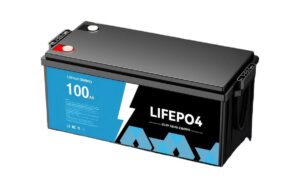
A group 31 AGM block of about 100Ah weighs about 29kg, which is 19kg more than a 12V 100Ah LiFePO4 block at about 10kg. The weight difference matters in a boat locker or an RV bay, and it shows up again in freight cost per usable kWh.
Cycle life of 300 to 500 cycles sets the replacement count
A deep cycle AGM battery is commonly rated 300 to 500 cycles at 50% depth of discharge. Battery University’s lead-acid summary lists 150 to 200 cycles at full depth for deep-cycle lead-acid, and cycle life rises as depth falls. The exact number belongs in the datasheet, because plate thickness and case size change it.
The calendar also sets a limit. Lifeline puts AGM service life at 5 to 8 years with proper charging and an average depth of discharge at or below 50%. A lightly used battery can hit the calendar limit before it hits the cycle limit, which is why a weekend boat and a daily off-grid cabin need different replacement schedules.
| Duty pattern | Cycles per year | Years per block at 300 to 500 cycles | Blocks in 10 years |
|---|---|---|---|
| Daily off-grid | 365 | 0.8 to 1.4 | 7 to 12 |
| Full-time RV | 250 | 1.2 to 2.0 | 5 to 8 |
| Weekend RV or boat | 100 | 3.0 to 5.0 | 2 to 3 |
| Seasonal cabin | 50 | 6.0 to 10.0 | 1 to 2 |
Ten years of daily cycling needs 7 to 12 AGM blocks
At one cycle per day, a 300-cycle block lasts about 10 months and a 500-cycle block lasts about 16 months. Ten years therefore consumes 7 to 12 blocks, before any failure from heat, sulfation or a missed recharge. A weekend user at 100 cycles per year needs 2 to 3 blocks, and the 5 to 8 year calendar limit keeps even a lightly used bank from lasting the full decade on one block.
The replacement count is the number that changes the budget. A quote for one block looks small because it excludes the seven to eleven blocks that follow. It also excludes the labor to disconnect, lift and reconnect each block, and the disposal or core charge at the end of each cycle.
Charge efficiency adds about 10% to the energy bill
Lead-acid coulombic efficiency is about 90%, against more than 99% for lithium-ion, according to Battery University’s efficiency summary. A charger or solar array must replace roughly 10% more energy than the battery delivers, and the gap widens at high temperature or low charge current.
That loss compounds over a decade. If a daily load pulls 600Wh from the battery, the charger has to supply about 667Wh at 90% efficiency. Over 3,650 cycles, the extra energy is about 245kWh, before any standby or self-discharge loss. With a lithium pack at more than 99% efficiency, the same load needs about 607Wh per cycle and about 22kWh of extra energy over 3,650 cycles.
The efficiency gap is small per cycle and large over the life of the bank. It is also the reason a solar array sized for an AGM bank may be undersized after a lithium swap, or oversized before one.
Overcharging and partial charge both shorten AGM life
AGM is sealed and maintenance-free, but it is less tolerant of overcharge than flooded lead-acid. Battery University notes that AGM has tighter charge-voltage tolerances, and a charger that holds the absorption stage too long will gas the cells and dry the mat. The water cannot be replaced in a sealed case.
Lifeline’s AGM charge settings are 14.2V to 14.4V for bulk and absorption, then 13.2V to 13.4V for float on a 12V system. A charger with a flooded profile that holds 14.8V or runs an equalize cycle does not match those numbers. The wrong profile can shorten life even when the battery is never deeply discharged.
Partial charge is the other failure path. A battery left at 70% state of charge for weeks sulfates, and the lost capacity does not come back. AGM tolerates storage better than flooded lead-acid, but it still needs a full recharge after each discharge and a top-up every few months when idle.
The ten-year cost formula uses usable kWh, not the label
Cost per delivered kWh equals the purchase price divided by usable energy per cycle and rated cycles. For a 100Ah AGM block, 600Wh × 300 to 500 cycles gives 180kWh to 300kWh over its rated life. A 12V 100Ah LiFePO4 block delivers 1,024Wh per cycle at 80% depth of discharge and is rated 6,000 cycles, which gives 6,144kWh. The AGM block has to cost roughly 20 to 34 times less to match on energy throughput.
| Metric | 12V 100Ah AGM | 12V 100Ah LiFePO4 |
|---|---|---|
| Nominal energy | 1,200Wh | 1,280Wh |
| Usable per cycle | 600Wh at 50% DoD | 1,024Wh at 80% DoD |
| Rated cycles | 300 to 500 at 50% DoD | 6,000 at 80% DoD |
| Lifetime delivered energy | 180 to 300kWh | 6,144kWh |
| Weight | about 29kg | about 10kg |
| Charge efficiency | about 90% | above 99% |
| Blocks at daily cycling, 10 years | 7 to 12 | 1 |
The table compares one block with one block. A real quote may use a 200Ah AGM block or a pair of 6V golf-cart blocks, so run the same formula on the quoted capacity. The ratio holds as long as the depth of discharge and cycle life are taken from the same datasheet line.
AGM can be the cheaper choice when the cycle count stays low
AGM can be the cheaper choice when the battery cycles fewer than about 50 times a year, when the installation already has an AGM charger, or when the project horizon is under three years. A weekend boat or a standby cabinet may never reach 300 cycles, so the lithium premium has no cycle life to work against.
The case for AGM weakens as soon as daily cycling starts. At 365 cycles a year, the replacement count climbs to 7 or 12 blocks in ten years, and each block adds labor and disposal. At 50 cycles a year, the same block may last 6 to 10 years on paper, and the calendar limit of 5 to 8 years sets the real replacement point.
What to ask for in an AGM quote
Ask for cycle life at a stated depth of discharge and temperature, the charge voltage window, the weight, and the case dimensions. A quote that gives only the 100Ah label and a price cannot support a ten-year comparison. The datasheet should also state the end-of-life capacity, because 300 cycles to 80% capacity and 300 cycles to 50% are different products.
| Datasheet field | Why it changes the 10-year cost |
|---|---|
| Cycle life at 50% DoD | Sets the replacement count |
| End-of-life capacity | Defines when replacement happens |
| Charge voltage window | Prevents overcharge and early failure |
| Weight and case size | Sets freight and mounting cost |
| Warranty terms | Covers pro-rata replacement |
A supplier who can provide those five lines in writing has a product file that can be checked against the purchase order. A supplier who answers with “deep cycle” and a capacity has not answered the cost question.
The LiFePO4 vs gel battery comparison covers the sealed lead-acid alternatives against lithium. The 12V lithium battery range lists the 100Ah, 150Ah and 200Ah cases with their datasheet values. The 12V 100Ah LiFePO4 product page carries the pack data used in the table, and the RV and van life application page shows how the bank size changes for a campervan. For the full ten-year method with lead-acid and lithium side by side, the LiFePO4 vs lead-acid cost comparison walks through the same calculation. The lithium vs lead-acid TCO guide for marine and RV applies the formula to flooded lead-acid duty cycles.
Frequently asked questions
At the counter, yes. Per kWh delivered, usually no. A 100Ah AGM block delivers about 180kWh to 300kWh over its rated life, against 6,144kWh for a 12V 100Ah LiFePO4 block. The AGM block has to cost 20 to 34 times less to match on energy throughput, before labor and disposal.
A typical deep cycle AGM battery is rated 300 to 500 cycles at 50% depth of discharge. Battery University’s lead-acid summary lists 150 to 200 cycles at full depth for deep-cycle lead-acid, and cycle life rises as depth falls. Check the datasheet for the depth, temperature and end-of-life capacity behind the number.
Occasionally, yes. For daily cycling, no. Lifeline states that frequent 80% discharges cut cycle life by more than half, and its sizing guidance keeps average depth of discharge at or below 50%. Use 80% for an occasional deep discharge, not for the daily cycle.
AGM is sealed and does not need water. It still needs clean, tight terminals, a full recharge after each discharge, and a charger that follows the AGM voltage window. Overcharging is more damaging to AGM than to flooded lead-acid because the sealed case cannot replace lost water.
Lifeline lists 14.2V to 14.4V for bulk and absorption and 13.2V to 13.4V for float on a 12V system. A flooded profile at 14.8V or an equalize cycle is outside that window. Confirm the charger has an AGM or sealed lead-acid setting before connecting the bank.
A group 31 100Ah AGM battery weighs about 29kg. A 12V 100Ah LiFePO4 block weighs about 10kg in a case of similar footprint. The 19kg difference matters for lifting, tray strength and freight.
Sources: LINEX 12V 100Ah LiFePO4 product page (12.8V nominal, 100Ah, 1,280Wh rated, 1,024Wh usable at 80% DoD, 100A maximum continuous discharge, 6,000 cycles at 25°C and 80% DoD, about 10kg, 332 x 172 x 218mm); LINEX 12V lithium battery range (100Ah, 150Ah and 200Ah cases); LINEX RV and van life application page; LINEX LiFePO4 vs gel battery comparison; LINEX LiFePO4 vs lead-acid ten-year cost comparison; Battery University BU-201a (AGM is maintenance free, has tighter overcharge tolerances than gel, and offers 80% depth of discharge); Battery University BU-214 (deep-cycle lead-acid cycle life 150 to 200 at full depth, specific energy 20 to 30Wh/kg); Battery University BU-808c (lead-acid coulombic efficiency about 90%, lithium-ion above 99%); Battery University BU-403 (lead-acid three-stage charging and AGM charge sensitivity); Lifeline Batteries deep-cycle AGM page (routine depth of discharge at or below 50%, 80% DoD occasionally, 5 to 8 years of service); Lifeline Batteries FAQ (14.2V to 14.4V bulk/absorb and 13.2V to 13.4V float for 12V AGM, frequent 80% discharges cut cycle life by more than half); Lifeline GPL-31T product page (12.9 x 6.75 x 9.27 inches, 64 lb / 29kg). Calculated values: 12V x 100Ah = 1,200Wh; 50% of 1,200Wh = 600Wh; 600Wh x 300 and 500 cycles = 180kWh and 300kWh; 1,024Wh x 6,000 cycles = 6,144kWh; 3,650 cycles x 600Wh / 0.90 and 1,024Wh / 0.99; replacement counts from 3,650 days divided by 300 and 500 cycles. Last updated 2026-11-06.