Six measurements cover a remote site battery
A remote battery monitor needs six values: pack voltage in volts, pack current in amps, state of charge in percent, state of health in percent, cell voltage delta in millivolts, and cell temperature in degrees Celsius. Each answers a different question: whether the site is charging, how much energy remains, how fast the pack is aging, whether the cells are balanced, and whether they are inside the charge window. A dashboard that shows only pack voltage is a voltmeter, not a monitoring system.
| Measurement | Unit | What it shows | Why it matters at a remote site |
|---|---|---|---|
| Pack voltage | V DC | Operating point of the 48V bus | Confirms the rectifier is charging or the site is on battery |
| Pack current | A | Charge or discharge rate | Shows the load during an outage and the charge current after recovery |
| State of charge | % | Remaining usable energy | The number an NOC needs to estimate runtime |
| State of health | % of rated capacity | Capacity fade against a new pack | Decides when a string is due for replacement |
| Cell voltage delta | mV | Spread between the highest and lowest cell | A widening spread points to a weak cell or a loose connection |
| Cell temperature | °C | Actual temperature at the cells | Sets the charge window and the aging rate |
The 48V 100Ah unit is rated at 4.8kWh, so state of charge can be shown in kWh as well as percent. That matters when the site controller reports runtime instead of amp-hours. A 50% reading means about 2.4kWh nominal, or roughly 2.2kWh after the usable-depth allowance.
Pack voltage cannot confirm state of charge
A 48V LiFePO4 pack holds a nearly flat voltage across most of its capacity. Battery University says the flat discharge curve of lithium-based batteries “renders the voltage method impracticable”, because 80% of stored energy sits inside that flat profile. A pack at 40% and a pack at 80% can sit in the same narrow voltage band at rest, and the gap widens under load.
State of charge comes from counting current in and out of the pack, then correcting the count when the pack reaches a known full point. The BMS knows when absorption voltage is reached and current tapers, and it can reset the counter there. Without that reset, the count drifts with every partial cycle. A remote site can then report 100% when the pack is at 85%.
State of health needs a capacity reference
State of health compares present full-charge capacity with the rated capacity. A 48V 100Ah pack rated at 4.8kWh that now accepts 3.84kWh is at 80% SOH. Battery University defines full charge capacity as the basis for state of health and treats 80% as a common replacement threshold. At 80% SOH, a 100Ah pack behaves like an 80Ah pack, so a 400W site load that ran for about eight hours runs for about 6.4 hours.
The 6,000-cycle rating for the 48V rack models is measured at 25°C and 80% depth of discharge. A site that runs hot, or cycles deeper than 80%, reaches the 80% SOH point sooner than the cycle count suggests. That is why the trend matters more than the cycle counter alone.
Cell voltage delta exposes imbalance before the string drops out
A 48V LiFePO4 pack puts 16 cells in series, each about 3.2V nominal. The BMS reports the highest and lowest cell voltage, and the difference between them is the delta. A new pack has a small delta. A pack that shows a wider delta at the same state of charge and temperature months later has a weak cell, a loose busbar or a failing sense lead.
The delta moves with current and state of charge, so compare it at the same point in the charge cycle. Recording it during absorption, when the cells are near full and current is tapering, gives the most repeatable reading. A delta that grows by tens of millivolts between visits is a reason to send a technician before the next outage.
Temperature belongs at the cell, not on the cabinet door
The 48V rack models publish a charge window of 0°C to 65°C and a discharge window of -20°C to 65°C. The BMS protects against over-temperature, but the sensor placement decides what it sees. Cabinet air can sit at 25°C while a cell in the middle of a rack runs warmer, especially when the rectifier and the battery share a sealed enclosure.
Heat also sets the aging rate. Battery University’s sealed lead-acid guideline is that each 8°C rise in temperature cuts life in half, so a battery specified for 10 years at 25°C lasts about five years at 33°C. LiFePO4 has a different chemistry and a different curve, but the direction is the same: a hot cabinet shortens service life. Cell temperature belongs in the daily data set, where a rising trend is visible before an alarm trips.
Alarms need a threshold, a delay and a cause
A raw alarm without a threshold and a delay produces nuisance calls. Set the over-voltage, under-voltage, over-current, high-temperature and low-temperature thresholds from the battery datasheet. Add a delay long enough to ignore startup transients, and log the cause code with the alarm. The BMS already protects against over-temperature, over-current, short circuit and over-discharge. The monitoring layer should report which protection operated and why.
| Alarm | Typical trigger | First check |
|---|---|---|
| Over-voltage | A cell above the charge limit during absorption | Rectifier absorption and float settings |
| Under-voltage | Pack near the 40.5V cutoff | Site load and actual backup time |
| Over-current | Current above the 100A model limit | Load profile, cable and any short circuit |
| High temperature | Cell above the 65°C operating limit | Fan, airflow and cabinet ambient |
| Low temperature | Cell below the 0°C charge limit | Heater, insulation and charge window |
| Communication loss | No poll from the BMS | Cable, address and protocol gateway |
CAN and RS485 carry the data to the site controller
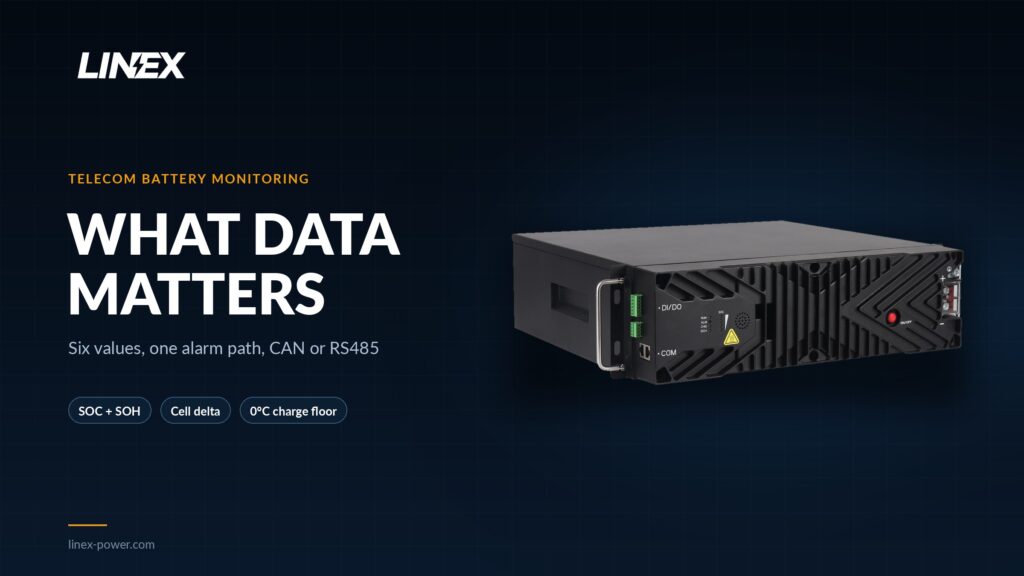
LINEX smart 48V models provide CAN and RS485. Standard 48V models provide RS485 and RS232. The IP65 pole-mounted 50Ah also provides RS485 and RS232. CAN suits a site controller that already reads a CAN bus. RS485 suits longer multidrop runs inside a cabinet. Neither interface is SNMP, so a NOC that polls SNMP needs a site controller or protocol gateway to translate the data.
| Model | Energy | Communication | Temperature range | Format |
|---|---|---|---|---|
| Standard 48V 50Ah | 2.4kWh | RS485, RS232 | Charge 0°C to 65°C; discharge -20°C to 65°C | 19-inch rack, 29kg |
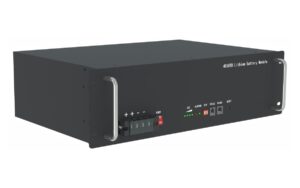
| Smart 48V 100Ah | 4.8kWh | CAN, RS485 | Charge 0°C to 65°C; discharge -20°C to 65°C | 3U rack, 43kg |
| IP65 Pole 48V 50Ah | 2.4kWh | RS485, RS232 | Operating -20°C to 60°C | Pole mount, IP65, 22.2kg |
The Smart 48V 100Ah adds a DC-DC converter with controlled output up to 57V for hybrid expansion. That converter is a power feature, not a monitoring feature. Specify it when the site has an existing lead-acid bank and a phased upgrade plan. The monitoring data is available on the standard models as well.
Commissioning data is the baseline for every later comparison
Record six values at commissioning: pack voltage, cell delta, cell temperature, capacity at a known load, BMS firmware and communication address. The first reading is only useful if the conditions are written down with it. A cell delta measured at 100% state of charge and 25°C cannot be compared with one measured at 40% state of charge and 5°C. The same applies to a capacity test: note the load, the cutoff voltage and the ambient temperature.
The 48V 100Ah model has a 10-year design life and a 3U case that fits a 19-inch rack. Those figures describe the battery, not the site. A commissioning record that includes the rack position, the torque check and the first capacity test is what makes the later trend readable.
The hardware side starts with a communication interface the site controller already supports. The 48V lithium battery range covers 50Ah to 200Ah in standard and smart models. The Smart 48V 100Ah telecom battery provides CAN and RS485 in a 4.8kWh 3U case. The telecom remote site battery systems page covers cabinet, pole-mount and rack options. For the selection sequence, the 48V telecom battery selection guide walks through load, backup time and rectifier settings.
Frequently asked questions
Six values: pack voltage, current, state of charge, state of health, cell voltage delta and cell temperature. Add the alarm state and the cause code. The site controller can then calculate runtime and flag a weak string.
No. Standard 48V models provide RS485 and RS232 telemetry. The Smart models add CAN, a DC-DC converter and more detailed state-of-health data for sites that need hybrid expansion or tighter integration with the site controller.
State of health is present full-charge capacity divided by rated capacity. Battery University treats 80% as a common replacement threshold. A 48V 100Ah pack at 80% SOH behaves like an 80Ah pack on the same load.
Send protection alarms when they occur, and log a trend snapshot at least once a day. The right interval depends on the site controller and the NOC’s polling capacity. A daily snapshot is enough to see capacity fade over months. It is not enough to catch a fast discharge event, which is what alarms are for.
No. Monitoring shows voltage, current, temperature and cell balance. It does not show a loose terminal, corrosion on a lug, a blocked fan or a damaged door seal. It tells a technician which site to visit and what to bring.
The BMS protects against over-temperature, and the 48V rack models publish a 0°C to 65°C charge window. Cell temperature sensors feed the protection logic. Confirm the number and placement of sensors for the exact model during project review.
Sources: LINEX Smart 48V 100Ah product page (4.8kWh, 3U, 43kg, CAN/RS485, 100A charge and discharge, 53.3V absorption, 51.0V float, 40.5V cutoff, 0°C to 65°C charge, -20°C to 65°C discharge, 6,000 cycles, 10-year design life); LINEX Standard 48V 50Ah product page (2.4kWh, RS485/RS232, 29kg); LINEX IP65 Pole-Mounted 48V 50Ah product page (2.4kWh, RS485/RS232, IP65, 22.2kg, -20°C to 60°C); LINEX telecom remote sites application page (400W site load and eight-hour backup example, 48V system context, cabinet and monitoring options); LINEX 48V lithium battery range; LINEX outdoor telecom cabinet page (45mm EPS insulation, IP65); Battery University BU-903 (flat discharge curve and voltage-based state of charge); Battery University state-of-health article (full charge capacity as SOH, 80% replacement threshold); Battery University BU-806a (sealed lead-acid life halves per 8°C rise). Calculated values: 80% SOH runtime from the 400W, eight-hour site example; nominal energy at 50% state of charge. Last updated 2026-11-04.