Outboard charging output ranges from 5A to 150A by engine class
The smallest charging option in Mercury’s outboard line is a 5A alternator on the FourStroke 6, and the largest is 150A on a Verado 350 or 400. The 90hp class shows how little horsepower predicts charging: Suzuki’s DF90A lists 27A, Yamaha’s F90 lists 35A, Tohatsu’s MFS90A lists 41A and Honda’s BF90 lists 44A. All four engines carry the same 90hp rating.
| Outboard (example) | Published charging output | Class |
|---|---|---|
| Mercury FourStroke 6 | 5A, optional | Portable |
| Suzuki DF90A | 27A | 90hp |
| Yamaha F90 | 35A | 90hp |
| Tohatsu MFS90A | 41A | 90hp |
| Honda BF90 | 44A | 90hp |
| Mercury Verado 350/400 | 150A | V8 offshore |
Those figures are alternator or charging-coil ratings at the engine. The current available to a trolling battery is lower, because the start battery, livewell pumps, chartplotter and lights draw from the same supply.
The rating is measured at wide-open throttle, not at trolling speed
Almost every outboard charging figure is quoted at or near full throttle. Mercury markets 20A at idle on its V8 FourStroke as a deliberate feature, which tells you that idle output is normally much lower. A 10A charging coil on a smaller engine can fall well below its rating at trolling RPM, and the owner’s manual is the only place that states the curve.
That gap matters because a trolling motor runs for hours at low speed while the outboard idles or is switched off. The charging system is built to maintain a start battery and run instruments, not to refill a 100Ah house pack.
ARCO Marine, which builds marine alternators, puts the limit plainly: “alternators are not battery chargers”. The same technical note says most alternators can safely charge at only two-thirds of their rated output for extended periods, because full output overheats the diodes and windings.
A 100Ah trolling battery needs about 50Ah to recover from a half-discharge
A 12V 100Ah LiFePO4 pack holds 1,280Wh. At 50% depth of discharge, 50Ah has been used, and replacing it takes about 50Ah plus a short absorption tail. On a 10A feed that is five hours of charging at full output. On a 20A feed it is two and a half hours.
The load side is larger. A 55lb thrust motor pulls about 50A at full throttle and empties the pack in roughly 1.6 hours. Three hours at half throttle, around 25A, uses 75Ah. A 30-minute run back to the ramp at 10A returns 5Ah, which is under 7% of that fishing day.
The arithmetic does not change with a bigger alternator unless the engine runs long enough to use it. A 44A Honda BF90 can support a 20A DC-DC charger, but only if the boat spends two or three hours at cruise. Most fishing days spend that time at trolling speed.
Cable length and gauge decide whether the battery sees 14.4V
A trolling battery in the bow sits 4m to 6m of cable from an outboard on the transom. Assume a 5m one-way run, a 10m loop and a regulator that holds 14.4V at the engine. 10 AWG cable has about 33mΩ of loop resistance, so 20A loses 0.66V and the battery sees 13.74V. 6 AWG loses 0.26V and leaves 14.14V.
| Cable | Cross-section | Loop resistance, 10m | Drop at 10A | Drop at 20A | Voltage at battery, 14.4V source |
|---|---|---|---|---|---|
| 10 AWG | 5.26mm² | 33mΩ | 0.33V | 0.66V | 14.07V / 13.74V |
| 8 AWG | 8.37mm² | 21mΩ | 0.21V | 0.41V | 14.19V / 13.99V |
| 6 AWG | 13.3mm² | 13mΩ | 0.13V | 0.26V | 14.27V / 14.14V |
| 4 AWG | 21.2mm² | 8mΩ | 0.08V | 0.16V | 14.32V / 14.24V |
Calculated for annealed copper at 20°C over a 10m loop. A 14.6V absorption target at the battery becomes 13.94V after 0.66V of drop, which is below the level that fills a LiFePO4 pack. The charger has to sit at the battery, not at the engine.
A DC-DC charger matches the alternator to the LiFePO4 profile
LiFePO4 charges at 14.6V absorption and 13.5V to 13.8V float, with no equalize cycle. An outboard regulator built for a lead-acid start battery holds a lower, temperature-compensated voltage, and LINEX notes that a standard alternator regulator can leave a lithium bank at 70% to 80% state of charge. A DC-DC charger takes the alternator’s variable input and holds the lithium profile at the battery end.
Size it to the spare alternator current, not to the battery’s maximum charge rate. A 10A output at 14.6V draws about 13.5A at 12V input after 90% conversion loss. If a 20A charging circuit carries 5A of electronics, a 10A DC-DC fits and a 20A unit does not. Use an ignition-triggered or voltage-sensing charger so it stops when the engine stops, and keep the start battery on its own circuit.
A combiner relay is not a substitute. It connects the two banks and lets the alternator sit at whatever voltage the lead-acid start battery wants. The lithium pack then charges slowly and rarely reaches full.
Charging time: 5 to 6 hours on a 20A shore charger
LINEX publishes 5 to 6 hours for a 20A shore charger to refill a 100Ah pack from 80% depth of discharge. A 50A charger cuts that to 2 to 2.5 hours. A 200W solar panel produces 10A to 14A in good sun, which is one to two sunny days. An outboard feeding a 10A DC-DC charger needs about 8 to 9 hours of engine run for the same 80Ah, because the last part of the charge tapers.
| Charging method | Current at the battery | Time to replace 80Ah | Basis |
|---|---|---|---|
| Shore charger, 20A | 20A | 5 to 6 hours | Datasheet |
| Shore charger, 50A | 50A | 2 to 2.5 hours | Datasheet |
| Solar, 200W panel | 10A to 14A | 1 to 2 sunny days | Datasheet |
| Outboard via 10A DC-DC | 10A | 8 to 9 hours of engine run | Calculated |
| Outboard via 20A DC-DC | 20A | 4 to 4.5 hours of engine run | Calculated |
For a half-discharged pack, halve the 80Ah column. The outboard rows assume the charger sees full output for the whole run, which only happens at cruise RPM.
Wiring rules: fuse both ends and keep the start battery separate
A trolling bank is a separate circuit, not a second start battery. Fuse the feed from the start battery within 30cm of the positive post and fuse the output at the trolling battery. LINEX specifies a 125A fuse and 25mm² cable for the 100Ah trolling model at 100A. Terminals are M8, torqued to 8Nm to 10Nm and rechecked after the first trip.
Do not open a battery switch or pull a cable while the engine is running. An alternator with no load can spike its output and damage the rectifier. Keep the start battery on its original charging path so a dead trolling bank never leaves the engine without cranking power.
When the outboard is the only charging source
Plan the fishing day around engine hours, not around the alternator rating. A 30-minute run each way at 10A returns 10Ah. Two hours at cruise returns 20Ah. Against a 75Ah day at half throttle, that covers 13% to 27%. The rest has to come from a larger bank, a second battery or solar.
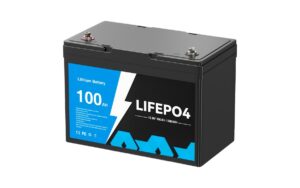
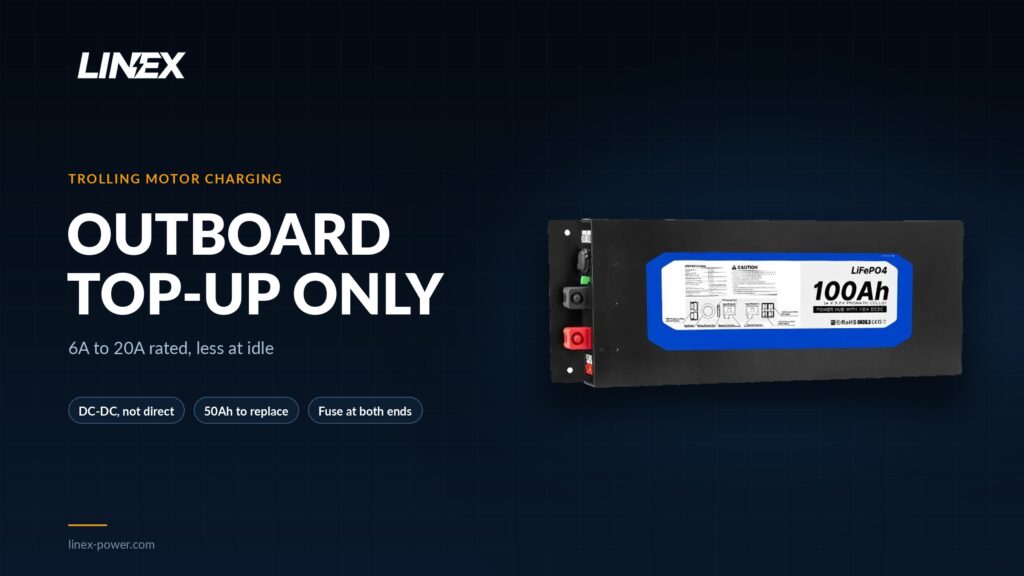
The practical setup for a boat without shore power is a 100Ah to 200Ah LiFePO4 bank, a 10A to 20A DC-DC charger and a solar panel for the days at anchor. For the pack itself, the 12V 100Ah trolling motor battery carries a 100A BMS, an LCD display and a 330 × 310 × 155mm case at about 12kg. The trolling motor battery sizing guide covers runtime by thrust and voltage. The trolling motor and fishing application page lists the full range and installation checks. For a 24V system, the 24V lithium battery range avoids series wiring.
Frequently asked questions
Only as a top-up. A direct feed runs at the outboard’s lead-acid voltage and loses more voltage over the cable run to the bow. A 10A to 20A DC-DC charger at the battery holds 14.6V absorption and 13.5V to 13.8V float, which is what a LiFePO4 pack needs.
Idle output is much lower than the published rating, and most builders do not publish it. Mercury quotes 20A at idle for its V8 FourStroke. A small portable engine with a 5A to 10A charging coil may deliver well below its rating at idle.
About 8 to 9 hours of engine run through a 10A DC-DC charger to replace 80Ah, or 4 to 4.5 hours through a 20A unit. The last 20% takes longer because the charger tapers.
Only if the charger has a lithium profile at 14.6V absorption and 13.5V to 13.8V float, with no equalize or desulfation stage. A fixed lead-acid charger will stop short of a full charge.
Yes. A 24V bank needs a 24V DC-DC charger, or two 12V chargers with one on each battery, and the two 12V units must stay balanced. A native 24V pack avoids that.
Sources: LINEX 12V 100Ah trolling motor battery page (100A BMS, 1,280Wh, 330 × 310 × 155mm, 12kg, 6,000 cycles, charging times, fuse and cable figures, charge temperature); LINEX marine and boating application page (alternator regulator behaviour and DC-DC charging); LINEX trolling motor battery sizing guide (motor current by thrust); OutboardSpecs outboard alternator output article (published output for Mercury, Suzuki, Yamaha, Tohatsu and Honda engines, and the wide-open-throttle rating basis); ARCO Marine charging systems technical note (alternator output limits and the two-thirds rule); Battery University BU-403 (lead-acid absorption and float voltages). Calculated values: voltage drop from annealed copper resistance at 20°C over a 10m loop; DC-DC input current at 90% efficiency. Last updated 2026-11-03.