House bank sizing starts with daily amp-hours, not engine size
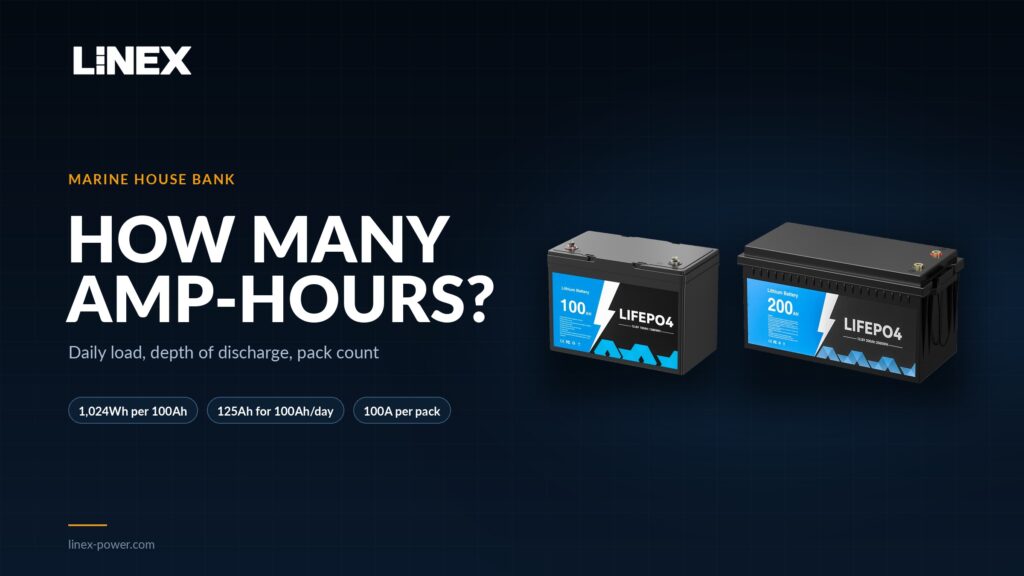
A lithium deep cycle marine battery bank is sized from the energy the boat uses between charges, not from the engine’s horsepower or the length of the hull. Add the daily loads in amp-hours at the system voltage, divide by the depth of discharge you plan to use, then round up to the nearest model. At 80% depth of discharge, a boat that uses 100Ah per day needs 125Ah of installed capacity before any reserve.
The calculation uses amp-hours at a stated voltage. A 12V load of 10A for 5 hours is 50Ah. A 24V load of 10A for 5 hours is also 50Ah, but it stores twice the watt-hours because the voltage is doubled. Convert mixed 12V, 24V and AC loads to watt-hours first: watts × hours ÷ system voltage gives the amp-hours at that voltage.
A 100Ah daily load needs 125Ah to 150Ah of installed capacity
The table applies the 80% depth-of-discharge limit to common daily loads on a 12V system. Bank size is the installed amp-hour rating, not the usable rating. Add 10% to 20% when the boat has no shore charging or when the alternator only runs for short periods.
| Daily house load (12V) | Daily energy | Bank at 80% DoD | Typical LINEX setup |
|---|---|---|---|
| 50Ah | 640Wh | 65Ah to 75Ah | One 12V 100Ah |
| 100Ah | 1,280Wh | 125Ah to 150Ah | Two 12V 100Ah in parallel, or one 12V 200Ah |
| 150Ah | 1,920Wh | 190Ah to 200Ah | One 12V 200Ah |
| 200Ah | 2,560Wh | 250Ah to 300Ah | Three 12V 100Ah, or one 24V 150Ah |
A 24V bank uses half the amp-hours for the same watt-hours, so a 100Ah daily load at 12V becomes 50Ah at 24V. The table stays in 12V amp-hours because most marine house-load lists are written that way. Convert to watt-hours before comparing a 24V pack with a 12V pack.
Usable energy: 1,024Wh from each 12V 100Ah unit
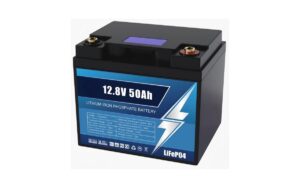
A 12V 100Ah LiFePO4 battery stores 1,280Wh at 12.8V nominal. At 80% depth of discharge, plan on 1,024Wh usable; the BMS low-voltage cutoff sits below that point. A 100Ah AGM battery at 50% depth of discharge gives about 600Wh, so one 100Ah lithium unit replaces roughly 1.7 times the usable energy of the same-label AGM.
The 12V 100Ah model weighs about 10kg and measures 332 × 172 × 218mm. The 12V 200Ah model doubles the energy to 2,560Wh and weighs about 22kg, but it keeps the same 100A continuous discharge limit. Capacity doubles; current does not.
Model capacity and current, from 100Ah to 200Ah
The four models below cover 1,024Wh to 4,096Wh of usable energy per unit. Continuous power is nominal voltage multiplied by continuous current, so the 24V packs deliver twice the power of the 12V packs at the same 100A.
| Model | Rated energy | Usable at 80% DoD | Continuous discharge | Continuous power | Weight | Case (L × W × H) |
|---|---|---|---|---|---|---|
| 12V 100Ah | 1,280Wh | 1,024Wh | 100A | 1,280W | about 10kg | 332 × 172 × 218mm |
| 12V 200Ah | 2,560Wh | 2,048Wh | 100A | 1,280W | about 22kg | 524 × 245 × 220mm |
| 24V 100Ah | 2,560Wh | 2,048Wh | 100A | 2,560W | about 22kg | 524 × 245 × 220mm |
| 24V 200Ah | 5,120Wh | 4,096Wh | 100A | 2,560W | about 40kg | 523 × 269 × 222mm |
The 12V 200Ah stores twice the energy of the 12V 100Ah but delivers the same 1,280W, because both models cap continuous discharge at 100A. A 24V 100Ah pack stores the same 2,560Wh as the 12V 200Ah and delivers 2,560W at the same 100A. The exact units are on the 12V 100Ah marine battery and 12V 200Ah deep-cycle battery pages.
Inverter size sets the pack count, not the amp-hour total
A 2,000W inverter pulls about 174A from a 12.8V bank at 90% efficiency. One 100Ah pack cannot carry that load, even when it has enough energy for the trip. Two 100Ah packs in parallel give 200A continuous, which covers the inverter with a 26A margin. The table converts inverter output to DC current and pack count.
| Inverter output | DC current at 12.8V | 12V 100Ah packs needed | DC current at 25.6V | 24V 100Ah packs needed |
|---|---|---|---|---|
| 1,000W | 87A | 1 | 43A | 1 |
| 2,000W | 174A | 2 | 87A | 1 |
| 3,000W | 260A | 3 | 130A | 2 |
| 5,000W | 434A | 5 | 217A | 3 |
The pack count assumes each pack is rated for 100A continuous and the packs share current evenly. Two 12V 100Ah batteries in parallel make a 12V 200Ah bank with 200A continuous. Two in series make a 24V 100Ah bank with 100A continuous. Both store 2,560Wh, but only the parallel bank doubles the current available to a 12V inverter.
Parallel packs need one fuse per positive terminal, equal cable lengths and the same model, age and state of charge. A loose cable or an older pack can push one BMS over its 100A limit before the other pack takes load. Above 5,000W, compare a 48V bank before adding more 12V packs. The 24V lithium battery range covers the native 24V models.
Charging a 100Ah bank takes 5 to 6 hours at 20A
The 12V 100Ah datasheet lists 50A recommended and 100A maximum charge current. A 20A charger delivers about 270W at 13.5V, so replacing 1,024Wh takes about 4 hours of bulk charging plus an absorption phase, or 5 to 6 hours in practice. A 50A charger cuts that to about 2 hours.
Alternator charging needs a DC-DC charger or an external regulator set for LiFePO4. A standard alternator regulator targets lead-acid absorption and can leave a lithium bank at 70% to 80% state of charge. Solar needs an MPPT controller with a lithium profile. A 200W panel produces about 10A to 14A in good sun, which is roughly one full day for a 100Ah unit. Charging stops below 0°C because the BMS blocks current; discharge works to -20°C.
Locker size decides the case, not the amp-hour label
The 12V 100Ah model measures 332 × 172 × 218mm. It is close to a Group 31 footprint (330 × 173 × 240mm) but is 22mm lower, which helps under a bench seat. It does not fit a Group 27 box (306 × 173 × 225mm) without changing the tray. The 12V 200Ah model measures 524 × 245 × 220mm and needs its own tray.
| BCI group | Length × width × height | Fits the 12V 100Ah? | Notes |
|---|---|---|---|
| 24 | 260 × 173 × 225mm | No | Case is 72mm too long |
| 27 | 306 × 173 × 225mm | No | Case is 26mm too long |
| 31 | 330 × 173 × 240mm | Close fit, 2mm longer | Case is 22mm lower; check tray |
Measure the tray, the height to the lid and the clearance around the terminals before ordering. A 200Ah pack does not fit a standard group box, and a 24V 100Ah pack uses the same case as the 12V 200Ah but needs a 24V charger and 24V loads. The marine and boating battery guide lists the full model range and the installation checks for salt air, IP65 and terminal torque.
The house bank and the start battery stay separate
LINEX deep-cycle models do not publish cold cranking ratings, and they are sold for house-bank and onboard loads. A separate start battery should handle engine cranking. A sudden BMS disconnect on the start circuit is a safety issue, and a deep-cycle BMS is not rated for the inrush current of a starter motor.
Charge the house bank through a DC-DC charger or an external regulator. Keep the start battery on the alternator’s original charging path. A voltage-sensitive relay or a DC-DC charger isolates the two banks so a depleted house bank cannot pull the start battery down. The marine cranking versus deep cycle guide explains why the two battery types are not interchangeable. The marine deep cycle battery guide covers house versus start duty; the lithium battery bank sizing guide covers the Ah to kWh math.
Frequently asked questions
About 125Ah of installed capacity at 80% depth of discharge, rounded up to 150Ah for reserve. That is two 12V 100Ah batteries in parallel or one 12V 200Ah battery. The 200Ah option is simpler to wire; the pair gives 200A continuous for a 2,000W inverter.
Yes, in usable-energy terms. A 100Ah LiFePO4 unit gives about 1,024Wh at 80% depth of discharge, while a 100Ah AGM gives about 600Wh at 50%. The lithium unit weighs about 10kg against 30kg to 33kg for the AGM. Check the case size and the charger profile before ordering.
24V halves the current for the same wattage, so cable and fuse sizes fall. A 2,000W inverter pulls about 174A at 12.8V but 87A at 25.6V. The trade is a 24V charger, a 24V inverter setting and DC-DC converters for any 12V equipment. Most small boats stay at 12V; larger loads move to 24V.
Only through a DC-DC charger or an external regulator set for LiFePO4. A standard alternator regulator targets lead-acid voltages and can leave the bank at 70% to 80% state of charge. Check the alternator’s spare capacity and the charger’s output current before relying on it for a full recharge.
Capacity falls in cold water, and LiFePO4 charging stops below 0°C because the BMS blocks current. Discharge works to -20°C. An unheated locker needs a charge schedule that waits for warmer hours or a heated battery option.
Sources: LINEX 12V 100Ah, 12V 200Ah, 24V 100Ah, 24V 150Ah and 24V 200Ah datasheets (rated energy, continuous discharge current, charge current, weight and case dimensions); LINEX marine and boating application page (daily-load sizing table, Group 24/27/31 fit, IP65 and terminal checks); LINEX lithium battery bank sizing guide (Ah, kWh and depth of discharge); LINEX marine deep cycle battery guide (house versus start duty). Calculated values: usable energy = rated Wh × 0.8, DC current = inverter watts ÷ nominal voltage ÷ 0.90, continuous power = nominal voltage × continuous current, charge time = usable Wh ÷ (charger amps × 13.5V). Last updated 2026-11-01.