Campervan electrical starts with the alternator
A campervan electrical system should match the voltage of its charging source and appliances, and most vans are built around a 12V alternator. The starter battery, headlights, blower, fridge, diesel heater, water pump and USB outlets all expect 12V. A 24V house bank does not change any of that. It adds a 12V-to-24V DC-DC charger on the alternator side, or a second 24V alternator, and a 24V-to-12V converter on the appliance side.
That conversion chain is the main cost of 24V. It is also why a 24V campervan usually starts as a new build, not a conversion of a finished van.
A 2,000W inverter is the point where 12V current becomes impractical
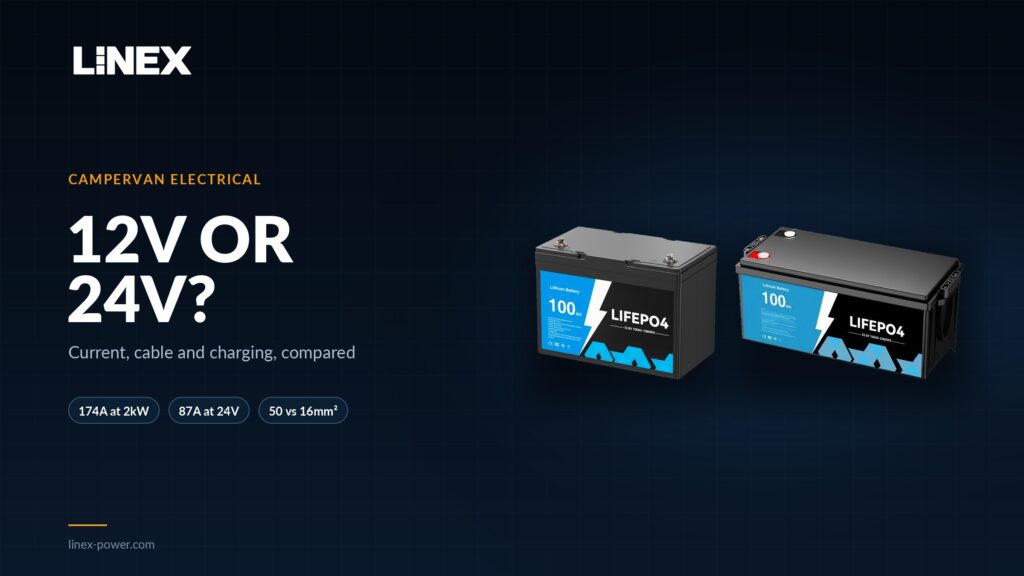
At 12.8V and 90% inverter efficiency, a 2,000W load pulls about 174A. A single 12V 100Ah pack has a 100A continuous BMS, and the 12V 200Ah pack keeps the same 100A limit. Neither one can carry that load alone.
Two 12V 100Ah packs in parallel give 200A, which covers the 2,000W load with a small margin. That assumes the BMS is rated for parallel operation, so check the datasheet before wiring. A single 24V 100Ah pack gives 100A at 25.6V, which is 2,560W of DC power. Below 1,000W, the 12V route needs no conversion and no second pack.
The 12V 100Ah datasheet lists “Maximum Continuous Discharge Current (A): 100”. That line, not the amp-hour label, sets the inverter ceiling.
At 2,000W, 12V pulls 174A and 24V pulls 87A
Current is the practical difference between the two voltages. A 24V pack delivers the same wattage at half the amps, so the cable and fuse can be smaller. The table below uses 90% inverter efficiency and a 3% voltage drop over a 3m one-way run.
| Inverter output | Current at 12.8V | Cable at 12V | Current at 25.6V | Cable at 24V |
|---|---|---|---|---|
| 1,000W | 87A | 25mm² | 43A | 6mm² |
| 2,000W | 174A | 50mm² | 87A | 16mm² |
| 3,000W | 260A | 70mm² to 95mm² | 130A | 25mm² |
Cable figures are calculated from copper resistivity and the 3% drop limit, then rounded up to a standard size. Check the cable’s ampacity, insulation rating and the local wiring rules before ordering. Fuse at about 1.25 times the continuous current: 125A for 1,000W at 12V, 60A at 24V, 250A for 2,000W at 12V and 125A at 24V.
At 2,000W, the 12V build needs 50mm² cable and a 250A fuse. The 24V build needs 16mm² and a 125A fuse. That difference is the strongest argument for 24V in a high-load campervan.
A 24V bank needs a 24V charging source
A 24V battery cannot be charged from a 12V alternator, a 12V solar panel or a 12V shore charger without a converter. The 24V 100Ah datasheet lists “Fast Charging Voltage (V): 29.2” and a float range of 27.0V to 27.6V. A 12V charger stops near 14.6V, which is half the voltage needed.
| Charging path | 12V campervan | 24V campervan |
|---|---|---|
| Alternator | 12V alternator with a 12V DC-DC charger | 24V alternator or a 12V-to-24V DC-DC charger |
| Solar | 12V panels with a 12V MPPT controller | Array above 29.2V, such as two 12V panels in series |
| Shore power | 12V lithium charger, 14.6V absorption | 24V charger, 29.2V absorption |
| DC appliances | Native 12V | 24V appliances or 24V-to-12V converters |
A 12V-to-24V DC-DC charger also has to be sized for the house bank, not just the alternator. A 40A unit at 25.6V delivers about 1,024W, which is a useful input but not a fast charge for a 5,120Wh bank. Check the charger’s output current at 24V before assuming the alternator will refill the bank during a drive.
Appliance choice keeps most campervans at 12V
The 12V market is larger. Compressor fridges, roof fans, diesel heaters, water pumps, lights, USB sockets and most DC-DC chargers are sold in 12V versions. A 24V build can use them through a 24V-to-12V converter, but each converter adds a connection, a fuse and roughly 5% to 10% of loss.
That loss matters at low loads. A 10W light through a 90% converter pulls 11W from the 24V bank. The cable saving at 2,000W is real, but a van that mostly runs lights and a fridge will not see it.
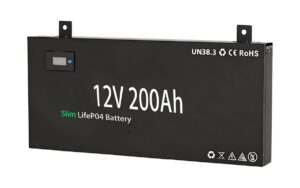
A 24V 100Ah and a 12V 200Ah store 2,560Wh but deliver different power
Both packs store 2,560Wh and weigh about 22kg. The 24V pack delivers 2,560W continuous, while the 12V pack delivers 1,280W continuous because its 100A limit is measured at 12.8V. The table below shows the full range.
| Pack | Nominal voltage | Rated energy | Continuous current | Continuous DC power | Weight | Case (L x W x H) |
|---|---|---|---|---|---|---|
| 12V 100Ah | 12.8V | 1,280Wh | 100A | 1,280W | about 10kg | 332 x 172 x 218mm |
| 12V 200Ah | 12.8V | 2,560Wh | 100A | 1,280W | about 22kg | 524 x 245 x 220mm |
| 24V 100Ah | 25.6V | 2,560Wh | 100A | 2,560W | about 22kg | 524 x 245 x 220mm |
| 24V 200Ah | 25.6V | 5,120Wh | 100A | 2,560W | about 40kg | 523 x 269 x 222mm |
Continuous DC power is nominal voltage multiplied by continuous current. The 24V 200Ah doubles energy, not output. Two 24V 100Ah packs in parallel would double both.
Stay at 12V unless the build needs 2,000W or more
Stay at 12V when the van already has a 12V alternator, the inverter is 1,000W or less, the appliances are 12V and the cable run from the bank to the inverter is short. This covers most campervans, including single-fridge builds and vans with a 1,000W inverter.
Choose 24V when the build is new, the inverter is 2,000W to 5,000W, the cable run is long, or the plan includes air conditioning, induction cooking or a 24V appliance set. Above 5,000W, compare 24V against 48V before ordering; the current falls again, but the conversion chain gets longer.
For the battery-only comparison, the 12V vs 24V RV battery guide covers pack choice. This article covers the rest of the campervan electrical system.
For the full range, see the 12V lithium battery line and the 24V lithium battery line. The exact units are on the 12V 100Ah product page, the 12V 200Ah product page and the 24V 100Ah product page. For tray, charging and install notes, the RV, van and 4WD battery page covers the rest of the build.
Frequently asked questions
Yes, through a 24V-to-12V DC-DC converter. Size the converter for the total simultaneous load, not the sum of every appliance label, and fuse each output circuit. A 30A converter at 12V delivers 360W, which covers lights, a pump and a laptop, but check the fridge’s startup current before adding it.
No. Runtime follows watt-hours, not voltage. A 24V 100Ah pack and a 12V 200Ah pack both store 2,560Wh, so they run the same load for the same time. The 24V pack delivers more current at the same amp rating, which changes the inverter ceiling, not the energy.
Only with a 12V-to-24V DC-DC charger or a second 24V alternator. A direct connection will not charge the bank, and it can damage the charger or the alternator. Check the charger’s 24V output current and the alternator’s spare capacity before ordering.
Both are low-voltage DC systems, and both need fuses, insulation and correct cable sizing. A 24V system runs at a higher potential, but the main safety difference is the lower current and smaller cable for the same load. Follow the inverter, charger and battery manuals for disconnect and grounding.
At 12.8V and 90% efficiency, a 2,000W inverter pulls about 174A, so 50mm² cable is a working size for a 3m run at 3% drop. At 25.6V, the same load pulls about 87A and 16mm² is enough. Check the cable’s ampacity and the inverter manual before ordering.
Sources: LINEX 12V 100Ah, 12V 200Ah, 24V 100Ah and 24V 200Ah datasheets (rated energy, continuous discharge current, charge and float voltage, weight and case dimensions); LINEX RV, van and 4WD application page (12V and 24V system choice, inverter current, cable and fuse starting points); LINEX 12V versus 24V RV battery guide (voltage choice); LINEX 24V versus 48V guide (voltage step above 5kW). Calculated values: DC current = AC watts / nominal voltage / 0.90, cable area = 0.0175 x round-trip length x current / allowed drop, continuous DC power = nominal voltage x continuous current. Last updated 2026-10-31.
For the parallel-pack alternative to a 24V bank, read the motorhome battery comparison. It covers one 200Ah versus two 100Ah packs at the same 2,560Wh.