A travel trailer house bank runs on 12V
A travel trailer house bank is a 12V deep-cycle battery that runs camping loads, not the tow vehicle. It powers the fridge control board, lights, water pump, furnace fan, roof vent and tongue jack. The battery sits on the A-frame or in a side compartment, and the tow vehicle’s 7-pin connector feeds it through a long charge wire. Many trailers ship with a Group 24, 27 or 31 lead-acid battery, often a dual-purpose unit rather than a true deep-cycle model.
The house bank and the tow vehicle starting battery are separate systems. Keep them that way, and treat the trailer battery as an energy store for camping loads.
Usable watt-hours decide the upgrade, not the amp-hour label
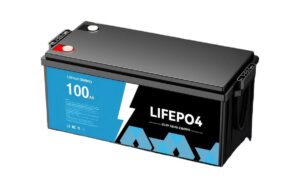
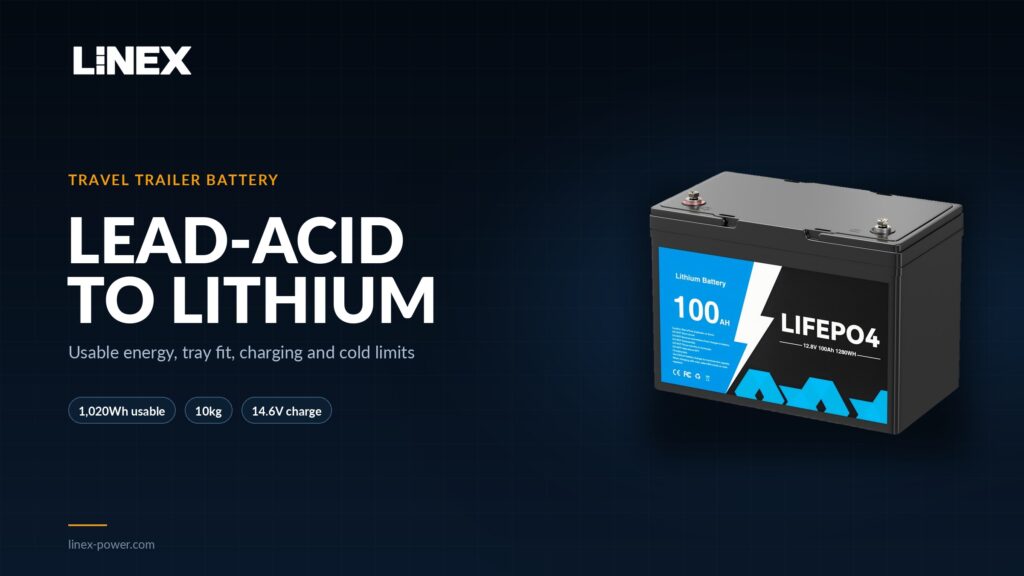
Usable energy is the number that changes with the upgrade. A 12V 100Ah lead-acid battery stores about 1,200Wh at 12V nominal, but regular cycling stops at 50% depth of discharge, so about 600Wh is available. A 12V 100Ah LiFePO4 battery stores 1,280Wh at 12.8V nominal and can use 80%, or about 1,020Wh. The lithium pack delivers roughly 70% more usable energy, and it weighs about 10kg against 30kg for an AGM battery of the same label.
| Battery | Nominal energy | Usable depth | Usable energy | Weight | Cycle rating |
|---|---|---|---|---|---|
| 12V 100Ah AGM | 1,200Wh | 50% | 600Wh | about 30kg | 300 to 500 cycles |
| 12V 100Ah LiFePO4 | 1,280Wh | 80% | 1,020Wh | about 10kg | 6,000 cycles at 25°C |
| 12V 200Ah LiFePO4 | 2,560Wh | 80% | 2,050Wh | about 22kg | 6,000 cycles at 25°C |
| 24V 100Ah LiFePO4 | 2,560Wh | 80% | 2,050Wh | about 22kg | 6,000 cycles at 25°C |
The Ah to kWh calculator converts any bank to watt-hours if the trailer has an odd voltage or a mixed set of batteries.
Group 24, 27 and 31 trays limit the case size
The BCI group number sets the case footprint, and a 12V 100Ah LiFePO4 case is close to Group 31. A Group 24 case measures 260 x 173 x 225mm, Group 27 measures 306 x 173 x 225mm, and Group 31 measures 330 x 173 x 240mm. The LINEX 12V 100Ah case is 332 x 172 x 218mm, close to Group 31 length and width but 22mm lower. Measure the tray, terminal height and hold-down clearance before ordering.
| BCI group | Length x width x height | Common trailer fit | Check against the 12V 100Ah case |
|---|---|---|---|
| Group 24 | 260 x 173 x 225mm | Small trailer, tight tray | Case is 72mm longer; check both ends |
| Group 27 | 306 x 173 x 225mm | Mid-size trailer | Case is 26mm longer |
| Group 31 | 330 x 173 x 240mm | Large trailer, deep-cycle | Case is 2mm longer and 22mm lower |
LiFePO4 replacements often use a different case from the lead-acid battery they replace. The battery types and sizes guide lists BCI dimensions and terminal types, and the 12V lithium battery line covers the 100Ah, 200Ah, thin and ultra-slim cases.
The converter has to reach 14.6V
LiFePO4 needs a 14.6V absorption stage, and a lead-acid profile that stops at 13.6V will not deliver it. The pack floats at 13.5V to 13.8V after that absorption step. At 13.6V the pack accepts some charge, but it does not reach a full, balanced state before the next discharge. Check whether the converter has a lithium mode, and confirm the setting with a voltmeter at the battery terminals.
Charge current also matters. A 30A converter puts about 30A into a 100Ah pack, or 0.3C, and the same converter takes twice as long on a 200Ah pack. The LINEX 12V 100Ah datasheet lists 50A recommended and 100A maximum charge current, so a 30A converter sits well inside the limit.
| Charge source | Typical output | What it covers | Check |
|---|---|---|---|
| Shore converter | 30A to 60A | Full charge at a powered site | Lithium profile and 14.6V absorption |
| DC-DC charger | 20A to 40A | Driving-day recharge | Input range and alternator load |
| Solar MPPT | 10A to 30A | Daytime top-up | Panel wattage and controller current |
| 7-pin charge wire | Maintenance only | Keeping a full battery topped up | Voltage at the trailer end |
The RV lithium battery upgrade checklist walks through the converter and alternator checks in the order they matter.
The 7-pin charge line is a maintenance feed
A 7-pin connector typically carries 10 AWG wire and a 30A fuse, which is enough for a maintenance trickle and not much else. The circuit runs from the tow vehicle battery through the vehicle wiring, the connector and the trailer wiring. Voltage drop over that path can pull the trailer end below the 13.5V float floor, so a depleted bank gains little during a drive day.
A DC-DC charger takes the vehicle voltage, holds the lithium profile and limits the current the alternator sees. Size it at 20A to 40A for a 100Ah to 200Ah bank. Modern trucks with variable-voltage alternators move the supply as the battery state changes, which makes the 7-pin feed even less predictable.
Cold weather stops the charge at 0°C
The BMS blocks charging below 0°C, while discharge remains available to -20°C. The 12V LiFePO4 datasheet lists 0°C to 50°C for charging and -20°C to 60°C for discharge. A trailer can run lights and a furnace in freezing weather, but the bank will not recharge until the compartment warms. A charger that keeps applying voltage below 0°C will see the BMS open the charge path, so nothing charges until the pack warms.
If winter camping is part of the plan, keep the battery in a heated space or accept that charging waits for warmer conditions.
Solar and shore power cover long stays
A 200W panel and a 30A converter solve different parts of the same trip. The panel produces about 10A to 14A at 12V in good sun, or roughly 0.6kWh to 0.8kWh over four peak sun hours. A 400W array doubles that to 1.2kWh to 1.6kWh. A 30A to 60A converter covers the same load at a powered site.
| Daily use | Recommended bank | Solar | DC-DC | Shore converter |
|---|---|---|---|---|
| 0.6 to 1.0kWh | 12V 100Ah | 200W | 20A | 20A to 30A |
| 1.0 to 1.6kWh | 12V 100Ah to 200Ah | 300W to 400W | 30A | 30A to 45A |
| 2.0 to 3.0kWh | 12V 200Ah to 300Ah or 24V 100Ah | 400W to 600W | 40A | 45A to 60A |
These are starting points for a 12V trailer, not fixed runtime promises. Add 30% for inverter losses and ageing.
The upgrade order is measure, size, charge, protect
Start with the tray measurement, then work outward to the bank, charger and fuse. Measure the tray and terminal clearance first. Add up daily watt-hours from the fridge, lights, pump, fan and inverter, then divide by 0.8 for usable depth of discharge. Confirm the converter and DC-DC charger can deliver the lithium profile.
A 1,000W inverter pulls about 93A at 12V after 90% efficiency, close to the 100A continuous limit of one 100Ah pack. A 2,000W inverter pulls about 185A, so it needs two packs in parallel or a 24V bank. The RV, van and 4WD battery page lists the 12V and 24V models that fit these builds.
Frequently asked questions
A Group 24 case is 260mm long, while the 12V 100Ah LINEX case is 332mm long. It may fit a Group 31 tray but not a short Group 24 box. Check length, width, height, terminal height and hold-down clearance before ordering.
Only if it has a lithium profile or can be set to 14.6V absorption and 13.5V to 13.8V float. Many stock converters stop near 13.6V, which will not complete the absorption stage. Check the model’s manual or measure the voltage at the battery.
A 45W compressor fridge running continuously draws about 1.08kWh in 24 hours, which is close to the 1,020Wh usable capacity of one 100Ah pack. At a 50% duty cycle the same fridge uses about 0.54kWh per day, so one pack covers roughly two days. Hot weather raises the duty cycle.
The 7-pin charge wire acts as a “maintenance feed” rather than a full charger. It can keep a full battery topped up, but voltage drop limits what reaches a depleted bank. Use a 20A to 40A DC-DC charger for a real driving-day recharge.
Discharge is rated to -20°C, so lights and furnace loads work. Charging is rated from 0°C, and the BMS blocks current below that. Warm the compartment or delay charging until the battery is above freezing.
Sources: LINEX 12V 100Ah, 12V 200Ah and 24V 100Ah datasheets (energy, dimensions, weight, charge and discharge current, voltage settings, temperature range and cycle life); LINEX RV, van and 4WD application page (lead-acid depth of discharge, cycle range and RV charging paths); LINEX battery types and sizes guide (BCI group dimensions); calculated values: usable energy = nominal energy x depth of discharge, inverter current = inverter watts / 12V / 0.90, solar yield = panel watts x four peak sun hours x 0.75. Last updated 2026-10-29.
For the Australian caravan market, read the caravan battery guide. It covers 12V loads, solar yield and DC-DC charging for caravans.