Fit to the load, not the brand label
There is no single best RV battery. A pack that runs a 1,000W inverter for an hour may not fit a tray that only accepts a Group 24 case, and a 200Ah pack with a 100A BMS cannot run a 2,000W load. Compare five measured values: usable watt-hours, continuous discharge current, case dimensions, charge profile and cycle life test conditions. The brand name and the marketing copy do not change any of them.
The 12V 100Ah datasheet lists “Maximum Continuous Discharge Current (A): 100”. That one line matters more than a marketing label that says deep cycle.
Usable watt-hours separate the candidates
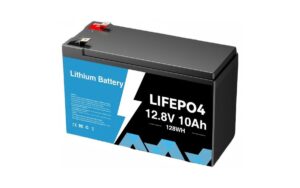
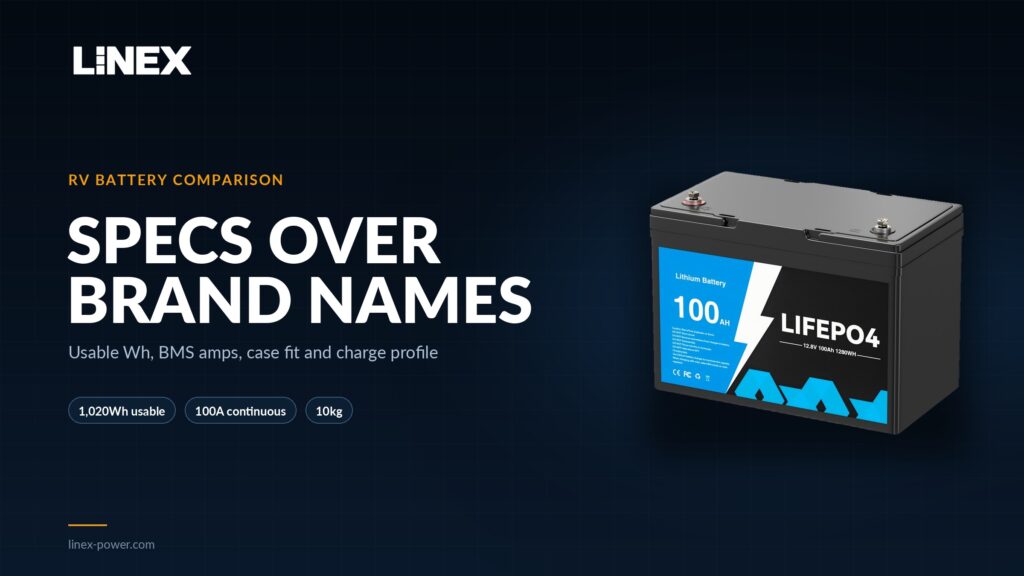
A 100Ah label hides the chemistry. Flooded and AGM batteries store about 1,200Wh at 12V nominal, but regular cycling stops at 50% depth of discharge, leaving about 600Wh. A 12V 100Ah LiFePO4 pack stores 1,280Wh and uses 80%, leaving about 1,020Wh. The lithium pack delivers roughly 70% more usable energy at about one third of the weight.
| Chemistry (100Ah, 12V) | Nominal energy | Usable depth | Usable energy | Typical weight | Cycle rating |
|---|---|---|---|---|---|
| Flooded lead-acid | 1,200Wh | 50% | 600Wh | about 30kg | 300 to 500 cycles |
| AGM lead-acid | 1,200Wh | 50% | 600Wh | about 30kg | 300 to 500 cycles |
| LiFePO4 | 1,280Wh | 80% | 1,020Wh | about 10kg | 6,000 cycles at 25°C |
The cycle figures come from the LINEX RV application page and the battery types guide. A cycle count without its depth of discharge and temperature is not a comparison.
Continuous discharge current exposes the weak pack
BMS current, not amp-hour capacity, sets the inverter ceiling. The 12V 100Ah and 12V 200Ah packs both list 100A maximum continuous discharge. At 12.8V that is 1,280W DC, or about 1,150W AC after 90% inverter efficiency. A 2,000W inverter pulls about 174A at 12.8V, so it needs two packs in parallel or a 24V bank, even when the bank says 200Ah.
This is the spec most likely to be missing from a shortlist. If two batteries share the same 100A BMS, the larger one adds runtime but not output.
Case size and weight decide whether the pack installs
A battery that does not fit the tray is not a candidate. The 12V 100Ah case is 332 x 172 x 218mm and weighs about 10kg. The 12V 200Ah case is 524 x 245 x 220mm and weighs about 22kg. The 24V 100Ah uses the same case and weight as the 12V 200Ah. Measure the tray, terminal height and hold-down clearance before comparing capacity.
| Model | Rated energy | Weight | Case (L x W x H) | Energy per kg |
|---|---|---|---|---|
| 12V 100Ah LiFePO4 | 1,280Wh | about 10kg | 332 x 172 x 218mm | about 128Wh/kg |
| 12V 200Ah LiFePO4 | 2,560Wh | about 22kg | 524 x 245 x 220mm | about 116Wh/kg |
| 24V 100Ah LiFePO4 | 2,560Wh | about 22kg | 524 x 245 x 220mm | about 116Wh/kg |
| 12V 100Ah AGM | 1,200Wh | about 30kg | about 330 x 173 x 240mm | about 40Wh/kg |
Energy per kg is rated watt-hours divided by datasheet weight. The AGM row uses a typical Group 31 case; check the actual case before ordering.
The charge profile has to match the converter
LiFePO4 charges at 14.6V and floats at 13.5V to 13.8V. A lead-acid converter that stops at 13.6V will not complete the absorption stage, so the pack stays partly charged and the cells never balance. Check the converter for a lithium setting, then measure 14.6V at the battery terminals with a voltmeter.
Charge current also matters. The 12V 100Ah pack lists 50A recommended and 100A maximum charge current. A 30A converter is 0.3C on a 100Ah pack and sits well inside that limit. Charging is rated from 0°C to 50°C, and the BMS blocks current below 0°C.
Cycle life claims need their test conditions
A 6,000-cycle claim means little without the depth of discharge, temperature and end-of-test capacity. The 12V 100Ah datasheet states 6,000 cycles at 25°C and 80% depth of discharge. A claim measured at 100% depth or at 45°C will not repeat in a van that sits in the sun. Ask for the test condition in writing before you compare two brands.
The same rule applies to capacity. A pack rated at 98Ah minimum capacity is a different product from one rated at 100Ah, and the discharge rate belongs next to the number.
A five-line scorecard settles the shortlist
Write five numbers on one line per candidate, then eliminate. The scorecard is usable Wh, continuous amps, case millimetres, charge volts and cycle test conditions. A pack that wins on watt-hours but loses on case fit or BMS current is not a candidate for that build.
| Check | What to record | Target for a weekend RV | Why it decides the shortlist |
|---|---|---|---|
| Usable energy | Rated Wh x depth of discharge | 1,000Wh or more | One day without charging |
| Continuous current | BMS continuous amps | 100A for a 1,000W inverter | Sets the inverter ceiling |
| Case size | Length x width x height | Fits the tray with hold-down clearance | A larger pack that does not fit is not a candidate |
| Charge profile | Absorption and float volts | 14.6V / 13.5V to 13.8V | Full charge and cell balance |
| Cycle test | Depth of discharge, temperature, end capacity | 80% depth at 25°C | Makes cycle claims comparable |
Where the three LINEX models fit
The 12V 100Ah suits a weekend trailer or a single-fridge caravan. The 12V 200Ah doubles energy for a family van but keeps the same 100A limit, so it does not double inverter output. The 24V 100Ah carries the same 2,560Wh at half the current, which suits a 2,000W inverter. Current draw, not brand preference, decides the voltage.
For the full range, see the 12V lithium battery line and the 24V lithium battery line. The exact units are on the 12V 100Ah product page, the 12V 200Ah product page and the 24V 100Ah product page. For install checks, the RV, van and 4WD battery page lists tray, charging and inverter notes.
Frequently asked questions
No. The 12V 200Ah doubles energy to 2,560Wh, but it keeps the same 100A continuous discharge limit as the 100Ah model. It runs a 1,000W load longer, and it still cannot carry a 2,000W inverter on its own.
LiFePO4 first if usable energy and weight matter. A 12V 100Ah LiFePO4 pack gives about 1,020Wh usable at 80% depth of discharge and weighs about 10kg. A flooded or AGM pack of the same label gives about 600Wh usable and weighs about 30kg.
The BMS design does, not the brand name. Two brands can use the same 100A BMS, and a 100Ah pack can carry a lower continuous rating. Read the continuous discharge line on the datasheet, not the capacity headline.
No. Amp-hours only become energy when multiplied by voltage. A 100Ah pack at 12.8V stores 1,280Wh, and a 100Ah pack at 25.6V stores 2,560Wh. Chemistry also changes how much of that energy is usable.
Ask for the datasheet page that lists continuous discharge current, case dimensions, charge and float voltage, charge temperature range and the cycle life test conditions. A supplier who cannot provide those five items cannot support a fair comparison.
Sources: LINEX 12V 100Ah, 12V 200Ah and 24V 100Ah datasheets (energy, dimensions, weight, continuous current, charge and float voltage, temperature range and cycle life); LINEX RV, van and 4WD application page (lead-acid depth of discharge, cycle range and RV bank sizing); LINEX battery types and sizes guide (BCI Group 31 dimensions); calculated values: usable energy = rated energy x depth of discharge, energy per kg = rated energy / datasheet weight, inverter current = inverter watts / 12.8V / 0.90, AC power = DC power x 0.90. Last updated 2026-10-30.
For a lead-acid replacement, read the travel trailer battery upgrade guide. It covers Group 24, 27 and 31 trays, converter settings and 7-pin charging.