Inverter sizing starts with continuous AC watts
Start with the appliances that run at the same time, add their continuous wattage, then add 20% headroom for loads you forgot. A 1,000W label is not a 1,000W guarantee: the continuous AC output is rated at a stated temperature, and the surge rating is a separate number with a time limit. Read both before comparing models.
The 12V battery does not care about the wattage label. It feels the amps pulled from its terminals, and the BMS will disconnect when those amps exceed its rating. Convert the AC load to DC current before choosing the battery configuration.
A 1,000W load pulls about 87A from a 12.8V pack
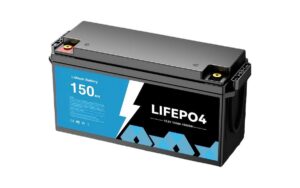
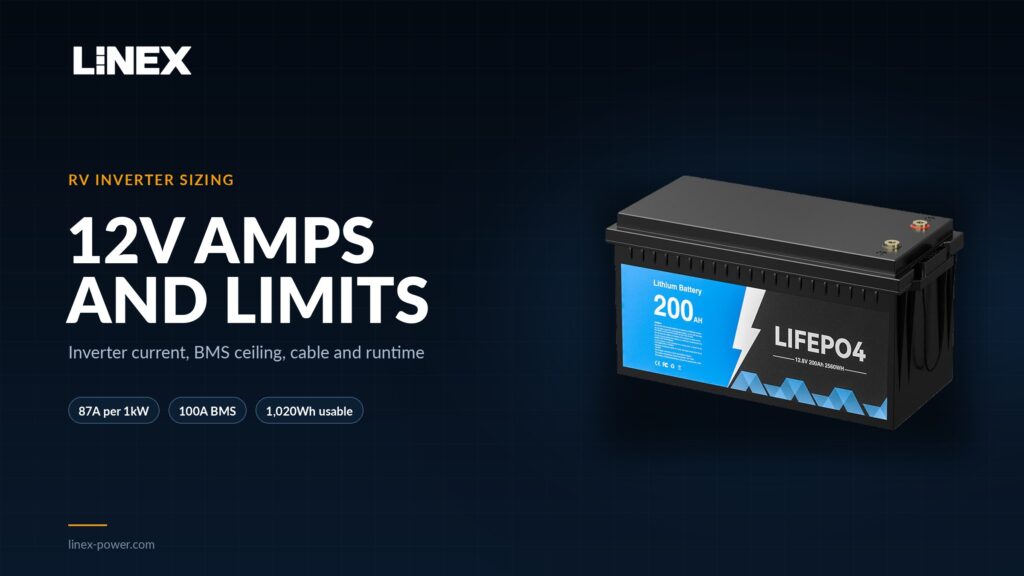
DC current is continuous AC watts divided by pack voltage, then divided by inverter efficiency. At 12.8V and 90% efficiency, a 1,000W load pulls 87A. The 12V 100Ah datasheet lists “Maximum Continuous Discharge Current (A): 100”, so the inverter uses 87% of the BMS limit. That leaves little margin for a surge or a hot day.
| Inverter continuous output | DC current at 12.8V, 90% efficiency | Minimum 12V bank | Fuse starting point |
|---|---|---|---|
| 300W | 26A | 1 x 100Ah | 40A |
| 500W | 43A | 1 x 100Ah | 60A |
| 1,000W | 87A | 1 x 100Ah | 125A |
| 1,500W | 130A | 2 x 100Ah | 200A |
| 2,000W | 174A | 2 x 100Ah | 250A |
| 3,000W | 260A | 3 x 100Ah or 24V/48V | 350A |
Fuse and cable figures are starting points for short runs. Check the inverter manual and local wiring rules before installing.
The BMS caps one 12V pack near 1,150W AC
A 100A BMS at 12.8V delivers 1,280W DC. After 90% inverter efficiency, that is about 1,152W AC. A 1,000W inverter fits with a small margin, and a 1,500W inverter does not. The 12V 200Ah pack does not solve this: it doubles energy to 2,560Wh but keeps the same 100A continuous limit.
Two 100Ah packs in parallel give 200A and 2,560Wh, which covers a 2,000W inverter at 174A. A single 24V 100Ah pack gives 2,560Wh and 100A at 25.6V, which covers the same 2,000W load at about 87A. Both routes work; the 24V route uses thinner cable, and the parallel route keeps a 12V system.
Parallel packs split the current, not the runtime
Two 100Ah packs share a 174A load as 87A each, so each BMS stays inside its 100A limit. Each pack needs its own fuse at the battery positive and equal cable lengths, or one pack will carry more current than the other. The pair gives 2,560Wh nominal, about 1,843Wh AC after 80% depth of discharge and 90% inverter efficiency. At 2,000W that is about 55 minutes.
Keep the parallel cables short and equal. Unequal cable lengths add resistance and shift current between two packs at 174A.
Cable and fuse size follow the current
A 1,000W inverter at 12.8V pulls 87A, so 25mm² cable and a 125A fuse are a working starting point for a run under 2m. A 2,000W build with two packs needs 25mm² cable and a 125A fuse per pack, then a 250A fuse at the inverter. Voltage drop at 12V costs more than at 24V, so keep the inverter close to the bank.
The fuse protects the cable, not the inverter. Size it above the expected current and below the cable’s ampacity, and install it at the battery positive terminal.
Runtime depends on usable energy, not inverter watts
A 100Ah pack gives 1,280Wh nominal, 1,024Wh at 80% depth of discharge, and about 922Wh AC at 90% inverter efficiency. At 500W that is 1.8 hours; at 1,000W it is 55 minutes. A 200Ah pack doubles both numbers, but only for loads below the 100A BMS limit.
| Load | 1 x 12V 100Ah | 2 x 12V 100Ah | 1 x 12V 200Ah | 1 x 24V 100Ah |
|---|---|---|---|---|
| 300W | 3.1h | 6.1h | 6.1h | 6.1h |
| 500W | 1.8h | 3.7h | 3.7h | 3.7h |
| 1,000W | 0.9h | 1.8h | 1.8h | 1.8h |
| 2,000W | Over 100A | 0.9h | Over 100A | 0.9h |
Runtime = rated Wh x 0.8 depth of discharge x 0.9 inverter efficiency / load. The table assumes a new pack at 25°C; cold cells and aging reduce it.
Idle draw can drain the bank between trips
An inverter left on draws current with no load. A 15W idle draw consumes 360Wh per day, about 35% of the usable capacity of one 100Ah pack. A 30W idle draw consumes 720Wh, about 70%. Switch the inverter off when the RV is parked, or choose a model with a low standby draw and a remote switch.
| No-load draw | Energy per day | Share of one 100Ah usable bank |
|---|---|---|
| 10W | 240Wh | 24% |
| 15W | 360Wh | 35% |
| 30W | 720Wh | 71% |
| 50W | 1,200Wh | 118% |
The share is calculated against 1,020Wh usable, not the 1,280Wh nominal rating.
Surge ratings and low-voltage cutoff protect the bank
Motor loads draw a surge at start, so the inverter’s surge rating and its duration matter as much as the continuous rating. A compressor fridge or an induction hob can pull several times its running current for a second or two. Check that the surge rating covers the appliance start, not just the running watts.
Set the inverter low-voltage cutoff at 11.0V to 11.5V under load. The 12V pack’s BMS low protection is 8.8V to 10V, and a hard BMS disconnect at full load will trip the inverter and interrupt the load. A higher cutoff keeps the inverter in control before the BMS acts.
A 24V bank halves the current above 2,000W
At 2,000W a 24V 100Ah pack pulls about 87A, the same current as a 1,000W load on 12V. A 3,000W load pulls about 130A at 24V, which exceeds the 100A continuous limit of one 24V 100Ah pack, so it needs two packs or a 48V bank. The 24V 100Ah case is 524 x 245 x 220mm and weighs about 22kg, the same as the 12V 200Ah.
The charger has to cover the inverter load plus the battery charge current, or the bank drains while the inverter runs. A 1,000W load at 12.8V pulls 87A, and a 30A converter covers only part of that. Check the converter, DC-DC charger and solar controller together before adding a larger inverter.
For the full range, see the 12V lithium battery line and the 24V lithium battery line. The exact units are on the 12V 100Ah product page, the 12V 200Ah product page and the 24V 100Ah product page. For the rest of the build, the RV, van and 4WD battery page covers bank sizing, charging paths and 12V versus 24V.
Frequently asked questions
No. A 2,000W load pulls about 174A at 12.8V, and the 100Ah pack has a 100A continuous BMS. Use two 100Ah packs in parallel or a 24V 100Ah pack.
A 1,000W inverter is the practical ceiling. It pulls about 87A at 12.8V, inside the 100A continuous limit with a small margin. A 1,500W inverter pulls about 130A, which exceeds the 100A continuous limit and trips the BMS.
No. The 12V 200Ah doubles energy to 2,560Wh but keeps the same 100A continuous discharge limit. Two 100Ah packs or a 24V 100Ah pack are the workable options.
About 55 minutes. The pack gives 1,280Wh nominal, 1,024Wh at 80% depth of discharge, and about 922Wh AC after 90% inverter efficiency.
Use a pure sine wave inverter for compressor fridges, induction motors, pumps and electronics with motors or power supplies. Resistive loads such as a kettle or an incandescent lamp can tolerate a modified sine wave. Check the appliance manual before choosing the cheaper waveform.
Sources: LINEX 12V 100Ah, 12V 200Ah and 24V 100Ah datasheets (rated energy, continuous discharge current, dimensions, weight, charge voltage, temperature range and cycle life); LINEX RV, van and 4WD application page (inverter current, fuse and cable starting points, 12V versus 24V bank choice); LINEX 12V versus 24V RV battery guide (voltage choice and cable sizing); calculated values: DC current = AC watts / 12.8V / 0.90, AC energy = rated Wh x 0.8 x 0.90, runtime = AC energy / load, idle share = no-load watts x 24 / 1,020Wh. Last updated 2026-10-30.
For the charging and alternator checks behind these numbers, read the RV lithium battery upgrade checklist. For the battery side of the same build, the 12V 100Ah fit and runtime guide covers case size and load examples.