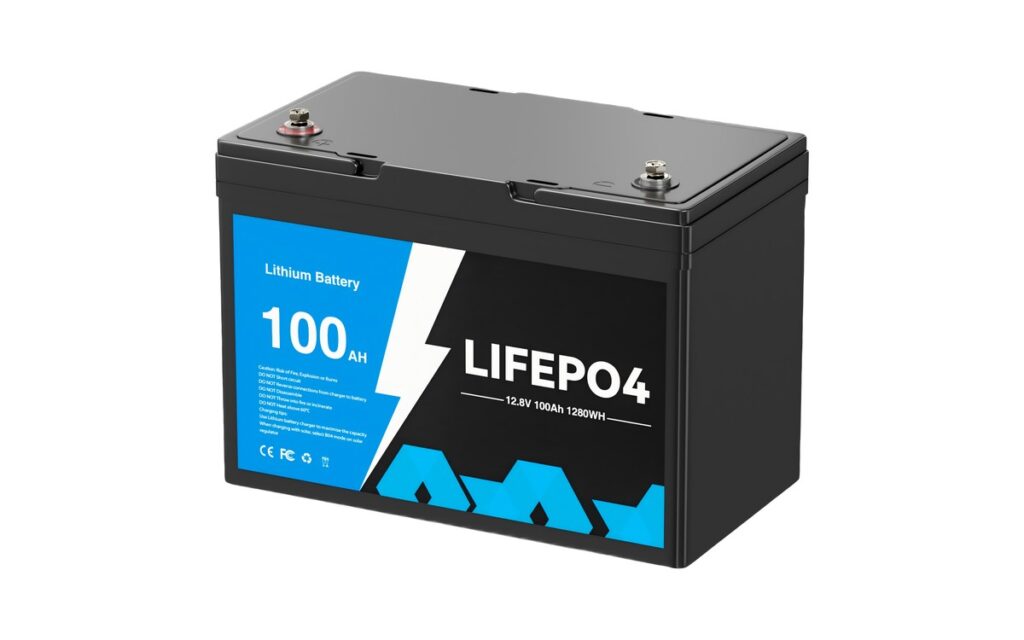
Every few days, someone sends us a photo of their battery tray with a tape measure laid across it. “Will a 100Ah lithium fit here?” Fair question — because the battery you can’t fit is the one that sends you back to the return counter.
So let’s talk about the 12V 100Ah LiFePO4 — the single most common battery in the RV, solar and marine world — and the five things worth knowing before you hand over money for one.
First, what 100Ah actually means
100Ah at 12.8V is about 1,280 watt-hours. Marketing pages rarely translate that, so here it is in real terms:
- A 50W fridge pulls about 40-50Ah over a 24-hour day. The battery has you covered for roughly a day and a half on its own.
- LED lights, a phone charger and a small fan will run 15-20 hours without breaking a sweat.
- A 1,000W inverter running a kettle or microwave? That’s about an hour of continuous load.
And unlike lead-acid, you actually get to use most of it. A lead-acid “100Ah” is really a 50Ah battery if you want it to survive more than a few hundred cycles — that’s the 50% discharge rule. LiFePO4 gives you 90%+ usable capacity without wrecking the cells. Same sticker, twice the juice.
The weight is the part you’ll notice every day
Here are the real numbers, no rounding tricks. Our 12V 100Ah LiFePO4 weighs about 10kg and measures 332 × 172 × 218 mm. A flooded or AGM battery with the same 100Ah label weighs around 30kg.
Twenty kilos. If you’ve ever lugged a dead lead-acid battery out of a boat locker or a caravan compartment to trickle-charge it in the garage, you already know what that number is worth. On a boat, 20kg off the stern changes how she sits in the water. In a van build, it’s a decent chunk of your payload budget back.
Same footprint, third of the weight. That’s most of the story right there.
How long will it actually last?
Our battery is rated for 4,000 cycles at 80% depth of discharge. Translate that into life:
- Cycle it once a day — a full charge-discharge routine — and you’re looking at 10+ years.
- Most RV and marine owners cycle far less often. Weekends and holidays. Realistically, you’d be looking at a battery that outlives the vehicle it’s installed in.
- Compare with a decent AGM: 300-500 cycles, and it dies quietly with no warning. A lithium that tells you its state of charge honestly, for a decade, is a different category of product.
One honest caveat: that cycle number assumes the battery isn’t cooked. Keep it out of direct engine-room heat above 60°C and treat the charge profile with a little respect, and the chemistry will do its part.
Five questions worth asking before you buy any 100Ah lithium
1. Will it fit — actually fit? Measure the tray’s length, width and height, and leave a couple of centimetres for terminals and cables. 332 × 172 × 218 mm covers a lot of standard Group 31 trays, but check before you order, not after.
2. Is the BMS beefy enough for your load? Ours does 100A continuous. If you’re running a 2,000W inverter, that’s around 160A at full pull — fine for short surges, but read the spec sheet instead of guessing. The BMS is the part that decides whether your battery quietly protects itself or your inverter trips at an awkward moment.
3. Where will the charge come from? Standard charge is 20A, max is 100A — meaning a 20A mains charger fills it overnight, or solar at 400-500W does it in a good day. Plan the charge side as carefully as the discharge side and you’ll never run flat.
4. Will it see cold weather? LiFePO4 shouldn’t be charged below 0°C. If you camp or work in freezing conditions, either keep the battery in a heated space or ask us about low-temperature options. Discharging in the cold is fine — it’s the charging that needs care.
5. Can you expand later? If you think you’ll add a second battery down the road, buy the same model and age-match it. Mixing capacities or brands in series is the classic mistake that quietly halves the life of both.
Quick answers
Can I run my 12V fridge and lights for a weekend? Easily. Most setups like that draw 40-60Ah a day, so a single 100Ah runs them for a full weekend and asks for a recharge on Sunday night.
Is it safe inside a caravan or cabin? Yes — LiFePO4 has no acid, no fumes and no maintenance. That’s one of the quiet advantages over lead-acid: you can mount it in a living space without ventilation headaches.
What about charging from the alternator? With a DC-DC charger, fine. Straight off a dumb alternator circuit, no — you’ll need the correct lithium profile.
If you’re sizing a setup and want a second opinion, send us what you’re running and how long you need it to last. We’ll tell you honestly whether one 100Ah is enough — or whether you need to go bigger. Our 12V 100Ah LiFePO4 page has the full spec sheet, and the wider 12V/24V range covers everything from 10Ah up to 300Ah.