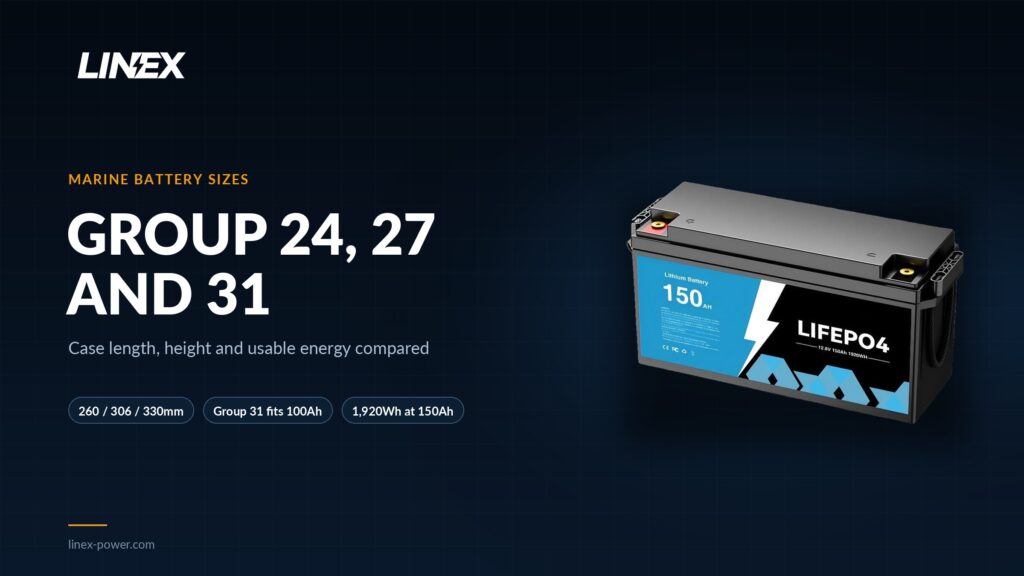
A group number is a case size, not an amp-hour rating
A Group 24, 27 or 31 label describes a BCI case size, and all three share a 173mm width. The lengths are 260mm, 306mm and 330mm, and the heights are 225mm, 225mm and 240mm. Two batteries with the same group number can hold different amp-hour ratings because the case sets the space, while the plates and chemistry set the energy.
The group also covers terminal layout. A boat built for a Group 31 battery may have a tray, hold-down and cable set sized for that footprint. None of those parts tells you the capacity of the battery that was originally fitted. Check the label on the old battery and measure the tray before assuming a group number.
| Group | Length × width × height | Inches | Typical use |
|---|---|---|---|
| 24 | 260 × 173 × 225mm | 10.3 × 6.8 × 8.9in | Small boats, tiller-steer, limited lockers |
| 27 | 306 × 173 × 225mm | 12.1 × 6.8 × 8.9in | Mid-size cabin boats, single house bank |
| 31 | 330 × 173 × 240mm | 13.0 × 6.8 × 9.4in | Larger boats, trolling banks, combined loads |
The three groups differ by 46mm and 24mm of length
Group 27 is 46mm longer than Group 24, and Group 31 adds another 24mm of length plus 15mm of height. The width stays at 173mm across all three. That makes length the first dimension to check when a battery does not drop into an existing tray.
A 46mm difference changes where the hold-down brackets sit. The battery may sit in the tray but leave no room for the strap, the terminal cover or the cable bend. A Group 31 case also sits 15mm taller, which matters under a bench seat or a low locker lid. Measure the tray interior and the height to the lid, then compare those numbers with the case drawing.
Typical AGM capacity runs from 70Ah to 125Ah across the groups
A Group 24 AGM is usually sold at 70Ah to 85Ah, a Group 27 at 90Ah to 110Ah and a Group 31 at 100Ah to 125Ah. Those ranges are typical published capacities at the 20-hour rate, and individual models vary. The group number does not guarantee an amp-hour figure.
At 50% depth of discharge, the planned usable energy runs from about 420Wh for a small Group 24 to about 750Wh for a 125Ah Group 31. That is the number that matters for a house bank. A 100Ah AGM in any of the three groups gives about 600Wh of planned capacity, because the 50% limit applies to the label rating, not to the case size.
| Group | Typical AGM capacity | Planned usable at 50% DoD | LiFePO4 fit |
|---|---|---|---|
| 24 | 70Ah to 85Ah | 420Wh to 510Wh | 12V 50Ah fits inside with a spacer |
| 27 | 90Ah to 110Ah | 540Wh to 660Wh | No standard model; 12V 100Ah is 26mm too long |
| 31 | 100Ah to 125Ah | 600Wh to 750Wh | 12V 100Ah at 332 × 172 × 218mm |
The 12V 100Ah case sits on a Group 31 tray with 22mm to spare
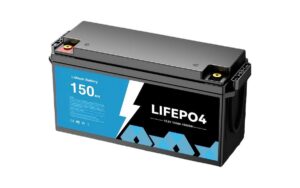
The LINEX 12V 100Ah case measures 332 × 172 × 218mm, which is 2mm longer, 1mm narrower and 22mm lower than a Group 31 case. It sits on the tray and leaves 22mm of height for terminals and cable lugs. The same case does not fit a Group 27 tray, where it is 26mm too long, or a Group 24 tray, where it is 72mm too long.
The larger 12V 150Ah and 12V 200Ah models need a custom tray. The 150Ah case is 483 × 170 × 240mm, which is 153mm longer than a Group 31 case. The 200Ah case is 524 × 245 × 220mm, which is 194mm longer and 72mm wider. Neither one is a drop-in replacement for a standard group box.
| Model | Case (L × W × H) | Rated energy | Usable at 80% DoD | Continuous discharge | Group fit |
|---|---|---|---|---|---|
| 12V 50Ah | 228 × 138 × 211mm | 640Wh | 512Wh | 50A | Smaller than Group 24; spacer needed |
| 12V 100Ah | 332 × 172 × 218mm | 1,280Wh | 1,024Wh | 100A | Group 31 tray |
| 12V 150Ah | 483 × 170 × 240mm | 1,920Wh | 1,536Wh | 145A to 150A | Custom tray |
| 12V 200Ah | 524 × 245 × 220mm | 2,560Wh | 2,048Wh | 100A | Custom tray or 8D tray with blocking |
Usable energy per group favors LiFePO4 by 1.7 times
A Group 31 AGM at 100Ah gives about 600Wh of planned usable energy, while the 12V 100Ah LiFePO4 case that fits the same tray gives 1,024Wh. The ratio is 1.7 to 1. A 125Ah Group 31 AGM reaches about 750Wh, which is still below the 1,024Wh lithium unit.
The gap comes from depth of discharge, not from a larger case. AGM is planned at 50% depth of discharge for daily cycling, while the LiFePO4 datasheet rating is 80%. A Group 24 AGM at 80Ah gives about 480Wh, and the smaller 12V 50Ah LiFePO4 gives 512Wh at 80% in a case that weighs about 5kg against about 25kg for the AGM.
Height and terminal clearance decide whether the lid closes
A Group 31 case is 240mm tall, and the 12V 100Ah LiFePO4 case is 218mm, which leaves 22mm before the lid. A Group 24 or Group 27 case is 225mm tall, so the same lithium case leaves 7mm. That is enough for the case but may not be enough for a terminal cover, a fuse holder or a cable lug that turns upward.
Measure from the tray floor to the underside of the lid, not from the top of the old battery. Add the height of the terminal and the cable bend to the case height. Check the lug type as well: a group number standardizes the case, but the boat’s cables may use a post, a stud or a dual terminal. The battery types and sizes guide lists the BCI dimensions and terminal notes.
Match the tray before matching the amp-hour label
Measure the tray interior to within 2mm, the height to the lid and the clearance around the terminals before comparing amp-hour ratings. A cardboard template cut to the new case size will show whether the battery drops in, whether the hold-down strap reaches and whether the cables still land on the terminals.
If the boat currently runs AGM and you plan to switch to LiFePO4, check the charger as well. A 12V LiFePO4 pack needs 14.6V absorption and 13.5V to 13.8V float, and the BMS blocks charging below 0°C. The marine deep cycle battery guide covers the chemistry and maintenance differences.
Group size narrows the case; current and chemistry set the rest
A group number is a fit check, and the difference between a pass and a fail can be 2mm. Once the case fits, compare rated energy, continuous discharge current, charge profile and cycle life at the depth of discharge the boat uses. The marine and boating battery guide lists the full model range and the house-bank sizing table.
For a Group 31 tray, the 12V 100Ah LiFePO4 battery is the direct fit. Its datasheet lists “Maximum Continuous Discharge Current (A): 100” and a 6,000-cycle rating at 80% depth of discharge. For a larger locker, the 12V 150Ah LiFePO4 battery gives 1,536Wh usable in a 483mm case. Keep the engine start on a separate battery: LINEX deep-cycle models do not publish cold cranking ratings and are not sold for starting duty.
Frequently asked questions
No. A Group 31 case is 330mm long and 240mm tall, against 306mm and 225mm for Group 27. The extra 24mm of length and 15mm of height usually stop it from dropping into the tray or closing under the lid.
Group 27 is 46mm longer than Group 24. Both are 173mm wide and 225mm tall. A Group 27 tray can hold a larger case, but the amp-hour rating still depends on the model.
It depends on the chemistry and model. A Group 31 AGM is typically 100Ah to 125Ah, while the LINEX 12V 100Ah LiFePO4 case fits the same footprint at 100Ah and 1,280Wh. The group number sets the case size, not the capacity.
Yes for a house bank, if the tray and terminals fit and the charger has a lithium profile. The lithium unit gives 1,024Wh usable at 80% depth of discharge against about 600Wh for a 100Ah AGM, and it weighs about 10kg against 30kg to 33kg. The charger needs a lithium profile; absorption is 14.6V and float is 13.5V to 13.8V.
Yes. The LINEX 12V 100Ah LiFePO4 case weighs about 10kg. A 100Ah AGM in a Group 31 case typically weighs 30kg to 33kg. Check the case height and terminal clearance before ordering, because the lithium case is 22mm lower than the Group 31 standard.
Sources: 12V 50Ah, 12V 100Ah, 12V 150Ah and 12V 200Ah datasheets (rated energy, continuous discharge current, case dimensions, weight, charge voltage, temperature limits and cycle life); LINEX battery types and sizes guide (BCI Group 24, 27 and 31 dimensions); LINEX marine and boating application page (group fit and house-bank sizing); LINEX marine deep cycle battery guide (chemistry and charging); LINEX deep cycle lead-acid versus lithium article (AGM usable energy and cycle life, industry-typical). Calculated values: usable energy = rated Wh × 0.8; planned AGM energy = 12V × Ah × 0.5; length difference = group length minus 260mm or 306mm. Last updated 2026-11-02.