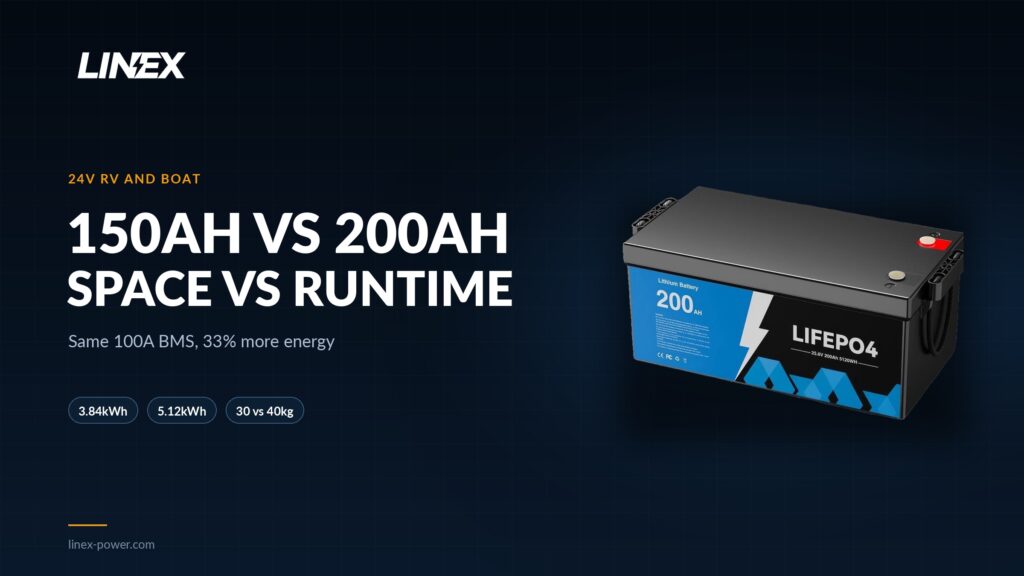
The 200Ah pack adds 1.28kWh in 24mm more width
A 24V 200Ah LiFePO4 battery stores 5,120Wh and delivers about 4,096Wh at 80% depth of discharge. The 24V 150Ah model stores 3,840Wh and delivers about 3,072Wh at the same depth. The extra 1,280Wh is 33% more energy, and it comes from a case that is 24mm wider and about 10kg heavier.
The 150Ah case measures 524 × 245 × 220mm. The 200Ah case measures 523 × 269 × 222mm. Length and height are nearly identical; the difference is width. A battery tray built around a 245mm case may not accept the 269mm model, and the width is measured at the case body, not at the terminals.
| Model | Rated energy | Usable at 80% DoD | Case (L × W × H) | Weight | Continuous power |
|---|---|---|---|---|---|
| 24V 150Ah | 3,840Wh | 3,072Wh | 524 × 245 × 220mm | 30kg | 2,560W |
| 24V 200Ah | 5,120Wh | 4,096Wh | 523 × 269 × 222mm | 40kg | 2,560W |
The 200Ah case volume is about 31.2 litres against 28.2 litres for the 150Ah, a 10.6% increase. Both packs store about 128Wh per kg, so the weight gain tracks the energy gain. The 200Ah uses its case volume more fully at about 164Wh per litre, against 136Wh per litre for the 150Ah.
Both models stop at 100A continuous
The 150Ah and 200Ah packs share the same “maximum continuous discharge current” of 100A, which is 2,560W at 25.6V. The BMS does not scale with capacity in this range. A 200Ah label buys runtime, not a higher inverter ceiling.
Both also share a 100A maximum charge current. The recommended charge current is 75A for the 150Ah and 100A for the 200Ah, so the recommended rate is about 0.5C for both. The standard charge current is 30A and 40A respectively.
| DC load | Current at 25.6V | Share of 100A BMS | Runtime, 150Ah | Runtime, 200Ah |
|---|---|---|---|---|
| 500W | 19.5A | 20% | 6.1h | 8.2h |
| 1,000W | 39.1A | 39% | 3.1h | 4.1h |
| 2,000W | 78.1A | 78% | 1.5h | 2.0h |
| 2,560W | 100A | 100% | 1.2h | 1.6h |
For AC loads through an inverter, add about 10% for conversion losses. A 2,000W AC load draws about 87A at the battery, which is 87% of the BMS limit. Keep continuous loads at or below 80% of the rating, which is 2,048W, to leave room for heat and age. If the build needs more than 2,560W, use two packs in parallel or move to a 48V bank.
Runtime scales 4:3 at the same load
At any load inside the BMS limit, the 200Ah pack runs 33% longer. The ratio is fixed by usable energy: 4,096Wh against 3,072Wh. The 200Ah label is 33% larger than the 150Ah label, and the runtime follows the same ratio once both packs are discharged to the same depth.
| AC load through 90% inverter | Current at 25.6V | Runtime, 150Ah | Runtime, 200Ah |
|---|---|---|---|
| 500W | 21.7A | 5.5h | 7.4h |
| 1,000W | 43.4A | 2.8h | 3.7h |
| 1,500W | 65.1A | 1.8h | 2.5h |
| 2,000W | 86.8A | 1.4h | 1.8h |
At 500W AC, the 150Ah pack runs about 5.5 hours and the 200Ah about 7.4 hours. At 1,000W, the figures are 2.8 and 3.7 hours. The 200Ah advantage is easiest to see on a boat at anchor, where a fridge and a laptop run for a full day, or in an RV with a 1,000W inverter and no driving for a day.
A 2,500W AC load would draw about 108A after inverter losses, above the 100A limit. That load needs two packs in parallel or a larger system, regardless of which capacity is on the label.
The 200Ah pack adds 10kg and 24mm of space
The 200Ah model weighs about 40kg; the 150Ah model about 30kg. Ten kilograms is the difference between one person lifting a pack into a locker and two people working it through a hatch. On a boat, weight low and near the centerline matters more than the label.
Measure the opening, not just the tray. A 269mm wide case needs a clear opening wider than 269mm once terminals and cable bends are included. A 245mm case needs the same check at a smaller width. The height difference is only 2mm, but the terminal posts and fuse holder can stand above the case, so check the lid clearance as well.
In an RV, the battery often sits under a bench or bed. The 200Ah case is 523mm long, so it may fit the same length as the 150Ah but not the same width. Check the seat frame, the heating duct and the door swing before ordering. A 40kg pack also needs a restrained tray, not a strap around the handle.
On a boat, a 40kg pack still needs a solid base. Use a tray with a lip, hold-down straps rated above the pack weight, and a fuse close to the positive terminal and sized to the cable. The IP65 case protects against spray, not against immersion.
Charging time depends on the charger, not the label
On a 30A charger, the 150Ah pack goes from 20% to full in about 4.4 hours, and the 200Ah pack takes about 5.9 hours. The calculation replenishes 120Ah and 160Ah respectively, then adds 10% for the absorption phase and losses. A 50A charger cuts those times to about 2.7 and 3.6 hours.
| Charger current | 150Ah, 20% to full | 200Ah, 20% to full |
|---|---|---|
| 30A | 4.4h | 5.9h |
| 50A | 2.7h | 3.6h |
| 75A | 1.8h | 2.4h |
| 100A | 1.3h | 1.8h |
The 150Ah model recommends 75A and accepts up to 100A. The 200Ah recommends 100A and accepts up to 100A. If the charger is fixed at 30A, the 200Ah will always take longer to refill, which matters on a boat with a short engine run or a van with a single alternator.
Both packs charge from 0°C to 50°C and discharge from -20°C to 60°C. The BMS blocks charge below 0°C. A cold-weather build needs a heated compartment or a charge window above freezing, and the larger pack does not change that limit.
Which pack fits which build
Choose the 150Ah pack when the battery bay is narrower than 269mm, the lifted weight must stay near 30kg, or the daily load is under 3kWh. Choose the 200Ah pack when the same footprint length is available and the extra 1,024Wh of usable energy removes a second pack or a generator run.
| Build | Pack | Why |
|---|---|---|
| Campervan, 2kWh per day, 500W inverter | 150Ah | 3.07kWh usable, 30kg |
| Full-time RV, 1,000W inverter | 200Ah | 4.10kWh usable, 4.1h at 1,000W DC |
| Boat, narrow locker, weekend use | 150Ah | 245mm case width, 30kg |
| Boat, long passages, fridge and autopilot | 200Ah | 33% more energy in the same length |
| Any continuous load above 2,560W | Neither alone | 100A BMS limit |
A 24V 150Ah and a 24V 200Ah pack can be paralleled, but the two packs should be the same model, similar age and similar state of charge. Mixing capacities makes the smaller pack work harder at the top and bottom of the charge curve. If the plan is to add capacity later, buy the second pack within a few months and use equal cable lengths. The series and parallel wiring guide covers fuse placement and cable equalisation.
The 24V 150Ah product page and the 24V 200Ah product page carry the full datasheets, including the 29.2V fast charge voltage, 27.0V to 27.6V float range and 17.6V to 20V low-voltage protection. The 24V lithium battery range covers 50Ah to 200Ah. For installation context, see the RV and van life page and the marine and boating page. The Ah to kWh calculator converts a daily load into pack capacity if the 3.84kWh and 5.12kWh figures need checking against a different duty cycle.
Neither pack is a starting battery
LINEX does not publish cold cranking ratings for the 24V 150Ah or 200Ah models, so neither is sold for engine starting. Both are house-bank packs for deep-cycle loads. A boat or RV should keep a separate start battery and charge the house bank through a DC-DC charger or an external regulator set for lithium.
The distinction matters because a start battery is sized by cranking current, while these packs are sized by energy and continuous current. A 100A BMS limit is generous for a fridge and an inverter, and it says nothing about the several hundred amps a starter may ask for in cold weather. Use the published rating for the job it was written for.
Frequently asked questions
No. Both the 24V 150Ah and 24V 200Ah models publish a 100A maximum continuous discharge current, or 2,560W at 25.6V. The 200Ah gives more energy and runtime, not a higher inverter ceiling.
The 200Ah case is 523 × 269 × 222mm and the 150Ah is 524 × 245 × 220mm. Length and height are almost the same, but the 200Ah is 24mm wider. Measure the clear opening, including terminals and cable bends, before ordering.
At 90% inverter efficiency, a 1,000W AC load draws about 43A from a 25.6V pack. The 150Ah pack runs about 2.8 hours and the 200Ah about 3.7 hours at 80% depth of discharge. Actual runtime falls as the pack ages and as temperature drops.
Yes. The 200Ah accepts 30A, but a full charge from 20% takes about 5.9 hours against 4.4 hours for the 150Ah. The 200Ah recommends 100A and accepts up to 100A, so a larger charger shortens the refill time.
It works electrically, but the pair is better matched by model, age and state of charge. A 150Ah and a 200Ah pack have different internal resistance and capacity, so the smaller pack can carry more than its share at the top and bottom of the curve. Use two packs of the same model when possible.
Sources: LINEX 24V 150Ah product page (25.6V, 150Ah, 3,840Wh, 100A maximum continuous discharge, 75A recommended charge, 100A maximum charge, about 30kg, 524 × 245 × 220mm, IP65, 6,000 cycles at 25°C and 80% DoD, checked 2026-11-27); LINEX 24V 200Ah product page (25.6V, 200Ah, 5,120Wh, 100A maximum continuous discharge, 100A recommended charge, about 40kg, 523 × 269 × 222mm, IP65, 6,000 cycles at 25°C and 80% DoD, checked 2026-11-27); LINEX 24V lithium battery range page (50Ah to 200Ah, native 24V, checked 2026-11-27); LINEX RV and van life page (battery space, charger and inverter checks, checked 2026-11-27); LINEX marine and boating page (house-bank sizing and separate start battery, checked 2026-11-27); LINEX battery voltage charts (24V 8S, 29.2V absorption and 27.0V to 27.2V float, checked 2026-11-27). Last updated 2026-11-27.