A 100Ah flooded block gives about 600Wh of planned house capacity
A 12V 100Ah flooded marine battery stores 1,200Wh at its rated capacity, and the 50% depth-of-discharge rule leaves about 600Wh for daily use. A 12V 100Ah LiFePO4 pack stores 1,280Wh and is planned at 80% depth of discharge, or 1,024Wh. The lithium unit delivers 1.7 times the usable energy from a case that weighs about 10kg.
The 50% figure is a service-life rule, not a hard chemical wall. A flooded battery can be discharged deeper, but each cycle below 50% costs plate life. Battery University’s lead-acid summary puts deep-cycle lead-acid at 400 to 500 cycles at 50% depth of discharge and 150 to 200 cycles at full depth.
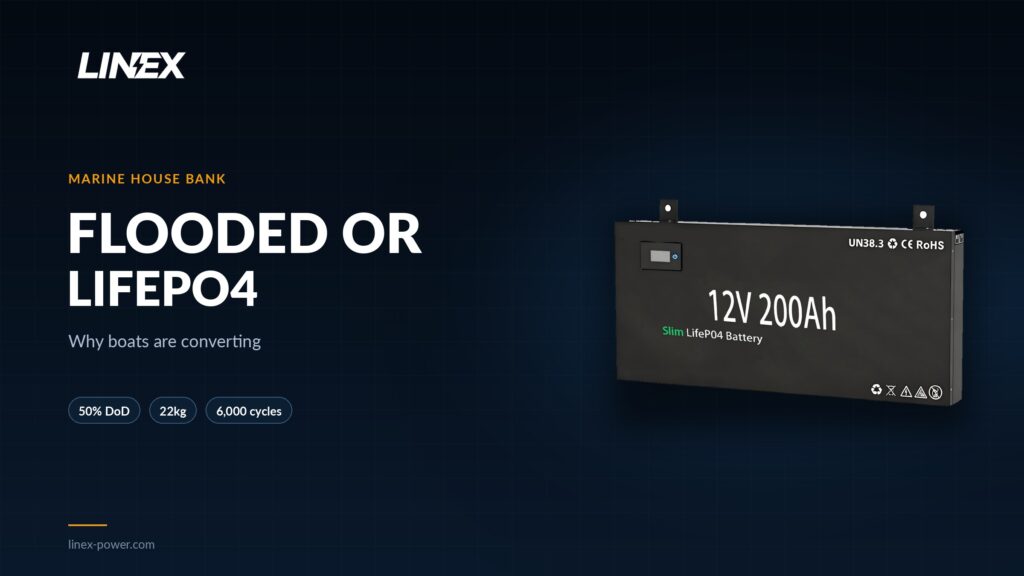
The gap widens at the bank level. A pair of Trojan T-105 6V blocks gives 12V 225Ah, or 2,700Wh, with about 1,350Wh usable at 50%. The LINEX 12V 200Ah LiFePO4 pack stores 2,560Wh and delivers 2,048Wh at 80%.
| Battery | Rated energy | Planned DoD | Usable per cycle | Rated cycles |
|---|---|---|---|---|
| 12V 100Ah flooded | 1,200Wh | 50% | 600Wh | 400 to 500 at 50% DoD |
| 12V 100Ah LiFePO4 | 1,280Wh | 80% | 1,024Wh | 6,000 at 80% DoD |
| 12V 200Ah LiFePO4 | 2,560Wh | 80% | 2,048Wh | 6,000 at 80% DoD |
| Trojan T-105 pair (12V 225Ah flooded) | 2,700Wh | 50% | 1,350Wh | 400 to 500 at 50% DoD |
Watering and equalizing set the maintenance calendar
A flooded marine battery needs water checks every few weeks when new, then monthly in light use, and an equalizing charge at 2.50V per cell, or 15.0V on a 12V battery, from monthly to once or twice a year. Battery University calls watering “the single most important step in maintaining a flooded lead acid battery.” The plates must stay covered, and distilled water goes in after charging, not before.
Equalizing is not a routine top-up. It is a deliberate overcharge that removes sulfate from the plates, and Battery University recommends it only when the specific gravity of the cells differs by 0.030. A sealed locker cannot handle the hydrogen that a flooded battery releases during charging. The locker needs a vent to outside air, and the battery needs a hold-down that survives a heel.
These tasks are the reason a flooded bank feels cheap at the counter and expensive in August. A liveaboard who checks water every two weeks spends about 26 visits a year on the bank before any terminal cleaning or equalizing.
The weight and case size change what the boat can carry
A pair of Trojan T-105 6V flooded blocks weighs 56kg and occupies 524 x 181 x 283mm when placed side by side. The LINEX 12V 200Ah LiFePO4 pack weighs about 22kg and measures 524 x 245 x 220mm. The swap removes about 34kg from the same footprint while adding 698Wh of usable energy per cycle.
| Bank | Nominal energy | Usable per cycle | Weight | Case footprint | Water checks |
|---|---|---|---|---|---|
| Trojan T-105 pair (12V 225Ah flooded) | 2,700Wh | 1,350Wh at 50% DoD | 56kg | 524 x 181 x 283mm | monthly |
| 12V 200Ah LiFePO4 | 2,560Wh | 2,048Wh at 80% DoD | 22kg | 524 x 245 x 220mm | none |
| 12V 100Ah LiFePO4 | 1,280Wh | 1,024Wh at 80% DoD | 10kg | 332 x 172 x 218mm | none |
| 12V 150Ah LiFePO4 | 1,920Wh | 1,536Wh at 80% DoD | 15kg | 483 x 170 x 240mm | none |
The lithium case is wider and shorter than the flooded pair, so the hold-down and terminal clearance need a check before the order. A 100Ah LiFePO4 unit weighs about 10kg, which one person can lift into a locker. A flooded block of the same label is heavier and needs a lifting point or a second person.
Charging is where most conversions fail
A flooded charger holds 14.4V to 14.7V absorption and 13.5V to 13.6V float, with about -3mV per °C per cell of temperature compensation. A 12V LiFePO4 pack needs 14.6V absorption, 13.5V to 13.8V float and no equalize cycle. The BMS blocks charge below 0°C on the standard models.
The alternator is the second charging source, and it is usually set for lead-acid. A standard internal regulator can leave a lithium house bank at 70% to 80% state of charge. The fix is a DC-DC charger or an external regulator with a lithium profile, not a different battery.
| Setting | Flooded lead-acid | 12V LiFePO4 |
|---|---|---|
| Absorption | 14.4V to 14.7V | 14.6V |
| Float | 13.5V to 13.6V | 13.5V to 13.8V |
| Equalize | 15.0V periodic | none |
| Temperature compensation | about -3mV/°C/cell | off |
| Charge below 0°C | yes, if the battery is not frozen | BMS blocks charge |
| Desulfation mode | may be used | must be off |
A charger with a fixed lead-acid profile or an automatic desulfation cycle is not suitable for lithium. The desulfation pulse can push the pack above its absorption voltage, and the BMS may disconnect the charge path as a fault. Check the charger menu for a lithium profile before the battery arrives.
A conversion checklist for the locker and the DC system
A safe conversion checks seven items before the first charge: charger profile, alternator or DC-DC path, cable and fuse ratings, BMS current limit, start battery separation, locker ventilation and hold-down, and monitoring. The battery is one part of the system, and the rest of the system decides whether the conversion works.
| Check | What to verify | Why it matters |
|---|---|---|
| Charger profile | 14.6V absorption, 13.5V to 13.8V float, no equalize | A lead-acid profile overcharges or undercharges the pack |
| Alternator path | DC-DC charger or external regulator | An internal regulator can stop at 70% to 80% state of charge |
| Cable and fuse | Continuous current and round-trip voltage drop | A 100A pack needs cable and a fuse rated for the load |
| BMS current limit | 100A continuous on the 12V 100Ah and 200Ah models | The BMS opens the circuit above its limit |
| Start battery | Separate start battery and charge path | Deep-cycle models do not publish cold cranking ratings |
| Locker | Ventilation, hold-down, terminal clearance | Flooded gas is removed, and the lithium case is wider |
| Monitoring | Shunt or BMS app | State of charge and cell balance need a data source |
The start battery is not optional. LINEX deep-cycle models do not publish cold cranking ratings and are not sold for engine starting. A separate start battery, or a dedicated high-current lithium start battery, keeps the engine circuit away from the house bank’s BMS.
The locker check is easy to skip because a lithium pack has no caps to open. The case still needs a hold-down that holds it in a heel, and the terminals need clearance for a wrench. IP65 protects against dust and splashing water, not against a locker that fills with seawater.
Boat type decides whether the conversion pays
A daysailer that cycles the house bank 30 times a year may never wear out a flooded bank before calendar aging ends it, while a liveaboard cycling 300 times a year uses up a 400 to 500 cycle bank in about 18 months. The conversion case grows with annual cycles, daily depth of discharge and the labor cost of watering.
A weekend cruiser at 80 to 100 cycles a year gets four to six years from a flooded bank at 400 to 500 cycles. A liveaboard at 300 cycles a year gets 16 to 20 months. The lithium pack’s 6,000 cycles at 80% depth of discharge change the replacement count, not the daily runtime.
A cold, unheated boat is the exception. Flooded lead-acid can accept charge below 0°C if the electrolyte is not frozen, while the standard LiFePO4 BMS blocks charge below 0°C. A heated lithium pack or a charge window above freezing is needed before the conversion makes sense in that locker.
A trolling motor boat has a different calculation. The 12V 100Ah LiFePO4 pack weighs about 10kg, so it can be moved between boats and lifted out at the end of the day. The same label in flooded lead-acid is heavier and needs water access, which is often the real limit in a small boat.
Where flooded lead-acid still fits
Flooded lead-acid still fits a boat with low annual cycles, an accessible battery locker, a three-stage charger with an equalize mode, and an owner who will check water monthly. It also fits a cold, unheated boat where charging below 0°C matters and a heated lithium pack is not in the plan. The case for conversion is weakest when the boat sits on a mooring for months and the bank is rarely cycled.
The case is strongest when the boat runs a fridge, an inverter and electronics every day, when the locker is hard to reach, or when the extra weight sits at the wrong end of the hull. A 34kg saving on a 200Ah bank is payload that can go into water, fuel or gear.
A conversion is not a battery purchase. It is a charging, wiring and locker project with a battery at the center. Price the charger, the DC-DC unit, the cable, the fuse and the labor before comparing the two batteries.
Where the LINEX 12V models fit
The LINEX 12V 100Ah model is 1.28kWh, 100A continuous, about 10kg and 332 x 172 x 218mm. The 12V 200Ah model is 2.56kWh, 100A continuous, about 22kg and 524 x 245 x 220mm. Both are IP65, rated 6,000 cycles at 25°C and 80% depth of discharge, and sold for house-bank and onboard loads, not engine starting.
For a restricted locker, the thin and ultra-slim 12V cases trade some case depth for a different footprint. The marine application page lists the 50Ah to 300Ah range and the daily-load sizing table. The 12V 100Ah product page and 12V 200Ah product page list the full specifications.
For the full cost comparison, the lithium versus lead-acid TCO for marine and RV runs the 10-year numbers. The AGM marine battery guide covers the sealed lead-acid alternative.
Frequently asked questions
Yes, if the charger, alternator or DC-DC path and cable protection are set for lithium. A 12V LiFePO4 pack needs 14.6V absorption, 13.5V to 13.8V float and no equalize cycle. The BMS blocks charge below 0°C on the standard models.
Only if the existing charger cannot be set to 14.6V absorption and 13.5V to 13.8V float, or if it runs an equalize or desulfation cycle. A charger with a lithium profile and a temperature sensor at the battery is the correct match.
A 12V 200Ah LiFePO4 pack weighs about 22kg, against 56kg for a pair of Trojan T-105 blocks with similar nominal energy. The swap saves about 34kg per 200Ah bank.
Charging produces hydrogen gas. Battery University’s charging guide says to charge in a well-ventilated area because the gas is explosive. A vented locker with an opening at the top and bottom keeps the gas below the explosive range.
No for the LINEX deep-cycle models. They do not publish cold cranking ratings and are sold for house-bank and onboard loads. Keep a separate start battery or choose a model with a published cranking rating.
Sources: LINEX 12V 100Ah LiFePO4 product page (12.8V, 100Ah, 1,280Wh, 100A continuous, 14.6V fast charge, 13.5V to 13.8V float, 0°C to 50°C charge, 6,000 cycles at 25°C and 80% DoD, IP65, about 10kg, 332 x 172 x 218mm, checked 2026-11-23); 12V 150Ah product page (1,920Wh, 145/150A continuous, about 15kg, 483 x 170 x 240mm, checked 2026-11-23); LINEX 12V 200Ah product page (2,560Wh, 100A continuous, about 22kg, 524 x 245 x 220mm, checked 2026-11-23); marine and boating application page (house-bank sizing, 12V 100Ah to 24V 200Ah, alternator charging note, checked 2026-11-23); 12V lithium battery range (50Ah to 300Ah, checked 2026-11-23); Trojan T-105 product page (6V, 225Ah at the 20-hour rate, 28kg, 262 x 181 x 283mm, checked 2026-11-23); Battery University BU-201 (deep-cycle lead-acid 400 to 500 cycles at 50% DoD and 150 to 200 cycles at full depth, checked 2026-11-23); Battery University BU-403 (absorption 2.40V to 2.45V per cell, float 2.25V to 2.27V per cell, -3mV/°C/cell, watering and hydrogen ventilation, checked 2026-11-23); Battery University BU-404 (equalize at 2.50V per cell, monthly to once or twice a year, specific gravity difference of 0.030, checked 2026-11-23). Last updated 2026-11-23.