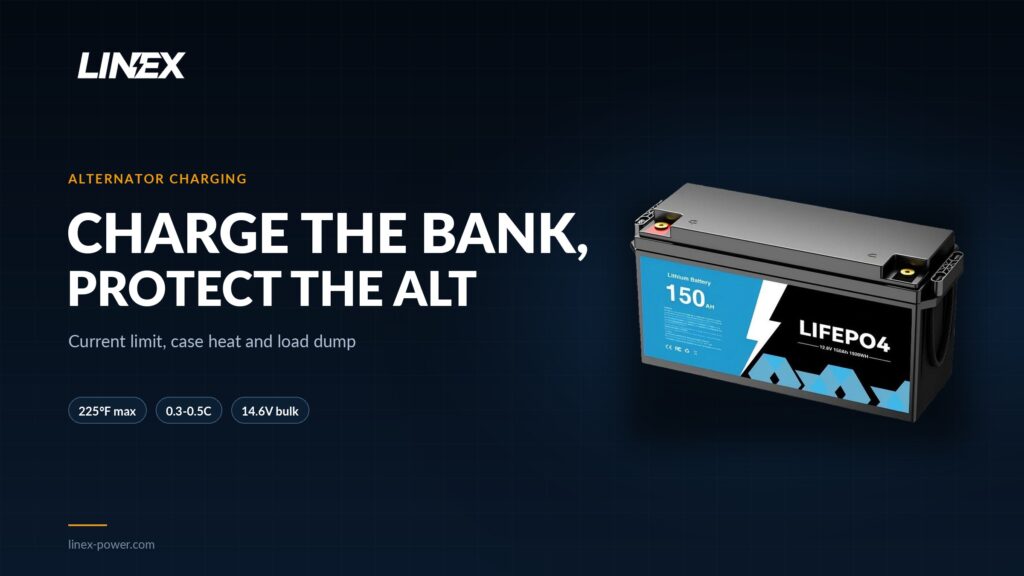
The alternator can charge LiFePO4, but not at its full rating for long
A marine alternator can charge a LiFePO4 house bank when the regulator is set for the right voltage and the current is capped. The limit is heat, not the battery. A 100Ah pack accepts up to 100A, and a 200Ah pack also accepts 100A, so the bank will take everything a small-case alternator can make and ask for more.
A lead-acid bank tapers its current as it fills. LiFePO4 holds a high acceptance rate until the top of the charge, then tapers quickly. The alternator runs near full output for longer, and that sustained load is what overheats it.
A 100Ah bank accepts 100A; the alternator decides how much it gets
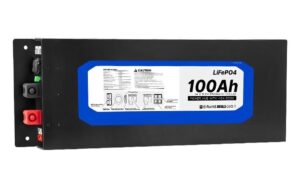
LINEX lists 100A maximum charge current for both the 12V 100Ah and 12V 200Ah models. The recommended charge current is 50A for the 100Ah and 100A for the 200Ah. A 100Ah bank at 50A is a 0.5C charge, inside the 0.3C to 0.5C range that MarineHowTo describes as comfortable for LFP.
The battery’s maximum is a ceiling, not a target. The alternator and its regulator set the actual current, and the alternator’s hot output is lower than its nameplate rating.
| Bank | Rated energy | 0.3C current | 0.5C current | Maximum charge current |
|---|---|---|---|---|
| 12V 100Ah | 1,280Wh | 30A | 50A | 100A |
| 12V 150Ah | 1,920Wh | 45A | 75A | 145A to 150A |
| 12V 200Ah | 2,560Wh | 60A | 100A | 100A |
Small-case alternators are not constant-duty rated
A small-case alternator is built for short bursts, not hours at full output. MarineHowTo’s author, an ABYC electrical systems specialist, writes that no small-case alternator can run at full output for three to four hours into an LFP load in a boat engine bay. Large-frame alternators are designed for continuous high output and handle LFP better.
If the engine has a small-case alternator, plan to derate it or add a DC-DC charger. A 165A small-case unit may fit the bracket, but its nameplate rating is not a promise of 165A for the length of a motor run.
Current limiting: set the field, not the voltage
External regulators such as Balmar’s use a feature called Belt Manager, formerly Amp Manager, to limit field current. Limiting the field caps alternator output. MarineHowTo recommends starting at level 3 or 4, then testing with the alternator at operating temperature.
The test is practical. Run the engine at cruise, load the alternator with an inverter or a depleted bank, and watch case temperature. If it climbs above 225°F (107°C), reduce the field further. The same source notes that fast idle is harder on the alternator than cruise because fan speed is low and cooling is poor.
Alternator temperature: keep the case below 225°F
MarineHowTo uses 225°F as the case temperature limit in its load-test procedure. An external regulator with an alternator temperature sensor can fold the output back before the case reaches that point. A standard internal regulator has no temperature input and no field control, so it cannot protect the alternator from a long LFP load.
The temperature sensor is the part that makes the system survivable on a long motor. Without it, the alternator keeps producing current until the winding or diodes fail.
A BMS disconnect can destroy the alternator
If the BMS opens the charge circuit while the alternator is producing current, the alternator sees a load dump. The voltage spike can damage its diodes and regulator. MarineHowTo calls this one of the biggest obstacles to LFP and recommends an alternator protection device from Balmar or Sterling Power, plus a regulator that shuts the field down before the BMS disconnects.
A quality BMS should signal charge sources before opening the main contactor. A drop-in battery with a FET BMS may not provide that signal. Ask for the disconnect sequence in writing before the bank goes into a boat with a high-output alternator.
DC-DC charging: the simpler route for most boats
A DC-DC charger sits between the start battery and the house bank. It takes alternator power at the start battery voltage and delivers a programmed LFP charge profile to the house bank. The alternator sees a moderate, stable load instead of the house bank’s full acceptance.
A 30A unit charges a 100Ah bank at 0.3C. A 50A unit charges a 200Ah bank at 0.25C. The trade is charging speed: a DC-DC charger will not use the alternator’s full output. It also isolates the house bank from the start battery, which protects the engine battery from a deep discharge.
Charge profile: 14.6V absorption, 13.5V to 13.8V float
LINEX lists 14.6V fast charging and 13.5V to 13.8V standby and float for the 12V models. The charger should hold 14.6V until the current tapers, then drop to float. Equalization and temperature compensation are lead-acid settings and should be off.
Charging stops below 0°C because the BMS blocks current. The charge window is 0°C to 50°C. A standard alternator regulator set for lead-acid may hold a lower absorption voltage, so check the setting before the bank is connected.
A worked example: 200Ah bank on a 100A alternator
A 200Ah bank at 50% state of charge needs about 100Ah to reach full. At a capped 50A, that is two hours of bulk charging plus about 30 minutes of absorption. At 80A, it is 1.25 hours plus absorption, but the alternator must hold 80A without exceeding 225°F.
| Charge current | 100Ah bank (50Ah to replace) | 150Ah bank (75Ah to replace) | 200Ah bank (100Ah to replace) |
|---|---|---|---|
| 30A | 1.7 h | 2.5 h | 3.3 h |
| 50A | 1.0 h | 1.5 h | 2.0 h |
| 80A | 0.6 h | 0.9 h | 1.25 h |
| 100A | 0.5 h | 0.75 h | 1.0 h |
Add about 30 minutes of absorption at 14.6V to each figure. The table assumes the charger can hold the current through the bulk stage and the alternator can sustain it without overheating.
A 100A alternator running at 80A is at 80% of its nameplate rating, which is a lot to ask from a small case. The safer setup is a 50A limit and a longer motor run, or a 50A DC-DC charger. A 200Ah bank at 50A is a 0.25C charge, which is gentle on the bank and still replaces 100Ah in two hours.
Cable size for 50A over a 10m round trip
A 50A charge current over a 10m round trip at 12.8V needs about 23mm² of copper to keep voltage drop at 3%, so use 25mm² cable. At 80A the same run needs 50mm². A short 5m run to a nearby busbar can use 16mm² at 50A.
Fuse the cable at the battery end. Size the fuse from the cable’s ampacity table and the expected charge current, not from the alternator rating. A fuse that is too large protects the alternator and leaves the cable exposed.
Where this setup fits
The setup suits a 12V house bank charged by an engine alternator, from a 100Ah day boat to a larger bank built from several packs. For the battery side, see the 12V 150Ah LiFePO4 battery and the 12V lithium battery line. The marine battery application page covers house bank sizing and installation, and the trolling motor charging article covers the outboard charging case. A 48V bank needs a different alternator and regulator, so start with the 48V lithium battery line.
Frequently asked questions
Only with a programmable regulator and a current limit. A standard internal regulator has no alternator temperature input and no field control, so a direct connection can overheat the alternator and leaves no protection against a BMS load dump.
Less than the nameplate rating once it is hot. Rated output is measured at a specified speed and temperature, and the hot output in an engine bay is lower. Set the current limit by test, not by the badge on the alternator.
It is the simplest safe option for a standard alternator. An external regulator with alternator temperature sensing is better for a high-output system that can use the current. Both approaches need a charge profile that matches the LiFePO4 bank.
Yes, with the current capped around 50A to 80A and the case temperature held below 225°F. The bank accepts up to 100A, but the alternator cannot sustain its full rating for the length of the charge.
For the LINEX 12V models, hold 14.6V for absorption, then drop to 13.5V to 13.8V for float. Turn off equalization and temperature compensation, which are lead-acid settings.
The alternator sees a load dump, and the voltage spike can damage its diodes and regulator. Use an alternator protection device and a BMS that signals charge sources before it opens the circuit.
Sources: MarineHowTo, “DIY LiFePO4 Batteries On Boats” (author describes himself as an ABYC electrical systems specialist; small-case alternators are not constant-duty rated; no small-case alternator can run at full output for three to four hours into LFP; Belt Manager levels 3 to 4; 225°F case temperature test limit; fast idle is harder on the alternator than cruise; load dump and alternator protection devices; LFP charge acceptance of 0.3C to 0.5C, checked 2026-11-17); LINEX 12V 100Ah product page (100A maximum charge, 50A recommended, 14.6V fast charge, 13.5V to 13.8V float, 0°C to 50°C charging, checked 2026-11-17); LINEX 12V 200Ah product page (100A maximum charge, 100A recommended, checked 2026-11-17); LINEX 12V 150Ah product page (145A to 150A maximum charge, 72.5A to 75A recommended, checked 2026-11-17); LINEX marine battery application page; LINEX trolling motor charging article. Last updated 2026-11-17.