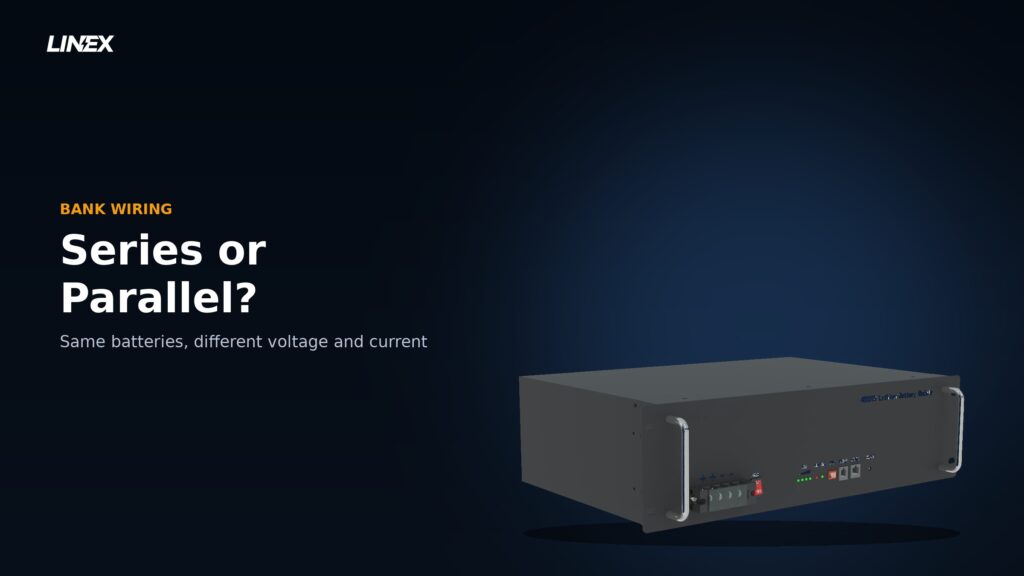
Series adds voltage and parallel adds current
A series connection joins the positive terminal of one battery to the negative terminal of the next. The voltages add, and the amp-hour capacity stays the same. A parallel connection joins positive to positive and negative to negative. The capacity adds, and the voltage stays the same. Both layouts double stored energy when the second battery is identical.
The 12V 100Ah datasheet lists “Maximum Continuous Discharge Current (A): 100”. Two units in series still pass the same current through both BMS units, so the bank limit stays 100A. Two units in parallel split the load, so the bank can deliver 200A. The voltage and current change in opposite directions.
| Configuration | Nominal voltage | Capacity | Rated energy | Continuous current | Continuous power |
|---|---|---|---|---|---|
| 1 x 12V 100Ah | 12.8V | 100Ah | 1,280Wh | 100A | 1,280W |
| 2 x 12V 100Ah in series | 25.6V | 100Ah | 2,560Wh | 100A | 2,560W |
| 2 x 12V 100Ah in parallel | 12.8V | 200Ah | 2,560Wh | 200A | 2,560W |
| 4 x 12V 100Ah in series | 51.2V | 100Ah | 5,120Wh | 100A | 5,120W |
| 4 x 12V 100Ah in parallel | 12.8V | 400Ah | 5,120Wh | 400A | 5,120W |
The table is arithmetic from the 12V 100Ah datasheet. It assumes every unit is the same model, at the same temperature, with a BMS that accepts the configuration. The 51.2V row is not a published LINEX configuration. Confirm the maximum series count with the factory before wiring four 12V units together.
Two 12V 100Ah batteries in series make a 25.6V bank
Two 12.8V batteries in series give 25.6V nominal, 100Ah and 2,560Wh. The charger needs 29.2V for the absorption stage, which is 2 x 14.6V from the 12V datasheet. Float charging sits at 27.0V to 27.6V, or 2 x 13.5V to 13.8V. A 12V charger cannot charge the string.
Series does not add capacity. A 24V 200Ah bank needs four 12V 100Ah units: two parallel strings of two series batteries. That is 2S2P, with 25.6V, 200Ah, 5,120Wh and 200A continuous. Each string carries 100A, and the two strings share the load.
The series string also has one more failure point than a single battery. If one BMS disconnects, the whole string goes open circuit. That is why matched units and a pre-assembly voltage check matter.
Two in parallel double runtime at 12.8V
Two 12V 100Ah batteries in parallel give 12.8V, 200Ah and 2,560Wh. Each unit keeps its own 100A limit, so the bank can deliver 200A continuous. The recommended charge current is 50A per unit, so a 100A charger is the right size for the pair. A 1,000W inverter draws about 78A at 12.8V before losses, which is 39A per battery when the pair shares the load.
Parallel keeps the system at 12V, so existing 12V loads, alternators and chargers stay in range. The cost is cable current. Twice the current needs a larger main cable, a larger busbar and a fuse on each string.
| Model | Rated energy | Max continuous discharge | Recommended charge current | Weight | Case (L x W x H) |
|---|---|---|---|---|---|
| 12V 100Ah | 1,280Wh | 100A | 50A | about 10kg | 332 x 172 x 218mm |
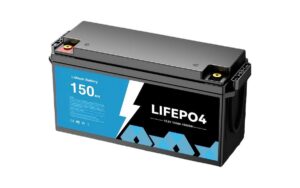
| 12V 150Ah | 1,920Wh | 150A | 75A | about 15kg | 483 x 170 x 240mm |
| 12V 200Ah | 2,560Wh | 100A | 100A | about 22kg | 524 x 245 x 220mm |
| 12V 300Ah | 3,840Wh | 150A | 100A | about 30kg | 523 x 269 x 222mm |
The 200Ah row is the one to read twice. It stores twice the energy of the 100Ah model but has the same 100A discharge limit. Two 100Ah units in parallel give 200A; one 200Ah unit gives 100A. Capacity and current are separate ratings.
Series strings need matched batteries and one charger profile
A series string works as one battery, so every unit has to match. Use the same model, similar age and the same state of charge. A 100Ah battery in series with a 150Ah battery has a smaller reserve, and its BMS reaches the low-voltage cutoff first. The string stops even though the larger unit still has charge.
Bring each unit to the same open-circuit voltage before connecting the string. A full battery and a half-full battery exchange current as soon as the circuit closes, limited only by cable resistance and BMS protection.
The charger profile is the sum of the unit profiles. For two 12V units, absorption is 29.2V and float is 27.0V to 27.6V. Charging temperature is 0°C to 50°C on the 12V line. Charging below 0°C is blocked by the BMS, so a cold installation needs a heater or a charger with low-temperature protection.
Parallel strings need equal cable lengths and a fuse per string
Use a common busbar and give every battery its own pair of cables, with the same gauge and length. Current divides in inverse proportion to resistance. A string with a longer cable carries less current, and the shorter string works harder. Over time the harder-working battery reaches its cycle limit first.
Do not daisy-chain the batteries. In a chain, the cable between the first two units carries the current of every unit downstream. The strings see different resistances, and the first battery works hardest.
Every parallel string needs its own DC breaker or fuse, sized above the unit’s continuous current and below the cable ampacity. One breaker on the busbar cannot isolate a faulted battery. The other batteries will feed a short circuit through it. The voltage drop and cable sizing guide covers the cable side, and the 48V parallel guide applies the same busbar rules to rack modules.
A native 24V battery removes the series compromise
The native 24V 100Ah LiFePO4 battery gives 25.6V, 100Ah, 2,560Wh and 100A in one 22kg case. It uses an 8S cell configuration and one BMS. Two 12V 100Ah units in series give the same voltage and energy, weigh about 20kg together, and add two BMS units plus the inter-battery cable.
The native pack is simpler to install and simpler to monitor. The trade is that a 24V pack cannot be split into two 12V batteries for a different vehicle or boat. Choose the native voltage when the system is fixed at 24V. Choose two 12V units when the batteries may be reused in a 12V system later.
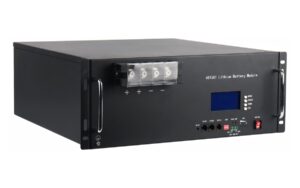
For 48V systems, the 48V 100Ah rack battery stores 4.8kWh in a 3U case and keeps one BMS per module. The 48V lithium battery line lists the full range. The BMS checklist covers the protection settings to confirm before either layout is ordered.
Commissioning checks before the first load
Record the open-circuit voltage of every unit before wiring. Connect the series links first, then the parallel strings, and check polarity at each step. Confirm the charger is set to the bank voltage, not the single-battery voltage. For a 24V string, that is 29.2V absorption and 27.0V to 27.6V float.
Close the string breakers one at a time. A spark or a large current surge points to a voltage mismatch or reverse polarity. Charge the bank to float, then apply a known load and measure the current in each parallel string with a clamp meter. A large difference points to a cable, lug or connection problem.
The 12V 100Ah LiFePO4 battery is the unit used in the examples above, and the 12V lithium battery line lists the 50Ah to 300Ah models. The 12V 200Ah model is the larger single-case option for a 12V bank.
Frequently asked questions
Yes, if both units are the same model, similar age and at the same state of charge, and the BMS is rated for the series connection. The result is 25.6V, 100Ah and 2,560Wh. Charge at 29.2V absorption and 27.0V to 27.6V float, and confirm the maximum series count with the factory first.
No. Series wiring adds voltage and keeps the amp-hour rating unchanged. Two 12V 100Ah batteries in series give 25.6V 100Ah. Parallel wiring keeps the voltage and adds the capacity.
No. A 100Ah and a 150Ah battery on the same bus hold the same voltage but do not share current evenly. The smaller battery reaches its BMS limit first and works harder. Use identical models, or use one larger battery if the bank needs more energy.
Use a 24V charger with a 29.2V absorption stage and a 27.0V to 27.6V float stage. Those figures are two times the 14.6V and 13.5V to 13.8V values on the 12V datasheet. Do not use a 12V charger on the series string.
Four 12V units in series give 51.2V nominal and 5,120Wh. LINEX does not publish a four-unit series rating for the 12V line, so confirm the maximum series count and BMS compatibility with the factory before building a 48V string. A native 48V rack module is the published alternative.
Sources: LINEX 12V 100Ah datasheet (12.8V, 100Ah, 1,280Wh, 4S, 100A continuous, 50A recommended charge, 14.6V fast charge, 13.5V to 13.8V float, 6,000 cycles at 25°C and 80% DoD, checked 2026-11-16); LINEX 12V 150Ah datasheet (1,920Wh, 150A, about 15kg, 483 x 170 x 240mm, checked 2026-11-16); LINEX 12V 200Ah datasheet (2,560Wh, 100A, about 22kg, 524 x 245 x 220mm, checked 2026-11-16); LINEX 12V 300Ah datasheet (3,840Wh, 150A, about 30kg, 523 x 269 x 222mm, checked 2026-11-16); LINEX 24V 100Ah datasheet (25.6V, 100Ah, 2,560Wh, 8S, 100A, about 22kg, checked 2026-11-16); LINEX 48V 100Ah rack datasheet (4,800Wh, 3U, 43kg, checked 2026-11-16); Wikipedia, Series and parallel circuits (voltage adds in series, current adds in parallel, checked 2026-11-16). Last updated 2026-11-16.