The current rating sets the load ceiling
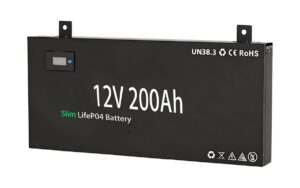
A BMS is rated by continuous current, and that number sets the largest inverter the pack can feed. At 12.8V, 100A is 1,280W DC. After 90% inverter efficiency, the AC ceiling is about 1,150W. A 2,000W inverter pulls about 156A at 12.8V at full efficiency, or about 174A after inverter losses, so a 100A board will disconnect before the load reaches full power.
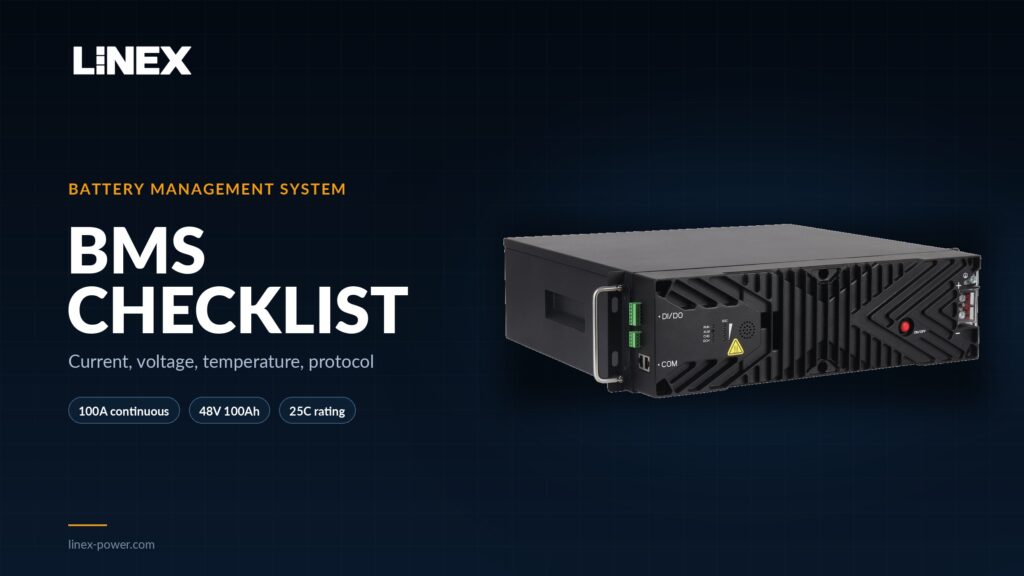
Voltage raises the ceiling. The 48V 100Ah telecom battery lists the same 100A board but runs at 48V, so it delivers 4,800W DC and about 4,320W AC. Capacity changes runtime, while voltage and current set the power the pack can deliver at any moment.
| Pack | Nominal voltage | BMS continuous current | DC power at nominal voltage | AC load at 90% inverter efficiency |
|---|---|---|---|---|
| 12V 100Ah | 12.8V | 100A | 1,280W | 1,150W |
| 12V 200Ah | 12.8V | 100A | 1,280W | 1,150W |
| 24V 100Ah | 25.6V | 100A | 2,560W | 2,300W |
| 48V 50Ah | 48V | 50A | 2,400W | 2,160W |
| 48V 100Ah | 48V | 100A | 4,800W | 4,320W |
| 48V 150Ah | 48V | 150A | 7,200W | 6,480W |
| 48V 200Ah | 48V | 100A | 4,800W | 4,320W |
Amp-hours do not set the current rating
The 12V 100Ah and 12V 200Ah packs both list a 100A continuous discharge rating. The 200Ah model doubles runtime at the same power, not the power itself. The pattern repeats at 48V: the 100Ah and 200Ah rack models both list 100A, while the 150Ah model lists 150A. The 48V 100Ah pack is a 4.8kWh unit, and the 48V 200Ah pack is a 9.6kWh unit, but both stop at 4,800W of DC output.
Buyers who size the BMS from the amp-hour number often order a 200Ah pack expecting 200A. They get a 100A board and a 4,800W ceiling at 48V. Read the current line on the exact model datasheet, then confirm the temperature it applies to. The 48V datasheets state 25°C for the current rating; ask for the same statement on a 12V quote.
Voltage thresholds must match the charger
A LiFePO4 BMS opens the charge path at a set cell voltage and opens the discharge path at a set low voltage. The charger has to use the same window. The 12V 100Ah pack charges at 14.6V, floats at 13.5V to 13.8V and protects the low end between 8.8V and 10V.
The 24V 100Ah pack uses 29.2V charge, 27.0V to 27.6V float and a 17.6V to 20V low-voltage window. The 48V telecom series uses 53.3V equalization, 51.0V float and 40.5V cutoff.
| Pack | Charge or equalization voltage | Float or standby voltage | Low-voltage protection |
|---|---|---|---|
| 12V 100Ah | 14.6V | 13.5V to 13.8V | 8.8V to 10V |
| 24V 100Ah | 29.2V | 27.0V to 27.6V | 17.6V to 20V |
| 48V telecom | 53.3V | 51.0V | 40.5V cutoff |
These are pack-level settings. Divide by the cell count when you compare cells: 14.6V across four cells is 3.65V per cell, and 53.3V across fifteen cells is 3.55V per cell. A charger set for a 16-cell pack will overcharge a 15-cell pack, even though both are sold as 48V. The 48V vs 51.2V comparison explains the difference, and the LiFePO4 voltage charts list the per-cell values behind these pack settings.
Temperature protection needs a charge cutoff at 0°C
Charging below 0°C damages a LiFePO4 cell, so the BMS must block charge current at the low-temperature limit. The 12V range lists 0°C to 50°C for charging and -20°C to 60°C for discharge. The 48V telecom range lists 0°C to 65°C for charge and -20°C to 65°C for discharge.
Ask for the charge cutoff temperature, not just the operating range. A pack that discharges at -20°C may still refuse to charge at -5°C, and that refusal protects the cells. Sites that need winter charging need a heated enclosure or a BMS with a heating control output, not a wider temperature claim.
Communication protocol decides inverter compatibility
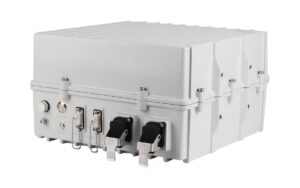
A 48V pack can pass voltage and current checks and still fail at commissioning if the inverter cannot read its state of charge. The standard LINEX 48V telecom packs list RS485 and RS232. The smart 48V 100Ah pack lists CAN and RS485.
CAN is a bus, not a protocol. Ask for the protocol document, the register map and the alarm list, then test the pair on a bench before the order. For a remote telecom site, the same data feeds the site controller, so a pack that reports voltage but not cell temperature is a poor fit.
Balancing and protection belong in the datasheet
Every 48V telecom datasheet lists over-temperature, over-current, short circuit and over-discharge protection. Balancing is the function buyers forget to ask about. A pack that balances keeps its cells aligned over hundreds of cycles; a pack without balancing lets the weakest cell set the cutoff.
Ask whether balancing is passive or active, at what voltage difference it starts and how much current it can move. A one-line answer is enough at the quotation stage. A supplier who cannot answer has not specified the board.
The BMS is not a fuse. A short-circuit trip protects the board, but the cable still needs a fuse or breaker sized for its ampacity. The inside a LINEX LiFePO4 battery page shows where the board sits in the assembly.
The order checklist fits on one page
A BMS order is a seven-line checklist, not a brand name. Use the table below to compare quotes, and ask for the datasheet that supports each line.
| Check | What to request | Red flag |
|---|---|---|
| Current | Continuous and peak rating in amps at 25°C | Only “100A” with no peak definition or temperature |
| Voltage | Charge, float and cutoff setpoints | Settings copied from a lead-acid sheet |
| Temperature | Charge and discharge range plus low-temperature cutoff | “Works in cold” with no cutoff number |
| Balancing | Passive or active, start voltage, current | No balancing statement |
| Communication | RS485, RS232 or CAN plus the protocol document | “Compatible with all inverters” |
| Protection | Over-temperature, over-current, short circuit, over-discharge | No model number or datasheet |
| Documentation | UN38.3 test summary naming the pack model, MSDS | Certificate in another company name |
Price comes after the seven lines. A cheaper 50A board will not run the 3kW inverter the project was sized around, and the mismatch appears at commissioning, not in the quote.
Frequently asked questions
Continuous is the current the board can carry for the full load period. Peak is a short burst with a time limit. Ask for both, plus the temperature they apply to. A rating without a temperature or a time window is incomplete.
No. A 2,000W inverter pulls about 174A at 12.8V after 90% inverter efficiency, and the board limits continuous current to 100A. Move to 24V, use two packs in parallel, or choose a pack with a higher current rating.
Not always. The LINEX 12V 200Ah and 48V 200Ah packs both list 100A continuous. The 48V 150Ah pack lists 150A. Read the current line on the datasheet for the exact model, not the capacity.
It opens the charge path and stops current. On a 12V pack the charge window starts at 0°C; below that the board should refuse charge. The event may clear when the pack warms up, but repeated cold charging shortens life.
Order the protocol the inverter documents, not the one with the longest feature list. Ask for the BMS protocol document and a bench test with that inverter model. Standard 48V packs list RS485 and RS232; smart 48V packs list CAN and RS485.
Sources: LINEX 12V 100Ah, 12V 200Ah, 24V 100Ah, 48V 50Ah, 48V 100Ah, 48V 150Ah and 48V 200Ah datasheets (voltage, current, temperature and cycle figures); LINEX smart 48V 100Ah datasheet (CAN and RS485); LINEX pole-mounted 48V 50Ah datasheet; calculated DC power = nominal voltage × continuous current, AC load = DC power × 0.90. Last updated 2026-10-28.
For the cells and assembly behind these boards, read what goes into a LINEX LiFePO4 battery. Importers comparing pack formats can start with lithium battery pack vs cells, and the lithium battery manufacturer in China guide covers factory checks beyond the BMS.