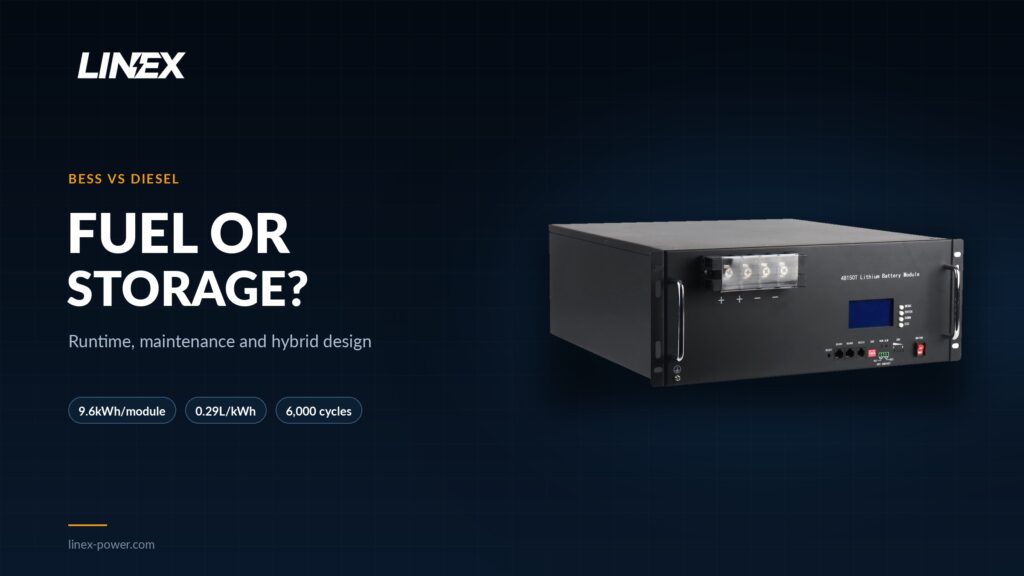
Energy and power: 9.6kWh per 48V 200Ah module
A 48V 200Ah LiFePO4 module stores 9.6kWh nominal and delivers 100A continuous at 25°C, which is 4.8kW at 48V. Two modules in parallel give 19.2kWh and 200A, or 9.6kW. At 80% depth of discharge, one module gives 7.68kWh before inverter losses.
The BESS side is modular. A 100Ah module is 4.8kWh and 100A; a 200Ah module doubles the energy but not the current. That matters when the load is a 10kW motor: the current rating sets the module count, not the kWh rating. The 48V hub lists 50Ah to 200Ah in the same rack format, with 2.4kWh to 9.6kWh per module.
| Module | Nominal energy (kWh) | Continuous current (A) | Continuous power at 48V (kW) | Usable at 80% DoD (kWh) | Weight (kg) |
|---|---|---|---|---|---|
| 48V 50Ah | 2.4 | 50 | 2.4 | 1.92 | 29 |
| 48V 100Ah | 4.8 | 100 | 4.8 | 3.84 | 43 |
| 48V 150Ah | 7.2 | 150 | 7.2 | 5.76 | 60 |
| 48V 200Ah | 9.6 | 100 | 4.8 | 7.68 | 78 |
Runtime at a fixed load favors the generator for long outages
A 9.6kWh BESS running a 2kW load delivers about 7.3kWh after 80% depth of discharge and 95% inverter efficiency, or about 3.6 hours. A 20kW diesel generator at 75% load produces 15kW and burns roughly 4.4L per hour at 0.29L per kWh, so a 100L tank lasts about 22 hours. The generator wins any outage longer than a day; the battery wins the first few hours without fuel.
The crossover moves with the load. At 5kW, one 200Ah module is current-limited to 4.8kW, so two modules are needed and they run about 2.9 hours. At 10kW, three modules cover the current with 14.4kW of continuous output, and four modules extend runtime to about 2.9 hours. The generator’s runtime scales with tank size rather than with the load in the same way.
| Load (kW) | BESS configuration | Usable energy (kWh) | BESS runtime (h) | Diesel fuel at 0.29L/kWh (L/h) | Fuel for 24h (L) |
|---|---|---|---|---|---|
| 2 | 1 x 48V 200Ah | 7.30 | 3.6 | 0.58 | 13.9 |
| 5 | 2 x 48V 200Ah | 14.59 | 2.9 | 1.45 | 34.8 |
| 10 | 4 x 48V 200Ah | 29.18 | 2.9 | 2.90 | 69.6 |
The fuel column assumes the generator is loaded at 50% to 75%. A 20kW set run at 2kW is at 10% load and should not be the design point.
Fuel and maintenance set the operating cost
The diesel side has two cost lines the battery does not: fuel and scheduled service. Fuel cost per delivered kWh is the diesel price per liter multiplied by 0.29 at the load the generator will actually carry. At 0.29L per kWh, a site that runs 10kWh per day burns about 2.9L per day. A typical oil and filter service interval of 250 to 500 running hours means four to eight services in a 2,000-hour year.
The battery side has a round-trip loss and a cycle limit. At 90% round-trip efficiency, 10kWh delivered needs about 11.1kWh from the grid. A 6,000-cycle pack at one cycle per day is rated for about 16 years. The operating cost is the grid tariff times 1.11, plus standby consumption. LINEX quotes project pricing by configuration, so compare the local tariff and the actual generator service contract rather than a list price. LINEX’s home-scale ESS vs generator article notes that “a generator needs fuel and maintenance across a 15-year life”, which is the part the battery avoids.
Response time and power quality differ by seconds
A hybrid inverter listed for backup duty typically transfers a backed-up load in under 20 milliseconds, so computers and routers ride through an outage without rebooting. A diesel generator needs 10 to 30 seconds to start, stabilize voltage and accept load. That difference matters for a data room, a point-of-sale system or a telecom site. It does not matter for a fridge or a sump pump.
The generator also has a minimum stable load. Running a 20kW set at 2kW is 10% load, which can cause wet stacking and incomplete combustion. A hybrid design runs the generator at 60% to 80% load to charge the battery, then shuts it down while the battery carries the load. That keeps the engine hot and cuts fuel use per delivered kWh.
Footprint and siting: 6U against a concrete pad
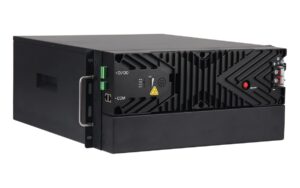
Two 48V 200Ah modules occupy 6U in a 19-inch rack, or 267mm of vertical space, and weigh 156kg together. A 20kW diesel generator needs a concrete pad, exhaust clearance, a fuel tank with secondary containment and an outdoor enclosure. The battery can sit in a plant room or cabinet. A generator cannot sit indoors without an exhaust and fuel arrangement.
A diesel generator at 20kW is typically 65dB to 75dB at 7m, which is why sites put it behind a wall or an acoustic enclosure. The enclosure adds cost and restricts airflow, so the siting decision belongs in the first layout. The battery has no combustion noise and no exhaust, but it still needs ventilation and a fire-rated location that meets local code.
Where the hybrid design fits
A generator that charges a battery is usually the stronger commercial design. A 20kWh BESS, built from two 48V 200Ah modules at 19.2kWh nominal, carries short outages and peak loads. A diesel set runs at 60% to 80% load for two hours a day to refill it. The generator’s running hours fall, fuel per delivered kWh falls, and the battery covers the seconds the generator needs to start.
For a telecom site, the same pattern uses a 48V rack and a rectifier. For a home or small shop, a wall-mounted 5kWh unit plus a 5kW generator covers a multi-day outage without running the generator overnight. The BESS vs generator decision starts with the load profile and the outage duration, not with the generator’s nameplate rating.
For the battery side, see the 48V lithium battery range and the 48V 200Ah battery. The home energy storage battery hub covers residential formats, and the ESS vs generator comparison covers the home-scale choice. For capacity math on larger sites, the BESS sizing article walks through the load and autonomy calculation.
Frequently asked questions
About 3.6 hours. The usable energy is 7.3kWh after 80% depth of discharge and 95% inverter efficiency, and 7.3 divided by 2 is 3.65.
About 0.29L per kWh at 35% engine efficiency. The figure comes from the diesel lower heating value of about 36MJ per liter and 3.6MJ per kWh. A generator running at part load uses more fuel per kWh, so the 0.29 figure assumes 50% to 75% load.
The BESS usually has the lower operating cost when outages are short and frequent, because it avoids fuel and engine service. The generator usually has the lower capital cost for multi-day runtime at high power. Compare the local diesel price, the service contract and the grid tariff over the same 10-year period.
Yes. A hybrid inverter or a dedicated charger can take generator power and charge the 48V bank. Run the generator at 60% to 80% load while charging, and size the charger at 0.2C to 0.3C of the bank. A 48V 200Ah bank wants 40A to 60A.
A LiFePO4 BESS has no fuel, oil or moving parts. It needs periodic inspection of connections, cooling and firmware, plus a capacity check every few years. The 6,000-cycle rating at 80% depth of discharge is about 16 years at one cycle per day.
Sources: LINEX 48V 100Ah product page (4.8kWh, 100A at 25°C, 43kg, 3U, 6,000 cycles, 53.3V equalization, 51.0V float, checked 2026-11-19); LINEX 48V 200Ah product page (9.6kWh, 100A at 25°C, 78kg, 482 x 610 x 178mm, 6,000 cycles, checked 2026-11-19); LINEX 48V battery hub (50Ah to 200Ah, 2.4kWh to 9.6kWh, weights and dimensions, checked 2026-11-19); LINEX Home Energy Storage Battery page (6,000 cycles, about 16 years at one cycle per day, 0.2C to 0.3C charger sizing, checked 2026-11-19); LINEX ESS vs Generator article (home-scale comparison, generator fuel and maintenance across a 15-year life, checked 2026-11-19); LINEX BESS sizing article (capacity method for lithium ion storage, checked 2026-11-19); Engineering ToolBox, Fuels – Higher and Lower Calorific Values (diesel lower heating value 42.6MJ/kg and 36.0MJ/L, checked 2026-11-19). Last updated 2026-11-19.