Sizing starts with daily kWh, not panel watts
Deep cycle batteries for solar are sized from the energy the house uses between charges. List every load, multiply watts by hours, and add the result. A 45W fridge running 10 hours at 50% duty draws 225Wh. Six 4W LED lights for five hours draw 120Wh, and a 60W laptop charger for three hours draws 180Wh. Those three loads total 525Wh, or 0.53kWh per day.
The array is sized after the load, not before it. A 400W panel that produces 1.6kWh on a good day at four sun hours can recharge a 1kWh daily load with margin. It cannot carry a 3kWh load without doubling. Write the daily kWh figure down before choosing a battery or a panel, because panel wattage says nothing about how long a cloudy spell the bank must survive.
Usable capacity is 80% of nameplate for LiFePO4
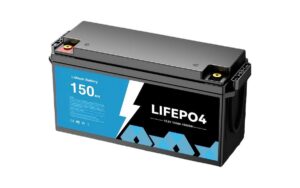
A 12V 100Ah LiFePO4 battery stores 1,280Wh. At 80% depth of discharge, 1,024Wh is usable before the BMS cuts off. The datasheet lists the cycle rating as “Cycle Life (25°C, 80% DoD): 6000”. The same label in lead-acid gives about 600Wh at 50% depth of discharge, because deeper cycles shorten plate life. The gap is why a 100Ah lithium block replaces a 100Ah lead-acid block with less weight and more runtime.
| Battery | Nominal energy | Usable at 80% DoD | Delivered AC at 90% inverter | Weight |
|---|---|---|---|---|
| 12V 100Ah | 1.28kWh | 1.02kWh | 0.92kWh | 10kg |
| 12V 200Ah | 2.56kWh | 2.05kWh | 1.84kWh | 22kg |
| 12V 300Ah | 3.84kWh | 3.07kWh | 2.76kWh | 30kg |
| 24V 100Ah | 2.56kWh | 2.05kWh | 1.84kWh | 22kg |
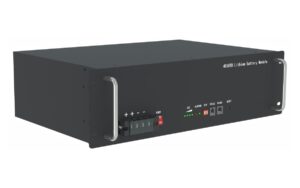
| 48V 100Ah | 4.80kWh | 3.84kWh | 3.46kWh | 43kg |
The 12V 200Ah and 24V 100Ah rows store the same energy. The 24V unit delivers it at half the current for the same power, so cable and fuse sizes fall. Above about 2kWh of daily load, 24V or 48V usually costs less to wire than a 12V bank of the same capacity.
Autonomy days multiply the bank before anything else
Autonomy is counted in days, and every extra day multiplies the bank. The bank stores daily kWh multiplied by autonomy days, divided by usable depth of discharge and inverter efficiency. A 2.4kWh daily load with two days of autonomy needs 2.4 × 2 ÷ (0.8 × 0.9) = 6.67kWh nominal. Add a 10% aging reserve and the figure is 7.41kWh.
| Daily AC load | 1 day | 2 days | 3 days | Example bank for 2 days |
|---|---|---|---|---|
| 1.2kWh | 1.9kWh | 3.7kWh | 5.6kWh | 3 × 12V 100Ah (3.84kWh) |
| 2.4kWh | 3.7kWh | 7.4kWh | 11.1kWh | 3 × 24V 100Ah (7.68kWh) |
| 4.8kWh | 7.4kWh | 14.8kWh | 22.2kWh | 2 × 48V 200Ah (19.2kWh) |
The table uses the same 0.648 overall derate as the worked example: 80% depth of discharge, 90% inverter efficiency and a 10% aging reserve. A site that needs three days of autonomy at 4.8kWh per day needs 22.2kWh of nameplate, which is a rack bank rather than a stack of 12V blocks.
Series adds voltage, parallel adds capacity
Four 12V 100Ah batteries in series make a 51.2V 100Ah bank with 5.12kWh. Four in parallel make a 12V 400Ah bank with 5.12kWh. Series wiring raises voltage and leaves capacity unchanged. Parallel wiring raises capacity and leaves voltage unchanged. Do not mix the two arrangements on one bank without a wiring diagram.
Use batteries of the same model, capacity and age. Fuse each parallel string separately and keep cable lengths equal so current splits evenly. The 12V 400Ah bank carries 400A at 1C, which is more than many 12V inverters accept. The 51.2V 100Ah bank carries the same energy at 100A and thinner cable. The parallel battery guide covers the fuse and cable rules for 48V banks.
Charge current between 0.1C and 0.5C keeps the bank healthy
The 12V 100Ah datasheet lists 20A standard charge, 50A recommended and 100A maximum. For a 100Ah battery, that is 0.2C, 0.5C and 1C. A solar array that delivers 30A is inside the recommended band. One that delivers 90A is legal but leaves little margin and heats the cells. Size the MPPT output to the battery, not only to the panel nameplate.
| System voltage | 400W array current | C-rate on 100Ah | 800W array current | C-rate on 100Ah |
|---|---|---|---|---|
| 12V | about 30A at 13.5V | 0.30C | about 59A at 13.5V | 0.59C |
| 24V | about 15A at 27V | 0.15C | about 30A at 27V | 0.30C |
| 48V | about 7A at 54V | 0.07C | about 15A at 54V | 0.15C |
The same 800W array is 0.59C on a single 12V 100Ah battery, 0.30C on a 24V 100Ah battery and 0.15C on a 48V 100Ah battery, because the same wattage produces less current at each higher voltage while the Ah rating stays at 100Ah. On a 12V 100Ah unit, an 800W array needs a controller that limits charge current to 50A. On a 48V 100Ah unit, the same array leaves room for a second battery in parallel.
A 2.4kWh/day cabin needs a 24V 300Ah bank
The worked example uses 2.4kWh per day, two days of autonomy, 80% depth of discharge, 90% inverter efficiency and a 10% aging reserve. Nominal capacity is 2.4 × 2 ÷ 0.648 = 7.41kWh. Three 24V 100Ah batteries give 7.68kWh nominal, 4.98kWh delivered, and 300A continuous when paralleled.
Recharge takes 1.2kW to 1.6kW of panels in a good-sun region. A 1.6kW array delivers about 59A at 27V, so a 300Ah bank at 20% state of charge needs about four hours to replace 240Ah, before the absorption taper. The bank accepts 300A across three units, so the array is the limit, not the BMS.
A 12V version of the same bank needs six 12V 100Ah batteries in parallel and about 118A of charge current at 13.5V. Both versions charge at roughly 0.2C, but the 24V bank uses half the current and smaller cable. That is the practical reason to move up in voltage once the bank passes about 5kWh.
Temperature and enclosure decide where the bank can sit
These 12V and 24V LiFePO4 models charge between 0°C and 50°C and discharge between -20°C and 60°C. The 48V rack model extends both ranges to 65°C at the top end. Charging below 0°C plates lithium and damages the cells, so a solar shed that drops below freezing needs the battery indoors, in an insulated box, or behind a BMS with a low-temperature cutoff. The IP65 rating covers dust and water jets, not condensation or direct sun.
Lead-acid needs a vented box because charging produces hydrogen. LiFePO4 does not vent hydrogen in normal operation, but the enclosure still needs room for cables, a breaker and airflow. Mount the battery on a surface that takes its weight: 10kg for the 12V 100Ah, 30kg for the 12V 300Ah, 43kg for the 48V 100Ah. A shelf rated for a 20kg lead-acid block may not carry two lithium units.
Frequently asked questions
One 12V 100Ah battery delivers about 0.92kWh at 80% depth of discharge and 90% inverter efficiency. For 1kWh per day with one day of autonomy, one unit is just short. Two units or a 12V 200Ah battery gives margin.
Above about 2kWh of daily load, 24V or 48V lowers current and cable size. Below that, a single 12V battery is simpler and needs one fuse, one breaker and one set of cables.
Not on one bank. The two chemistries need different absorption and float voltages, so one will be undercharged or overcharged. Use separate controllers with separate banks, or replace the whole bank at once.
These LiFePO4 batteries have a built-in BMS that cuts charge below 0°C and discharge at low voltage. A lead-acid bank does not, so its controller needs temperature compensation and a low-voltage disconnect.
About 20 hours at 0.92kWh delivered and a 45W continuous draw, or closer to 40 hours at 50% duty cycle. Hot weather raises the duty cycle and shortens both figures.
Yes, if the new units match the model, capacity and age, and the cabling and fuses are sized for the final count. Mixing a new battery with an old one in parallel makes the old unit work harder.
Sources: LINEX 12V 100Ah, 200Ah and 300Ah datasheets (1,280Wh, 2,560Wh and 3,840Wh; 100A to 150A maximum continuous discharge; 10kg, 22kg and 30kg; 6,000 cycles at 80% DoD; charge 0 to 50°C; discharge -20 to 60°C; IP65); LINEX 24V 100Ah datasheet (2,560Wh, 100A, 22kg); LINEX 48V 100Ah datasheet (4,800Wh, 100A, 43kg); LINEX 12V range page for series and parallel arrangements. Delivered AC figures assume 80% depth of discharge and 90% inverter efficiency. Last updated 2026-10-26.
For the battery range and model dimensions, see 12V lithium batteries from 10Ah to 300Ah and the 12V 100Ah LiFePO4 product page. The home energy storage battery page covers larger solar banks, and the lead-acid vs lithium cost comparison explains the replacement cadence behind the 80% depth of discharge figure.