Usable energy: 2,560Wh against 1,280Wh
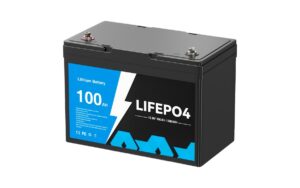
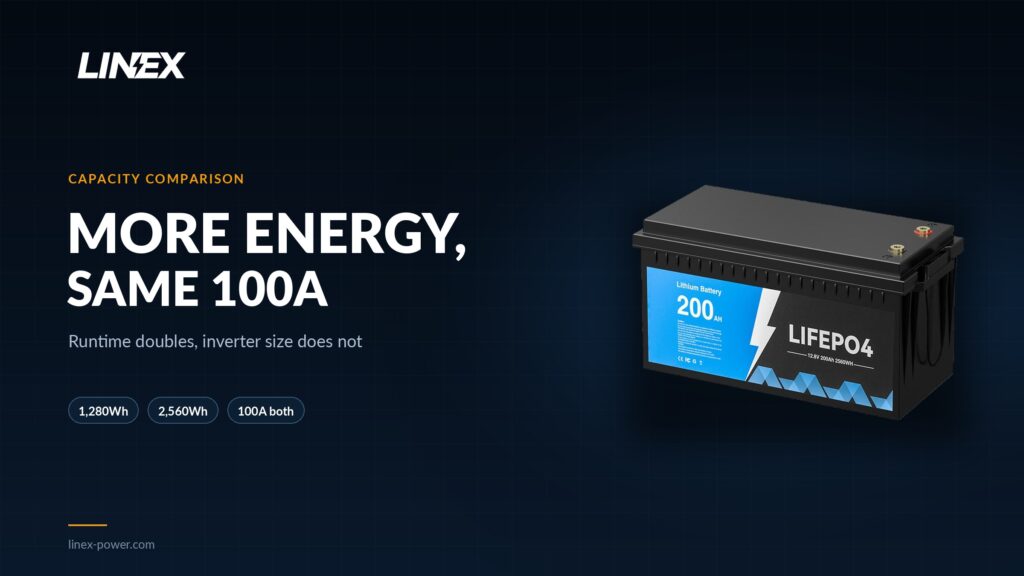
A 12V 200Ah LiFePO4 battery stores 2,560Wh. The 12V 100Ah model stores 1,280Wh. At 80% depth of discharge, the usable figures are about 2,048Wh and 1,024Wh. The larger pack doubles the energy in one box, and that is the first real difference between the two sizes.
Both models use a 4S cell configuration and a 12.8V nominal voltage. Case size and weight scale with capacity. The BMS current rating does not.
| Model | Rated energy | Usable at 80% DoD | Weight | Case size (LWH) |
|---|---|---|---|---|
| 12V 100Ah | 1,280Wh | 1,024Wh | about 10kg | 332 x 172 x 218mm |
| 12V 200Ah | 2,560Wh | 2,048Wh | about 22kg | 524 x 245 x 220mm |
Continuous output stays at 100A on both models
Both batteries list 100A maximum continuous discharge, which is 1,280W at 12.8V. The 200Ah model does not double the current limit. A 2,000W inverter draws about 185A after losses, so neither model runs it alone. Two units in parallel give 200A, or the system moves to 24V.
This is the most common surprise in a capacity comparison. Amp-hours tell you how long the battery lasts at a given current. The BMS rating tells you the largest current it can supply at all. A 200Ah pack with a 100A BMS is a long-run battery, not a high-power battery.
Runtime at the same load doubles, with one exception
The published runtime table doubles almost line for line. A 45W fridge runs 22 hours continuous on the 100Ah unit and 45 hours on the 200Ah unit. A 1,000W inverter runs about one hour and about two hours. The exception is any load above 100A, where both models stop.
| Load | Draw | Runtime on 100Ah at 80% DoD | Runtime on 200Ah at 80% DoD |
|---|---|---|---|
| LED lighting | 20W | 51 h | 102 h |
| 12V compressor fridge | 45W | 22 h continuous, about 45 h cycling | 45 h continuous, about 90 h cycling |
| Water pump | 60W | 17 h | 34 h |
| CPAP machine | 30W | 34 h | 68 h |
| 1,000W inverter | about 93A | about 1 h | about 2 h |
| Trolling motor | about 50A | about 1.6 h | about 3.2 h |
| 2,000W inverter | about 185A | Not supported | Not supported |
The runtime figures assume a new battery at 25°C and a load that does not exceed the BMS limit. Cold weather reduces usable capacity, and an inverter at full load adds heat and conversion loss. Treat the table as a planning baseline, then measure the actual load.
Weight and footprint: 22kg against 10kg
The 200Ah case weighs about 22kg and measures 524 x 245 x 220mm. The 100Ah case weighs about 10kg and measures 332 x 172 x 218mm. A 150Ah unit sits between them at about 15kg and 483 x 170 x 240mm, for buyers who need more energy without the 200Ah case length. Two 100Ah units weigh about 20kg, slightly less than one 200Ah, but they need two sets of cables, two fuses and a wider mounting area.
The single 200Ah box is easier to secure in one tray and simpler to wire. It is harder to lift into a locker and harder to replace alone. On a boat or a campervan, the access route often decides the choice before the energy math does.
Two 100Ah units match the energy, not the simplicity
Two 100Ah batteries in parallel give 200Ah, 2,560Wh and 200A continuous. That is more current than one 200Ah unit can deliver. The trade is wiring: matched units, equal cable lengths, a fuse per battery and a balanced busbar.
One 200Ah unit needs one set of cables and one BMS. For a locker with limited access, the single unit wins. For a system that may grow, two units allow a staged purchase and a smaller initial pack. Do not mix a new 100Ah with an old one in the same bank. Internal resistance and capacity drift apart, and the older unit carries less of the load.
Charging time: 200Ah takes twice as long at the same current
Both models accept up to 100A of charge current. The recommended current is 50A for the 100Ah and 100A for the 200Ah, so a 50A charger runs the smaller pack at 0.5C and the larger pack at 0.25C. From 50% state of charge, the 100Ah unit needs about one hour of bulk charging and the 200Ah unit about two hours. The absorption stage adds roughly 30 minutes at 14.6V.
A 100A charger halves both times but needs cable, fuses and a charger rated for the current. Charging stops below 0°C on both models because the BMS blocks current to protect the cells. The charge window is 0°C to 50°C, and the discharge window is -20°C to 60°C.
Sizing example: 1.5kWh per day
A boat or camper that uses 1.5kWh per day needs 1,875Wh of usable capacity at 80% depth of discharge. One 200Ah battery covers that with 173Wh spare. One 100Ah battery covers 1,024Wh, or about two thirds of a day.
Two days without charging need 3,750Wh. That is two 200Ah units or four 100Ah units, both at 4,096Wh usable. A 600W solar array in four peak sun hours produces about 2.4kWh before losses. The array covers a day of load but not two, so the bank size and the solar size have to be planned together.
Where the 200Ah model fits
The 200Ah size suits boats, campervans and small off-grid systems with a 1kWh to 2kWh daily load and room for a 524mm case. It does not suit engine starting, because the datasheet does not publish cold cranking ratings. It also does not replace a 2,000W inverter bank on its own, because the 100A limit caps output at 1,280W.
For the exact model, see the 12V 200Ah LiFePO4 battery. The smaller unit is on the 12V 100Ah LiFePO4 battery page. For the full range and parallel wiring, see the 12V lithium battery line. If you are converting the daily load from Ah to kWh, the Ah to kWh calculator handles 12V, 24V and 48V banks. The motorhome 200Ah comparison covers the same choice in a vehicle with limited locker space.
Frequently asked questions
It has twice the energy, not twice the power. Both LINEX models list 100A maximum continuous discharge, so the 200Ah pack runs the same load for about twice as long but cannot run a larger inverter on its own.
No. A 2,000W load draws about 185A at 12V, which is above the 100A continuous limit. Use two units in parallel for 200A, or move to a 24V or 48V bank with a higher current rating.
The LINEX 12V 200Ah model weighs about 22kg. The 12V 100Ah model weighs about 10kg, so two 100Ah units weigh about 20kg in total and need twice the connections.
No. Parallel banks should use the same model, capacity and approximate age. A mixed bank shares current unevenly because the two packs have different internal resistance, and the smaller unit can be overloaded or undercharged.
At 50A, a 200Ah battery at 50% state of charge needs about two hours of bulk charging plus roughly 30 minutes of absorption. At 100A the bulk stage drops to about one hour. The exact time depends on the charger, cable loss and temperature.
No. LINEX does not publish cold cranking ratings for these models, and they are sold for house banks and onboard loads. A starting battery needs a different cell and BMS design.
Sources: LINEX 12V 100Ah product page (12.8V, 100Ah, 1,280Wh, 100A maximum continuous discharge, 100A maximum charge, 50A recommended charge, about 10kg, 332 x 172 x 218mm, 6,000 cycles at 25°C and 80% DoD, IP65, checked 2026-11-17); LINEX 12V 200Ah product page (12.8V, 200Ah, 2,560Wh, 100A maximum continuous discharge, 100A maximum charge, 100A recommended charge, about 22kg, 524 x 245 x 220mm, 6,000 cycles at 25°C and 80% DoD, IP65, checked 2026-11-17); LINEX 12V 150Ah product page (12.8V, 150Ah, 1,920Wh, 145/150A maximum continuous discharge, 145/150A maximum charge, about 15kg, checked 2026-11-17); LINEX 12V lithium battery hub; LINEX Ah to kWh calculator. Last updated 2026-11-17.