Current halves when the bank moves from 24V to 48V
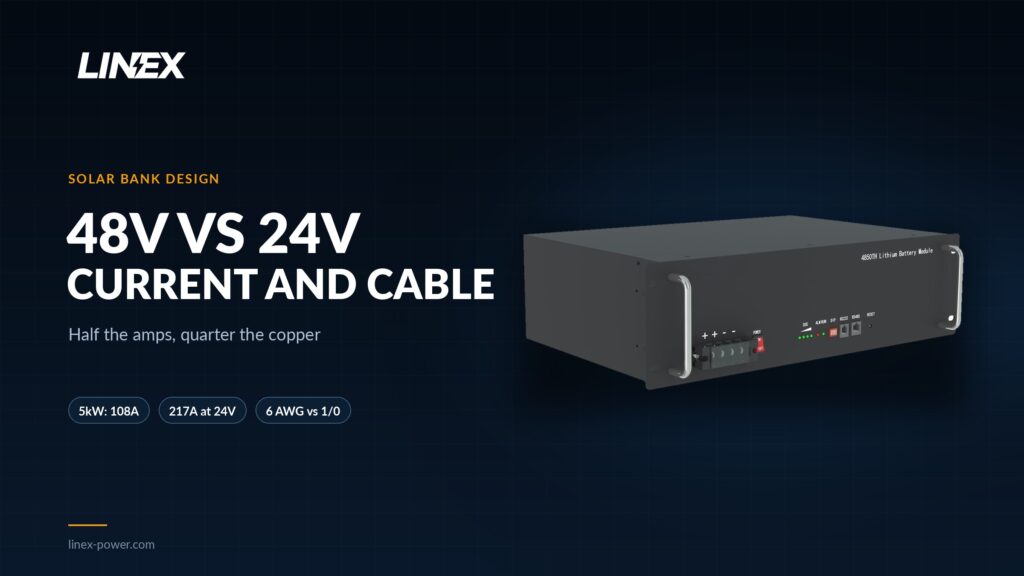
A 5kW load pulls about 108A from a 51.2V 48V bank and about 217A from a 25.6V 24V bank, assuming 90% inverter efficiency. The 48V pack uses 16 LiFePO4 cells in series and the 24V pack uses 8, so the voltage doubles and the current halves for the same power.
| Load | Current at 24V (25.6V) | Current at 48V (51.2V) | Ratio |
|---|---|---|---|
| 2kW | 86.8A | 43.4A | 2.0 |
| 3kW | 130.2A | 65.1A | 2.0 |
| 5kW | 217.0A | 108.5A | 2.0 |
| 8kW | 347.2A | 173.6A | 2.0 |
The currents use 25.6V and 51.2V, the nominal voltages of 8S and 16S LiFePO4 packs. The product datasheets rate the 48V modules at 48V nominal, which is why a 48V 100Ah module is listed as 4.8kWh rather than 5.12kWh. The current comparison is the same either way: double the voltage, half the amps.
Cable copper falls by about 75% at the same voltage drop
For a 3m one-way run at 2% voltage drop, a 5kW load needs about 44.5mm² of copper at 24V and about 11.1mm² at 48V. The formula is A = 2 × L × I × ρ / ΔV, with L in metres, I in amps, ρ = 0.0175 Ω·mm²/m for copper at 20°C, and ΔV = 2% of the nominal voltage. The factor 2 covers the positive and negative conductors.
| Load | 24V minimum copper | Nearest 24V size | 48V minimum copper | Nearest 48V size |
|---|---|---|---|---|
| 2kW | 17.8mm² | 4 AWG (21.2mm²) | 4.5mm² | 10 AWG (5.26mm²) |
| 3kW | 26.7mm² | 2 AWG (33.6mm²) | 6.7mm² | 8 AWG (8.37mm²) |
| 5kW | 44.5mm² | 1/0 AWG (53.5mm²) | 11.1mm² | 6 AWG (13.3mm²) |
| 8kW | 71.2mm² | 3/0 AWG (85.0mm²) | 17.8mm² | 4 AWG (21.2mm²) |
These are voltage-drop minimums, not a cable specification. Continuous ampacity, insulation temperature, bundling and local code can force a larger size. At 8kW, for example, 4 AWG is the voltage-drop answer at 48V, but 174A continuous will usually need a larger cable on ampacity alone. The 48V bank needs about a quarter of the copper area for the same loss, because losses scale with current squared.
One 48V pack covers loads that need two or three 24V packs
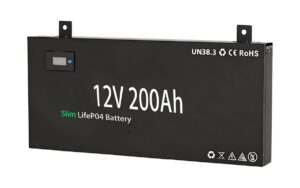
A 48V 100Ah module has a 100A continuous limit and delivers 4.8kW at 48V. A 24V 100Ah or 200Ah pack stops at 2.56kW, so a 3kW load needs two 24V packs but only one 48V 100Ah pack. The battery capacity and the BMS current are separate numbers, and the BMS often decides the pack count before the kWh does.
| Model | Rated energy | Max continuous current | Continuous power at nominal | Packs for 3kW | Packs for 5kW |
|---|---|---|---|---|---|
| 24V 150Ah | 3.84kWh | 100A | 2.56kW | 2 | 3 |
| 24V 200Ah | 5.12kWh | 100A | 2.56kW | 2 | 3 |
| 48V 100Ah | 4.8kWh | 100A | 4.8kW | 1 | 2 |
| 48V 150Ah | 7.2kWh | 150A | 7.2kW | 1 | 1 |
| 48V 200Ah | 9.6kWh | 100A | 4.8kW | 1 | 2 |
The pack counts assume 90% inverter efficiency and a continuous load, not a surge. A 5kW load pulls 108.5A at 51.2V, just above the 100A limit of the 48V 100Ah and 200Ah modules, so those need two units. The 48V 150Ah module lists a 150A limit and covers 5kW on its own. On the 24V side, the same load splits into 72A per pack only with three 200Ah units.
The 48V 200Ah row shows why the datasheet matters. It stores 9.6kWh, twice the energy of the 100Ah module, but its “maximum charge / discharge current” is still 100A. A larger case does not always mean a larger BMS.
The charge controller sees the same current split
A 3kW solar array charging a 48V bank sends about 59A into the battery, while the same array at 24V sends about 117A. The array power is the same; the battery voltage sets the output current. That current decides the MPPT rating, the cable from the controller to the bank, and how many controllers the system needs.
At 3kW, a 48V bank can use one 80A MPPT with margin, while a 24V bank needs a 120A or 150A controller, or two 60A units in parallel. At 5kW, the 48V side needs about 98A and the 24V side about 195A. A 100A controller covers the 48V case; the 24V case needs two 100A controllers or a single unit rated for the full current.
The charge voltage also changes. A 48V LiFePO4 solar bank uses a typical absorption range of about 56.8V to 58.4V, and a 24V solar bank uses about 28.4V to 29.2V, according to the battery voltage chart. The controller must be set for the actual pack configuration, not just the label on the inverter.
Cost shifts from copper to electronics
The battery cost per kWh is close between 24V and 48V LiFePO4, but the 48V bank usually spends less on cable, breakers and combiners and more on the inverter and charge controller. At 3kW and above, the saving in copper and the reduction in pack count often outweigh the higher cost of a 48V inverter. At 2kW, a 24V inverter and a single 24V 100Ah pack can be the lower-cost build.
The comparison only works on a full bill of materials. A battery quote alone hides the cable, fuse, breaker, combiner, controller and labour lines. Ask for a quote with each line item, and compare the same load, cable length and backup time on both voltages. The factory prices 24V and 48V packs by configuration, so the battery line should be quoted for the actual model and quantity, not a generic per-kWh figure.
Enclosure and temperature decide the outdoor case
The 24V 150Ah and 200Ah packs carry IP65 cases, while the standard 48V 100Ah rack module lists IP20 and needs a dry cabinet. The 48V 150Ah and 200Ah modules use the same rack format, so plan a cabinet or power room for them as well. That difference matters for an outdoor solar site. A 24V pack can sit in a weatherproof battery box near the array, while a 48V rack module needs a cabinet, a shed or an indoor power room with ventilation.
The 48V pole-mounted 50Ah model is the exception: it carries an IP65 case and 2.4kWh, which suits a small remote load. For a larger outdoor bank, the enclosure cost belongs in the 48V column. The 24V IP65 case avoids that cost but limits the bank to the 50Ah to 200Ah models.
Both voltage classes share the same charging boundary. The 24V models charge from 0°C to 50°C and discharge from -20°C to 60°C. The 48V rack modules charge from 0°C to 65°C and discharge from -20°C to 65°C. Neither accepts charge below 0°C, so a cold site needs a heated enclosure or a charge window above freezing.
Which bank voltage fits which solar site
Use 24V when the inverter is under 3kW, the cable run is short, and one or two 24V packs fit the space. Use 48V when the inverter is 3kW or larger, the cable run is long, or the bank needs rack modules and a dry cabinet.
| Site | Bank | Why |
|---|---|---|
| Cabin, 2kW inverter, 3m cable run | 24V | One 24V 100Ah pack at 87A, lower-cost inverter |
| Home backup, 3kW inverter | 48V | One 48V 100Ah pack at 65A, half the cable |
| Home backup, 5kW inverter | 48V | One 48V 150Ah pack at 108A, 6 AWG against 1/0 AWG |
| Off-grid shop, 8kW inverter | 48V | 174A against 347A, 4 AWG against 3/0 AWG |
| Outdoor box, 2.4kWh load | 48V pole 50Ah | IP65 case, small remote load |
| Tight budget, 2kW load | 24V | Fewer electronics, one 24V 100Ah pack |
The 48V lithium battery for solar page covers bank sizing from nightly kWh, and the 24V vs 48V battery page covers the general voltage choice. The solar power battery storage page covers the array, controller and bank as one system. The 48V 100Ah product page and 48V 150Ah product page carry the full datasheets, and the 24V 200Ah product page shows the 100A limit on the 24V side. For cable sizing beyond the 3m example, the voltage drop and cable sizing guide covers 12V, 24V and 48V banks.
Frequently asked questions
It halves the current, and the copper area for the same voltage drop falls by about 75%, not 50%. At 5kW and a 3m run, the calculated minimum is about 44.5mm² at 24V and 11.1mm² at 48V. Check ampacity separately, because a cable that meets the voltage-drop target can still be too small for continuous current.
Only with identical units, an external balancer and BMS units that support series connection. Most 24V deep-cycle packs are designed for parallel expansion, not series. A native 48V pack avoids the balancing problem and keeps one BMS in control of all 16 cells.
No. The charge controller’s battery voltage range must cover the 48V pack’s absorption voltage, which is about 56.8V to 58.4V. A controller rated only for 12V and 24V will not charge a 48V bank. Check the PV input range as well, because a 48V bank often pairs with a higher-voltage array.
Both are low-voltage DC systems, and both need correct insulation, fuses, breakers and disconnects. A 48V bank carries more energy and can sustain a longer arc, so the DC protection devices must be rated for 48V and for the available fault current. The shock risk remains low compared with AC mains.
A 48V system usually has the lower total bill at 5kW. One 48V 150Ah pack covers the load, and the cable and breaker sizes are smaller than a three-pack 24V bank. The exact difference depends on inverter, controller, enclosure and cable length, so compare a full quote rather than a battery price per kWh.
Sources: LINEX 48V 100Ah product page (48V, 100Ah, 4.8kWh, 100A maximum charge and discharge, 43kg, 442 × 420 × 133mm, 3U rack, IP20, 6,000 cycles, checked 2026-11-27); LINEX 48V 150Ah product page (48V, 150Ah, 7.2kWh, 150A maximum charge and discharge, 60kg, 482 × 440 × 178mm, checked 2026-11-27); LINEX 48V 200Ah product page (48V, 200Ah, 9.6kWh, 100A maximum charge and discharge, 78kg, 482 × 610 × 178mm, checked 2026-11-27); LINEX 24V 150Ah product page (25.6V, 150Ah, 3.84kWh, 100A maximum continuous discharge, checked 2026-11-27); LINEX 24V 200Ah product page (25.6V, 200Ah, 5.12kWh, 100A maximum continuous discharge, checked 2026-11-27); LINEX 48V pole-mounted 50Ah page (2.4kWh, IP65, checked 2026-11-27); LINEX battery voltage charts (24V 8S and 48V 16S, absorption and float ranges, checked 2026-11-27); LINEX 48V lithium battery for solar page (bank sizing and 48V inverter window, checked 2026-11-27); Wikipedia Electrical resistivity and conductivity (copper resistivity 1.68 × 10⁻⁸ Ω·m at 20°C, checked 2026-11-27); Wikipedia American wire gauge (cross-sectional areas for AWG sizes, checked 2026-11-27). Last updated 2026-11-27.