A flooded 100Ah block gives about 600Wh per cycle at 50% depth of discharge
A 12V 100Ah flooded lead-acid battery stores 1,200Wh at its nominal voltage, and half of that is usable on a routine basis: about 600Wh. The 50% limit is a service-life rule, not a hard chemical wall. Trojan’s T-105 datasheet lists 225Ah at the 20-hour rate and 1.50kWh of energy for a 6V block, so a pair in series gives 12V 225Ah and 2.7kWh, with about 1.35kWh usable at 50% depth of discharge.
A flooded lead acid marine battery usually costs less per amp-hour at the counter than an AGM or lithium block. It is also the one that needs water, ventilation and equalization. Those tasks are the reason a marine or RV total cost calculation cannot stop at the purchase price.
Marine and RV duty cycles set the replacement count
A flooded deep-cycle block is commonly rated 300 to 500 cycles at 50% depth of discharge. Battery University’s lead-acid summary lists 150 to 200 cycles at full depth for deep-cycle lead-acid, and cycle life rises as depth falls. The duty pattern decides how quickly those cycles are used.
| Duty pattern | Cycles per year | Years per block at 300 to 500 cycles | Blocks in 10 years |
|---|---|---|---|
| Weekend sailor | 50 | 6.0 to 10.0 | 1 to 2 |
| Seasonal RV | 100 | 3.0 to 5.0 | 2 to 3 |
| Full-time cruiser | 250 | 1.2 to 2.0 | 5 to 8 |
| Liveaboard | 365 | 0.8 to 1.4 | 7 to 12 |
A weekend sailor at 50 cycles a year may replace one block in ten years, while a liveaboard at 365 cycles a year needs 7 to 12. The same battery, the same price and the same label produce two different budgets. That is why a TCO comparison without an annual cycle count is not a comparison.
Watering, equalizing and ventilation are labor, not trivia
Flooded lead-acid needs water. Battery University’s charging guide says a new battery should be checked every few weeks to estimate the watering interval, and the plates must never be exposed. Trojan’s T-105 datasheet specifies a HydroLink watering system and warns: “Do not install or charge batteries in a sealed or non-ventilated compartment.”
The labor adds up. A weekend sailor may check water monthly and equalize quarterly. A liveaboard may check every two to four weeks and equalize monthly. Each task takes time, and a missed watering leaves the top of the plates exposed, which permanently reduces capacity.
| Task | Flooded lead-acid | LiFePO4 |
|---|---|---|
| Water level | every 2 to 4 weeks in heavy use, monthly in light use | none |
| Terminal cleaning | every 3 to 6 months | every 12 months |
| Equalization | monthly to quarterly | not applicable |
| Specific gravity | monthly | not applicable |
| Ventilation | hydrogen, vented compartment | none |
| Charge profile | 14.4V to 14.8V absorption, 13.5V to 13.6V float | 14.6V absorption, 13.5V to 13.8V float |
The charge profile is part of the labor. A flooded bank needs a three-stage charger with an equalize mode, and the equalize voltage can reach 16.2V on a 12V system, according to Trojan’s T-105 settings. A lithium pack does not use equalize, and its BMS blocks charge below 0°C. The charger and the battery have to match.
Weight and space change the boat or RV budget
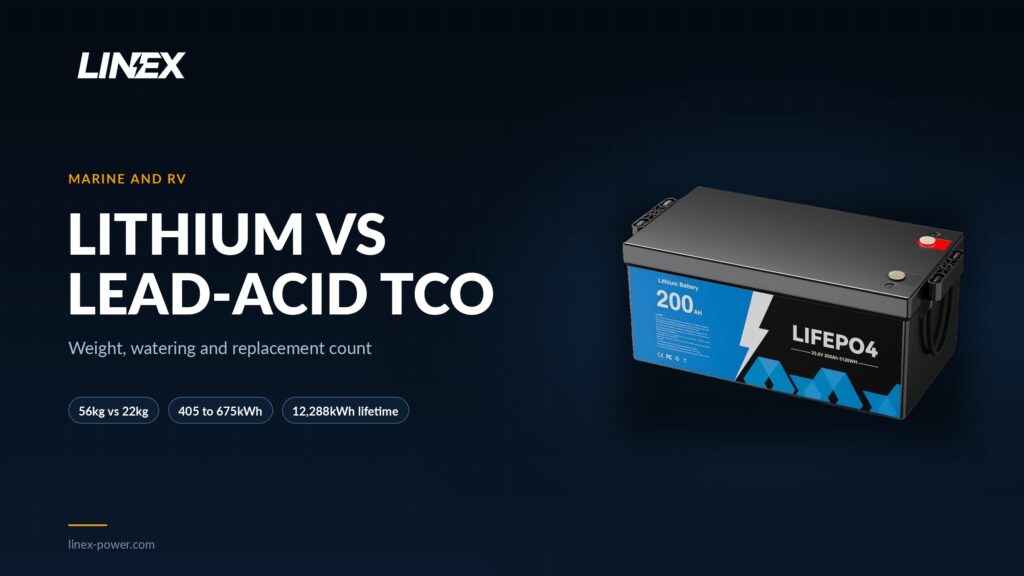
Two Trojan T-105 blocks weigh 56kg and occupy a footprint of 524mm × 181mm × 283mm when placed side by side. A 12V 200Ah LiFePO4 pack weighs about 22kg and measures 524mm × 245mm × 220mm. The lithium pack stores 2,560Wh nominal against 2,700Wh for the flooded pair, and delivers 2,048Wh usable at 80% depth of discharge against 1,350Wh for the flooded pair at 50%.
| Bank | Flooded T-105 pair | LiFePO4 12V 200Ah |
|---|---|---|
| Nominal energy | 2,700Wh | 2,560Wh |
| Usable per cycle | 1,350Wh at 50% DoD | 2,048Wh at 80% DoD |
| Weight | 56kg | about 22kg |
| Footprint | 524 × 181 × 283mm | 524 × 245 × 220mm |
| Watering | monthly | none |
| Charge efficiency | about 90% | above 99% |
The weight difference is 34kg for a 200Ah bank. On a 40ft sailboat, that is payload that can go into water, fuel or gear. On a travel trailer, it is tongue weight and tow vehicle load. The space difference is smaller, but the flooded pair is taller and needs a ventilated box with room to open the caps.
Charge efficiency favors lithium by about 10 points
Lead-acid coulombic efficiency is about 90%, against more than 99% for lithium-ion, according to Battery University’s efficiency summary. A flooded bank therefore needs about 10% more energy from the alternator, shore charger or solar array than it delivers to the load. The loss shows up as longer charging runs and more fuel or generator time.
The charging window also differs. Flooded lead-acid accepts charge below 0°C, which is an advantage in a cold climate, but it needs a full absorption stage and periodic equalization. LiFePO4 charges from 0°C to 50°C on the 12V models, and the BMS blocks charge below 0°C to prevent lithium plating. A cold boat locker needs a heated battery or a charge window above freezing.
The TCO formula: price ÷ (usable kWh × cycles)
Total cost of ownership equals the purchase price plus replacements, labor, charging energy and disposal, divided by usable kWh delivered. The cycle term dominates. The flooded T-105 pair delivers 405kWh to 675kWh over its rated life at 50% depth of discharge. A 12V 200Ah LiFePO4 pack delivers 12,288kWh at 80% depth of discharge and 6,000 cycles.
| Metric | Flooded T-105 pair | LiFePO4 12V 200Ah |
|---|---|---|
| Usable energy per cycle | 1,350Wh | 2,048Wh |
| Rated cycles | 300 to 500 at 50% DoD | 6,000 at 80% DoD |
| Lifetime delivered energy | 405 to 675kWh | 12,288kWh |
| Blocks at daily cycling, 10 years | 7 to 12 | 1 |
| Weight per block | 56kg | about 22kg |
| Charge efficiency | about 90% | above 99% |
The lithium pack can cost 18 to 30 times more than the flooded pair and still break even per delivered kWh, before labor, watering and weight savings. At a lower multiple, which is common in 2026 quotes, the lithium pack is ahead on energy cost alone. At a higher multiple, the flooded pair can still win on purchase price for a low-cycle boat.
When flooded lead-acid still makes sense on a boat or RV
Flooded lead-acid still makes sense when the annual cycle count is low, when the boat or RV already has a three-stage charger with an equalize mode, and when the owner can reach the caps for watering. A seasonal boat that leaves the dock 20 times a year may never wear out a flooded bank before calendar aging sets in.
It also makes sense when the installation can vent hydrogen safely and when the extra 34kg is not a problem. A cheap flooded bank with a good charger can deliver years of service at low cycle counts. The case for lithium grows with daily cycling, deep discharges, limited weight capacity and a wish to stop watering.
Five numbers to request before a marine or RV quote
Ask for cycle life at 50% depth of discharge, usable energy at that depth, weight, case dimensions and the charge voltage window. Those five numbers decide the replacement count and the installation cost. A quote that gives only the amp-hour label and a price cannot support a TCO comparison.
| Datasheet field | Why it changes the marine or RV TCO |
|---|---|
| Cycle life at 50% DoD | Sets the replacement count |
| Usable energy at 50% DoD | Sets runtime per cycle |
| Weight | Sets payload, tongue weight and freight |
| Case dimensions | Sets locker or bay fit |
| Charge voltage window | Sets charger and alternator cost |
For the lithium side, the 12V 200Ah LiFePO4 product page lists the pack data used above, and the 12V lithium battery range covers the 100Ah, 150Ah and 200Ah cases. The marine and boating application page shows how the bank size changes for a boat, and the RV and van life page covers campervan and travel trailer installations. For the AGM-specific version of the same cost calculation, the deep cycle AGM battery ten-year cost guide runs the numbers on sealed lead-acid.
Frequently asked questions
Over ten years of daily cycling, usually yes. A flooded pair delivers 405kWh to 675kWh over its rated life, while a 12V 200Ah LiFePO4 pack delivers 12,288kWh. The lithium pack can cost 18 to 30 times more and still break even per delivered kWh, before labor and weight savings.
Check every two to four weeks in heavy use and monthly in light use. Battery University’s charging guide recommends checking a new battery every few weeks to establish the interval, and the plates must stay covered. Top up with distilled water after charging, not before.
Yes, if the charger, alternator and DC-DC converter are set for lithium. A 12V LiFePO4 pack needs 14.6V absorption and 13.5V to 13.8V float, and it blocks charge below 0°C. The flooded bank’s equalize mode must be disabled, and the cable and fuse sizes must match the new current limit.
Charging produces hydrogen gas, and the Trojan T-105 datasheet warns against installing or charging the battery in a sealed or non-ventilated compartment. A vented box with an opening at the top and bottom keeps the gas below the explosive range. AGM releases less gas but still needs a vented space.
A 12V 200Ah LiFePO4 pack weighs about 22kg, against 56kg for a pair of Trojan T-105 blocks with similar nominal energy. The swap saves about 34kg per 200Ah bank. A 400Ah bank saves about 68kg, before tray and cable changes.
Only if the existing charger cannot be set to 14.6V absorption and 13.5V to 13.8V float, or if it runs an equalize or desulfation cycle. Those modes overcharge lithium cells. A charger with a lithium profile and a temperature sensor at the battery is the correct match.
Sources: LINEX 12V 200Ah LiFePO4 product page (12.8V nominal, 200Ah, 2,560Wh rated, 2,048Wh usable at 80% DoD, 100A maximum continuous discharge, 6,000 cycles at 25°C and 80% DoD, about 22kg, 524 x 245 x 220mm); LINEX 12V 100Ah LiFePO4 product page (1,280Wh, 1,024Wh usable at 80% DoD, 6,000 cycles, about 10kg); LINEX 12V lithium battery range; LINEX marine and boating application page; LINEX RV and van life application page; LINEX deep cycle AGM battery ten-year cost guide; Trojan T-105 product page (6V, 225Ah at 20-hour rate, 1.50kWh, 62 lb / 28kg, 10.30 x 7.13 x 11.15 inches / 262 x 181 x 283mm); Trojan T-105 datasheet (bulk 14.82V, float 13.50V, equalize 16.20V on a 12V system, HydroLink watering, do not install or charge in a sealed or non-ventilated compartment); Battery University BU-214 (deep-cycle lead-acid 150 to 200 cycles at full depth, specific energy 20 to 30Wh/kg); Battery University BU-808c (lead-acid coulombic efficiency about 90%, lithium-ion above 99%); Battery University BU-403 (lead-acid three-stage charging, watering checks every few weeks, hydrogen ventilation); Battery University BU-201a (AGM 80% depth of discharge, flooded specified at 50% for the same cycle life). Calculated values: 12V x 100Ah = 1,200Wh; 50% of 1,200Wh = 600Wh; 2 x 6V x 225Ah = 2,700Wh; 2,700Wh x 50% = 1,350Wh; 1,350Wh x 300 and 500 cycles = 405kWh and 675kWh; 2,048Wh x 6,000 cycles = 12,288kWh; 2 x 28kg = 56kg; replacement counts from 3,650 days divided by 300 and 500 cycles. Last updated 2026-11-06.