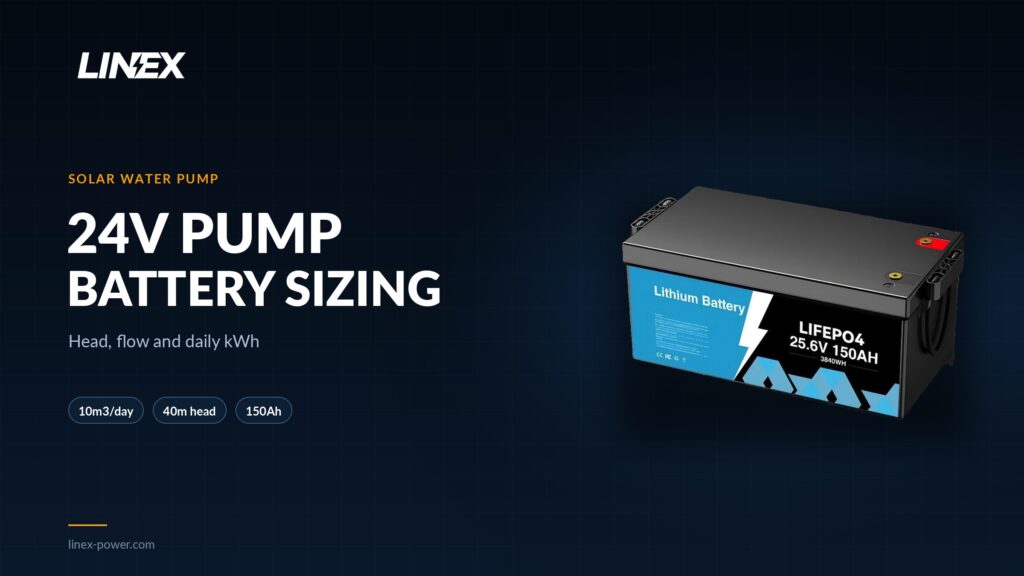
Battery sizing starts with daily water volume and total head
A 24V battery for a solar water pump is sized in four steps: daily water volume, total head, pump efficiency and daily electrical energy. For 10m3 per day at 40m total head, the hydraulic work is 1.09kWh. At 45% wire-to-water efficiency the pump draws 2.42kWh, and a 10% allowance for the controller brings the battery load to 2.66kWh. One 24V 150Ah pack provides 3.07kWh at 80% depth of discharge, so it covers one pumping day with margin.
The order matters. Starting from a battery label or a pump wattage produces a system that either runs dry by noon or carries capacity nobody uses. Starting from cubic meters per day and head produces an energy number that the array and the battery can both be checked against.
Hydraulic power is flow times head divided by 367
Hydraulic power in kW equals flow in cubic meters per hour multiplied by total head in meters, divided by 367. The divisor comes from water density, gravity and unit conversion: 1000 kg/m3 times 9.81 m/s2, divided by 3.6 million joules per kWh. The Engineering ToolBox pump power page puts it plainly: “the ideal hydraulic power to drive a pump depends on the mass flow rate, the liquid density, the differential height.”
A pump moving 2m3/h against 40m therefore delivers 0.22kW of hydraulic power. That is the work done on the water, before motor, pump and controller losses. The 367 shortcut is accurate for water at normal temperatures and is easier to use in the field than the full formula.
| Daily water | Flow over a 5-hour window | Hydraulic power at 40m | Pump input at 45% efficiency | Daily electrical energy |
|---|---|---|---|---|
| 5m3 | 1m3/h | 0.11kW | 0.24kW | 1.21kWh |
| 10m3 | 2m3/h | 0.22kW | 0.48kW | 2.42kWh |
| 20m3 | 4m3/h | 0.44kW | 0.97kW | 4.84kWh |
| 30m3 | 6m3/h | 0.65kW | 1.45kW | 7.25kWh |
The table assumes the pump runs for five hours. A shorter window raises the flow and the pump power for the same daily volume. A longer window lowers both, which usually means a smaller pump, a smaller array and a smaller battery.
Total head includes drawdown, friction and discharge height
Total head is the sum of static lift, drawdown, pipe friction and discharge height. A well with a 28m static water level, 5m of drawdown, 5m of pipe and fitting loss, and a tank inlet 2m above the pump discharge has 40m of total head. The well depth may be 60m, but the pump only lifts water 40m in this example.
| Head component | Example value | How to measure it |
|---|---|---|
| Static lift | 28m | Water level to the highest discharge point |
| Drawdown | 5m | Pumping water level minus static level |
| Pipe and fitting friction | 5m | Supplier table for pipe size, flow and fittings |
| Discharge height | 2m | Outlet above the pump or tank inlet |
| Total head | 40m | Sum of the four lines |
Drawdown is the component most often left out. A well that stands at 28m can pull down to 33m after an hour of pumping, and the pump has to lift from the lower level. Friction rises with flow to the power of 1.852 in the Hazen-Williams relation, so a pipe that is fine at 2m3/h can add several meters of head at 4m3/h. Use the supplier’s friction table for the actual pipe diameter and fitting count.
Pump efficiency turns hydraulic kWh into battery kWh
Wire-to-water efficiency decides how much electrical energy the pump needs for a given hydraulic duty. At 45% efficiency, 1.09kWh of hydraulic work needs 2.42kWh at the pump terminals. At 35% it needs 3.11kWh, and at 55% it needs 1.98kWh. The difference between a poor match and a good one is more than a third of the battery.
| Wire-to-water efficiency | Electrical energy for 10m3 at 40m | Current at 25.6V over 5 hours |
|---|---|---|
| 35% | 3.11kWh | 24.3A |
| 45% | 2.42kWh | 18.9A |
| 55% | 1.98kWh | 15.5A |
Use the datasheet’s wire-to-water efficiency when it is published. If the datasheet gives only pump efficiency, multiply by motor efficiency and controller efficiency. A pump with 60% hydraulic efficiency, a 90% motor and a 95% controller lands near 51% wire-to-water. A datasheet that lists only a motor wattage is not enough to size the battery.
One 24V 150Ah pack covers a 2.4kWh pumping day
A 24V 150Ah LiFePO4 pack stores 3.84kWh and delivers 3.07kWh at 80% depth of discharge. The 2.42kWh pumping day plus a 10% controller loss is 2.66kWh, so the 150Ah pack finishes the day with about 0.4kWh in reserve. The 100Ah pack stores 2.56kWh and delivers 2.05kWh, which is 77% of the same day. The 200Ah pack delivers 4.10kWh, or about 1.5 days.
| Model | Rated energy | Usable at 80% DoD | Days at 2.66kWh | Continuous discharge |
|---|---|---|---|---|
| 24V 50Ah | 1,280Wh | 1,024Wh | 0.38 | 1,280W |
| 24V 100Ah | 2,560Wh | 2,048Wh | 0.77 | 2,560W |
| 24V 150Ah | 3,840Wh | 3,072Wh | 1.15 | 2,560W |
| 24V 200Ah | 5,120Wh | 4,096Wh | 1.54 | 2,560W |
Two 100Ah packs in parallel give 4.10kWh usable and 200A continuous, which covers the same day with more reserve than one 150Ah pack. They also take two cases and two sets of cable. One 150Ah pack is the simpler fit when the daily load is known and stable.
The 100A BMS caps pump input at about 2.5kW
The 100Ah, 150Ah and 200Ah models all have a 100A maximum continuous discharge current, which is 2,560W at 25.6V. A pump drawing 2kW uses 78A and sits inside that limit with 22A of headroom. A 2.5kW pump draws 98A and leaves almost no margin, and a 3kW pump exceeds the BMS rating.
| Pump input | Current at 25.6V | Share of 100A BMS | Runtime from 2,048Wh usable |
|---|---|---|---|
| 250W | 9.8A | 10% | 8.2h |
| 500W | 19.5A | 20% | 4.1h |
| 1,000W | 39.1A | 39% | 2.0h |
| 1,500W | 58.6A | 59% | 1.4h |
| 2,000W | 78.1A | 78% | 1.0h |
| 2,500W | 97.7A | 98% | 0.8h |
| 3,000W | 117.2A | 117% | not supported |
Keep the running load at or below 80% of the BMS rating, which is 2,048W on a 100A pack. Pump motors draw a startup current above the running figure, so a soft starter or a pump controller with a controlled ramp matters more on a battery system than on a generator. If the pump needs more than 2kW, use two packs in parallel or move the system to 48V.
The array must replace the daily load, not the battery label
The solar array has to replace 2.66kWh per day after controller and wiring losses. At 5 design sun hours and a 0.75 system factor, the array needs 0.71kWp. At 4 sun hours it needs 0.89kWp, and at 6 hours it needs 0.59kWp. Design sun hours come from the site’s monthly irradiance data, not from the panel’s datasheet.
| Design sun hours | Array for 2.66kWh/day | Array for 4.84kWh/day |
|---|---|---|
| 4h | 0.89kWp | 1.61kWp |
| 5h | 0.71kWp | 1.29kWp |
| 6h | 0.59kWp | 1.08kWp |
The 0.75 factor covers temperature derating, dust, wiring and controller loss. A hot site pushes module output below the nameplate rating, and dust and wiring add to the loss. Use the site’s design sun hours from Global Solar Atlas or PVGIS and keep the array within the pump controller’s maximum input.
Direct drive and battery buffering solve different problems
A direct-drive solar pump stores water in a tank and runs only when the sun is up. A battery-buffered system stores energy and can pump at night or through cloud. The tank is usually cheaper than the battery for the same days of autonomy, but it needs space and a site that can hold it.
| Design | Energy storage | Pumping window | Best fit |
|---|---|---|---|
| Direct drive | Water tank | Daylight only | Daytime irrigation with tank capacity |
| Battery buffered | LiFePO4 pack | Any time | Night irrigation, cloudy climates, fixed water demand |
| Hybrid | Tank plus small battery | Extended daylight | Sites that need pressure after sunset |
If the tank can hold one day of water, a direct-drive system avoids the battery, the BMS and the charge controller. If the tank is small or the irrigation schedule is fixed, the battery earns its place. A battery changes when the pump runs, not how much water the site receives.
Where the 24V models fit
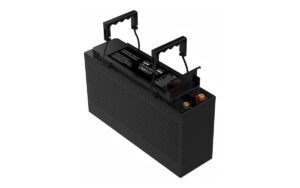
The 24V range covers 50Ah to 200Ah, all in an 8S LiFePO4 configuration with IP65 cases and a 6,000-cycle rating at 25°C and 80% depth of discharge. The 100Ah, 150Ah and 200Ah models share a 100A continuous discharge limit; the 50Ah model is rated 50A. The 100Ah and 150Ah models use the same 524 x 245 x 220mm case, and the 200Ah model uses a 523 x 269 x 222mm case.
| Model | Rated energy | Continuous power | Recommended charge current | Weight | Case |
|---|---|---|---|---|---|
| 24V 50Ah | 1,280Wh | 1,280W | 25A | 10kg | 332 x 172 x 218mm |
| 24V 100Ah | 2,560Wh | 2,560W | 50A | 22kg | 524 x 245 x 220mm |
| 24V 150Ah | 3,840Wh | 2,560W | 75A | 30kg | 524 x 245 x 220mm |
| 24V 200Ah | 5,120Wh | 2,560W | 100A | 40kg | 523 x 269 x 222mm |
The 24V lithium battery range lists all four models. The 24V 100Ah product page, 24V 150Ah product page and 24V 200Ah product page carry the full datasheets, including the 29.2V fast charge voltage, 27.0V to 27.6V float range, 0°C to 50°C charge window and 17.6V to 20V low-voltage protection. The solar battery storage page covers the array side, and the Ah to kWh calculator converts a daily load into pack capacity.
Frequently asked questions
For 10m3 per day at 40m total head, one 24V 150Ah pack covers a 2.66kWh day at 80% depth of discharge. For 20m3 per day, two 24V 150Ah packs in parallel cover the same one-day autonomy.
Yes, if the pump controller accepts a DC input and the tank can hold the water you need after sunset. A direct-drive system pumps only in daylight, so size the tank for the night and cloudy periods.
About 2kW of pump input. The BMS allows 100A continuous, or 2,560W at 25.6V, and a 2kW load draws 78A. Keep the running load at or below 2,048W to leave margin for startup and heat.
Add static lift, drawdown, pipe friction and discharge height. A 60m well with a 28m water level, 5m drawdown, 5m friction and 2m discharge height has 40m of total head, not 60m.
No. The standard 24V models accept charge from 0°C to 50°C and discharge from -20°C to 60°C. The BMS blocks charge below 0°C, so a cold site needs a heated enclosure or a charge window above freezing.
Sources: LINEX 24V 100Ah product page (25.6V, 100Ah, 2,560Wh, 100A continuous, 29.2V fast charge, 27.0V to 27.6V float, 0°C to 50°C charge, -20°C to 60°C discharge, 6,000 cycles at 25°C and 80% DoD, IP65, about 22kg, 524 x 245 x 220mm, checked 2026-11-24); LINEX 24V 150Ah product page (3,840Wh, 100A continuous, 75A recommended charge, about 30kg, 524 x 245 x 220mm, checked 2026-11-24); LINEX 24V 200Ah product page (5,120Wh, 100A continuous, 100A recommended charge, about 40kg, 523 x 269 x 222mm, checked 2026-11-24); LINEX 24V 50Ah product page (1,280Wh, 50A continuous, 25A recommended charge, about 10kg, 332 x 172 x 218mm, checked 2026-11-24); LINEX 24V lithium battery range page (50Ah to 200Ah, native 24V, IP65, checked 2026-11-24); Engineering ToolBox pump power calculator (hydraulic power formula P = q x density x gravity x head / 3.6 x 10^6, checked 2026-11-24); Engineering ToolBox Hazen-Williams page (friction head loss formula, checked 2026-11-24); Global Solar Atlas (site irradiance and design sun hours, checked 2026-11-24); LINEX solar battery storage page (solar bank sizing, checked 2026-11-24); LINEX Ah to kWh calculator (12V, 24V and 48V conversion, checked 2026-11-24). Last updated 2026-11-24.