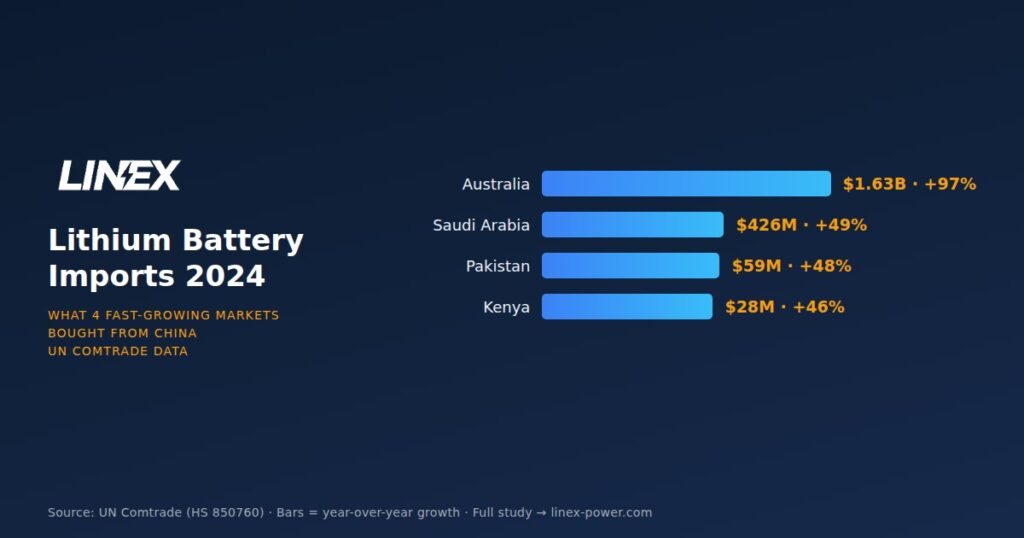
Note: everything below comes from UN Comtrade, the official trade database. No estimates, no “industry sources say” — just customs numbers for lithium-ion batteries (HS code 850760) that left China for each market in 2024, compared with 2023.
If you import batteries — or you are deciding which markets to enter — this is the starting point. Shipments do not lie.
The numbers
| Market | 2024 imports from China | vs 2023 |
|---|---|---|
| Australia | $1.63 billion | +97% |
| Saudi Arabia | $426 million | +49% |
| South Africa | $399 million | normalized* |
| Philippines | $99 million | -9% |
| Pakistan | $59 million | +48% |
| Kenya | $28 million | +46% |
| Nigeria | $23 million | -17% |
*South Africa pulled in $1.7 billion in 2023 — an outlier year, likely a wave of large single orders — then settled back to $399 million, still one of the biggest emerging-market buyers on this list. Nigeria’s dip comes off a small base and bounces around year to year. Smaller markets are volatile; keep that in mind everywhere on this page.
Three stories behind the table
Australia nearly doubled, and it is not a mystery why. Retail electricity prices, rooftop solar everywhere and home battery subsidy programs pushed households to add storage. When a market that already understands solar starts buying batteries, volumes move fast.
The Gulf is buying for projects, not shelves. Saudi Arabia’s 49% jump reflects telecom build-outs and commercial solar-plus-storage work — order sizes are bigger, and buyers here tend to care more about certifications and after-sale support than the lowest possible unit price.
East Africa keeps compounding. Kenya grew 46%, and the PayGo solar industry keeps expanding across the region. The volumes are still small compared with Australia, but growth in markets like Kenya and Nigeria is where smaller importers can build real positions before the big players bother.
If you are picking a market
Three quick reads from the table. Big and growing: Australia is both — the biggest buyer here and still doubling. Expect competition and margin pressure; win on service and stock, not price. Small and fast: Kenya, Pakistan and Nigeria move fewer dollars but grew 46–48% (or bounced back hard). These are the places where a distributor can matter. Project-driven: Saudi Arabia buys less often but bigger — if you can handle specs and paperwork properly, that market pays for it.
How we pulled the data
Source: UN Comtrade, HS code 850760 (“lithium-ion accumulators”), reporting country = destination market, partner = China, 2024 vs 2023. Some markets (Vietnam, Bangladesh, Indonesia) did not report complete data for these years, so they are not in the table — we would rather show seven solid numbers than ten fuzzy ones.
We supply LiFePO4 batteries to importers and distributors across these regions every week — Australia included. If you are sizing a market, send us a note and we will tell you what we see moving, honestly.