A 24V LiFePO4 pack is eight 3.2V cells at 25.6V nominal
A 24V LiFePO4 battery is a pack of eight LiFePO4 cells in series, not a single 24.0V cell. Each cell has a 3.2V nominal voltage, so eight cells give 25.6V. The “24V” label is a class name that also covers 25.6V packs.
That difference matters at the charger. A 24V LiFePO4 pack is charged at 29.2V absorption, which is 3.65V per cell. A charger with a 24.0V setpoint leaves the pack part charged and never finishes the absorption stage.
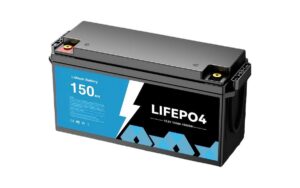
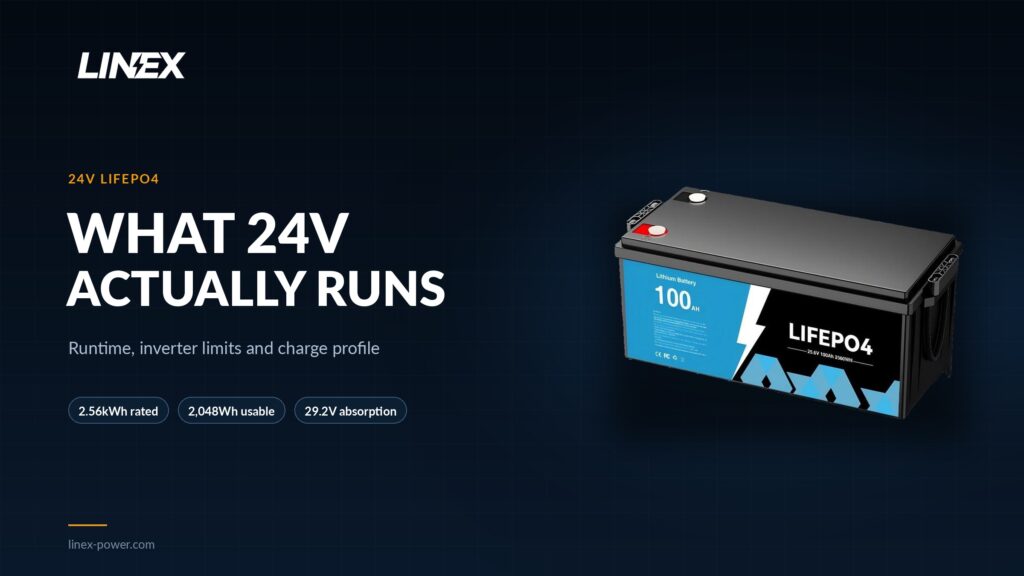
The LINEX 24V 100Ah model lists 25.6V nominal, 100Ah, 2,560Wh rated, 100A maximum continuous discharge, 50A recommended charging current and 100A maximum charging current. It weighs about 22kg and measures 524 x 245 x 220mm.
A 16V lithium pack or a 6V lithium pack is a different product with its own cell count and charger. Do not treat either as a substitute for a native 24V pack. A series string of smaller packs needs a BMS rated for that configuration.
Usable energy: 2,048Wh from a 24V 100Ah pack
A 24V 100Ah pack stores 2,560Wh at 25.6V. At 80% depth of discharge, the usable energy is 2,048Wh. The remaining 512Wh is the reserve you keep for shallow cycling, and the BMS cuts the load at the low-voltage protection point if the pack is discharged further.
The 80% figure is not a marketing allowance. The 6,000-cycle rating for this model is specified at 25°C and 80% depth of discharge. A pack cycled to 100% every day will not deliver the same cycle count.
| Model | Rated energy | Usable at 80% DoD | Continuous power | Weight | Case (L x W x H) |
|---|---|---|---|---|---|
| 24V 50Ah | 1,280Wh | 1,024Wh | 1,280W | about 10kg | 332 x 172 x 218mm |
| 24V 100Ah | 2,560Wh | 2,048Wh | 2,560W | about 22kg | 524 x 245 x 220mm |
| 24V 150Ah | 3,840Wh | 3,072Wh | 2,560W | about 30kg | 524 x 245 x 220mm |
| 24V 200Ah | 5,120Wh | 4,096Wh | 2,560W | about 40kg | 523 x 269 x 222mm |
The 150Ah and 200Ah models share the 100A BMS with the 100Ah model, so the extra capacity buys runtime rather than more instantaneous power. A load above 2,560W needs a second pack in parallel or a 48V system.
Inverter ceiling: 2,000W continuous, about 55 minutes at full load
A 2,000W inverter draws about 2,222W from the pack at 90% efficiency, which is 87A at 25.6V. That sits inside the 100A continuous limit, with 13A of margin. The runtime is 2,048Wh divided by 2,222W, or about 0.9 hours.
A 3,000W inverter pulls about 3,333W and 130A at 25.6V. That exceeds the BMS limit, so a single 24V 100Ah pack cannot carry it. Two packs in parallel give 200A and 5,120Wh, which covers the current but adds weight and wiring.
The datasheet line that decides this is “Maximum Continuous Discharge Current (A): 100”. The amp-hour label does not set the inverter size; the BMS current rating does.
Runtime by load: 45 hours on a fridge, 1.6 hours at full throttle
A 45W compressor fridge runs for about 45 hours on 2,048Wh when the compressor runs continuously. In normal use the compressor cycles at roughly 50% duty, so the same pack lasts about 90 hours. Hot weather raises the duty cycle and cuts that number.
| Load | Draw | Runtime at 80% DoD | Notes |
|---|---|---|---|
| 12V compressor fridge | 45W | 45 h continuous, about 90 h at 50% duty | Duty cycle rises in hot weather |
| Water pump | 60W | 34 h | Intermittent use stretches runtime |
| CPAP machine | 30W | 68 h | About eight 8-hour nights |
| 1,000W inverter | 1,000W | 1.8 h | 90% efficiency assumed |
| 1,500W inverter | 1,500W | 1.2 h | 90% efficiency assumed |
| 2,000W inverter | 2,000W | 0.9 h | At the BMS limit |
| 55lb trolling motor | 50A at 25.6V | 1.6 h | Full throttle; 3.2 h at half throttle |
A 55lb thrust trolling motor draws about 50A at 24V, which is 1,280W. The 2,048Wh pack lasts about 1.6 hours at full throttle, or 3.2 hours at half throttle. A 24V motor is required. A 12V trolling motor cannot run from this pack without a converter, and the converter adds losses.
Charging profile: 29.2V absorption and 27.0V to 27.6V float
The 24V 100Ah datasheet lists a 29.2V fast charge and absorption voltage, a 27.0V to 27.6V float window and a 17.6V to 29.2V operating range. The charge temperature range is 0°C to 50°C. A charger outside those values is the wrong charger, even if it says “24V” on the case.
A 24V charger regulates one 25.6V pack. Two 12V chargers cannot be stacked to charge a 24V pack, because each charger regulates its own output and the two halves never settle at the same voltage. One charger will carry the other, and the pack will not reach a full charge.
| Parameter | 24V 100Ah datasheet |
|---|---|
| Nominal voltage | 25.6V |
| Absorption / fast charge | 29.2V |
| Float / standby | 27.0V to 27.6V |
| Standard / recommended / maximum charge current | 20A / 50A / 100A |
| Charging temperature | 0°C to 50°C |
| Discharge low-voltage protection | 17.6V to 20V |
| Cycle life | 6,000 at 25°C and 80% DoD |
Charge current: 50A is the working number, 100A the ceiling
The datasheet lists 20A standard, 50A recommended and 100A maximum charge current. At 50A, the charger delivers about 1,460W at 29.2V, so replacing 2,048Wh takes about 1.4 hours plus the absorption stage. Plan on 1.5 to 2 hours from 80% depth of discharge.
A 20A charger delivers about 584W and takes about 3.5 hours plus absorption, or 4 to 5 hours in practice. A 100A charger is the 1C ceiling for a 100Ah pack. It shortens the bulk stage, but the absorption stage still takes time, and the cable, fuse and charger must be rated for 100A.
Charging below 0°C is outside the datasheet range. The BMS blocks charge current in that condition, so a cold van or boat needs the pack above freezing before charging starts.
Solar and alternator charging need one 24V profile
A solar array for a 24V pack needs a controller with a 24V LiFePO4 profile, not a 12V controller. A 600W array delivers about 20A at 29.2V, and a 1,200W array delivers about 41A. Those currents sit inside the 50A recommended charge rate, so a 30A or 50A MPPT controller is the usual match.
The array voltage has to be above the battery voltage. Two 12V nominal panels in series, or one 24V nominal panel, give the controller enough input to hold 29.2V absorption. A single 12V panel with a 22V open-circuit voltage cannot charge a 24V pack through an MPPT controller.
For alternator charging, use a 24V DC-DC charger. A pair of 12V chargers is not a substitute. The alternator then sees one bank, one charge profile and one temperature signal.
24V versus two 12V batteries in series
A native 24V 100Ah pack and two 12V 100Ah packs in series both deliver 25.6V and 100Ah. The difference is the number of BMS units and the balancing path. The native pack has one BMS watching eight cells. The series pair has two BMS units that must stay balanced with each other.
| Factor | Native 24V 100Ah | Two 12V 100Ah in series |
|---|---|---|
| BMS | One unit manages eight cells | Two units must stay balanced |
| Balancing | Cell level inside one pack | Pack-to-pack drift over time |
| Wiring | One connection | Series link plus midpoint monitoring |
| Replacement | Replace one unit | Replace both if mismatched |
| Typical use | New 24V builds | Existing matched 12V pair |
A series pair is reasonable when the two 12V units are the same model, age and charge level, and both are rated for series connection. A new build is simpler with a native 24V pack. If the load is above 2,560W or the cable run is long, compare 24V with 48V before buying. A 48V 100Ah pack doubles the energy and halves the current again.
Sizing a 24V bank from daily kWh
Start with daily consumption in watt-hours, not with the inverter label. A campervan that uses 1.5kWh per day needs 1,500Wh divided by 0.8, or 1,875Wh of rated capacity. One 24V 100Ah pack at 2,560Wh covers that day with 685Wh of margin.
Two days without sun need 3,000Wh divided by 0.8, or 3,750Wh. A 24V 150Ah pack at 3,840Wh covers that. Three days need 5,625Wh, which is more than one 24V 200Ah pack at 5,120Wh, so add a second pack in parallel or cut the daily load.
The same math applies to a boat or a small off-grid cabin. The pack count follows the daily kWh and the days of autonomy, not the size of the inverter.
The 24V lithium battery range lists the 50Ah, 100Ah, 150Ah and 200Ah models with their datasheet values. The 24V 100Ah LiFePO4 product page carries the pack data used in the tables above. For the voltage decision, the 24V vs 48V battery comparison shows where the current limit moves a build to 48V, and the campervan 12V vs 24V guide covers the alternator and converter side of a van build. The trolling motor battery sizing guide covers 12V, 24V and 36V motor setups, and the Ah to kWh calculator converts pack capacity for a different daily load.
Frequently asked questions
No. A 3,000W load draws about 130A at 25.6V after inverter losses, and the BMS limits continuous discharge to 100A. Use two packs in parallel or a 48V battery.
No. Each charger regulates its own output, so the two halves never settle at the same voltage. Use one 24V charger or a 24V DC-DC charger.
About 1.5 to 2 hours from 80% depth of discharge on a 50A charger, and 4 to 5 hours on a 20A charger. The absorption stage adds time at the end of the bulk stage.
About 2,048Wh usable: a 45W fridge for 45 hours continuous, a 1,500W inverter for 1.2 hours, or a 55lb trolling motor for 1.6 hours at full throttle.
For a 2,000W inverter or a long cable run, yes. A 2,000W load pulls 87A at 25.6V against 174A at 12.8V, so the cable and fuse are smaller. For a small load with 12V appliances, 12V is simpler.
Yes, when both packs are the same model and age and the BMS is rated for parallel operation. Parallel packs add capacity and current, but confirm the maximum parallel quantity with the datasheet before wiring.
Sources: LINEX 24V lithium battery range (50Ah, 100Ah, 150Ah and 200Ah models; 25.6V nominal; IP65; continuous discharge 50A for the 50Ah model and 100A for the 100Ah, 150Ah and 200Ah models; charging table 29.2V absorption, 27.0V to 27.6V float, 20A / 50A / 100A charge current, 0°C to 50°C charging); LINEX 24V 100Ah LiFePO4 product page (25.6V nominal, 100Ah, 2,560Wh rated, 100A maximum continuous discharge, 50A recommended and 100A maximum charging current, 17.6V to 29.2V operating range, 17.6V to 20V low-voltage protection, 6,000 cycles at 25°C and 80% DoD, IP65, about 22kg, 524 x 245 x 220mm); LINEX 24V 50Ah, 24V 150Ah and 24V 200Ah product pages (1,280Wh, 3,840Wh and 5,120Wh rated energy; 100A continuous discharge on the 150Ah and 200Ah models); LINEX 24V vs 48V battery page (voltage and current comparison); LINEX campervan 12V vs 24V guide (2,000W load current at 12.8V and 25.6V); LINEX trolling motor battery sizing guide (12V, 24V and 36V motor configurations); Battery University BU-409 (Li-ion charge efficiency about 99 percent and the constant-current then saturation charge profile). Calculated values: 8 x 3.2V = 25.6V; 25.6V x 100Ah = 2,560Wh; 2,560Wh x 80% = 2,048Wh; 1,280Wh x 80% = 1,024Wh; 3,840Wh x 80% = 3,072Wh; 5,120Wh x 80% = 4,096Wh; inverter current = watts / 0.90 / 25.6V; runtime = 2,048Wh / (watts / 0.90); 45W fridge runtime 2,048 / 45 = 45.5 hours; 60W pump 2,048 / 60 = 34.1 hours; 30W CPAP 2,048 / 30 = 68.3 hours; 55lb motor at 50A = 1,280W and 2,048 / 1,280 = 1.6 hours; 50A charger at 29.2V = 1,460W and 2,048 / 1,460 = 1.40 hours; 20A charger at 29.2V = 584W and 2,048 / 584 = 3.51 hours; 600W / 29.2V = 20.5A; 1,200W / 29.2V = 41.1A; daily sizing 1,500Wh / 0.8 = 1,875Wh, 3,000Wh / 0.8 = 3,750Wh, 4,500Wh / 0.8 = 5,625Wh. Last updated 2026-11-07.