Sizing errors start with the nameplate. A 100Ah battery does not deliver 100Ah at the load: some capacity is held back by the depth-of-discharge policy, some is lost in conversion, and some disappears in the cold. This guide works through the three numbers that decide a lithium deep cycle battery bank — cycles, depth of discharge and usable energy.
What Does 6,000 Cycles at 80% DoD Actually Mean?
A cycle is a full equivalent, not one discharge. Two days at 40% depth count as 0.8 of a cycle, so a lightly cycled battery accumulates cycles more slowly than the calendar suggests.
The LINEX 12V 100Ah datasheet rates 6,000 cycles at 80% depth of discharge and 25°C before capacity falls to 80% of its original value. Multiply that by the energy moved per cycle and the pack delivers about 6,100 kWh over its rated life (6,000 × 1.02 kWh usable). At one full cycle a day, 6,000 cycles is 16.4 years — longer than most packs see in calendar terms, typically 10–15 years depending on storage temperature and state of charge.
Depth of discharge is the variable that moves the cycle claim most. The 6,000 figure is tied to 80%; running to 100% every day is outside that rating, and industry-typical LiFePO4 ratings at 100% DoD are 3,000–5,000 cycles. Confirm the number on the datasheet you are buying against.
How Much Usable Energy Does Each Configuration Deliver?
Usable energy is nominal energy × depth of discharge. Add system efficiency and the working figure is nominal × 0.8 × 0.9, or 0.72. The table applies that factor to the 12V models in the range, with nominal energy calculated at 12.8V.
| Configuration | Nominal energy | Usable at 80% DoD | Delivered at 90% system efficiency | Nightly load it covers |
|---|---|---|---|---|
| 1 × 12V 100Ah | 1.28 kWh | 1.02 kWh | 0.92 kWh | Up to about 0.9 kWh |
| 1 × 12V 200Ah | 2.56 kWh | 2.05 kWh | 1.84 kWh | About 1.8 kWh |
| 2 × 12V 100Ah parallel | 2.56 kWh | 2.05 kWh | 1.84 kWh | About 1.8 kWh, with redundancy |
| 1 × 12V 300Ah | 3.84 kWh | 3.07 kWh | 2.76 kWh | About 2.7 kWh |
| 2 × 12V 200Ah parallel | 5.12 kWh | 4.10 kWh | 3.69 kWh | About 3.6 kWh |
| 3 × 12V 200Ah parallel | 7.68 kWh | 6.14 kWh | 5.53 kWh | About 5.5 kWh |
The 0.9 efficiency allowance covers inverter conversion, wiring and standby draws; a DC-only system can use a smaller allowance, an older inverter a larger one. The 0.8 depth figure is the rating basis, not a hard limit — the BMS will run deeper, but the cycle claim no longer applies.
What Limits the Pack: Current, Temperature and Cutoff
Energy decides runtime; current decides whether the pack can deliver it. A 100Ah LiFePO4 model rated 100A continuous is a 1C pack, so a 2,000W inverter at 12V — about 174A at 90% efficiency — needs two units in parallel even though the energy would last the night.
| Parameter | 12V 100Ah LiFePO4 | Practical consequence |
|---|---|---|
| Nominal voltage | 12.8V | 1,280Wh per 100Ah |
| Absorption / float | 14.6V / 13.5–13.8V | Set the charger; do not leave a lead-acid profile |
| Low-voltage cutoff | 8.8–10V (BMS) | Protects cells; not a daily discharge target |
| Charge current | 20A standard, 50A recommended, 100A max | 0.2C to 1C; 20A needs about 5 hours from empty |
| Continuous discharge | 100A (1,280W) | Parallel units for loads above 1.2kW |
| Charge temperature | 0–50°C | Charging below 0°C is blocked by the BMS |
| Discharge temperature | −20 to 60°C | Cold cuts usable capacity before it cuts power |
| Cycle life | 6,000 at 80% DoD, 25°C | Warmer sites age faster than the rating |
| Weight | About 10 kg | Case and shelf loads stay modest |
Temperature catches cold-climate installs. The BMS blocks charge below 0°C to prevent lithium plating, so a pack in an unheated locker accepts discharge but not charge until it warms. Discharge continues to −20°C with less capacity available — plan the bank on the winter figure.
Charge current follows the same table: 20A standard takes about five hours from empty, 50A about two. A large alternator or array will not shorten that past the 100A maximum, and the BMS limits what the cells cannot absorb.
How to Size a Bank in Four Steps
- Daily kWh: watts × hours for every load, added up.
- Nominal kWh: daily kWh ÷ (DoD × efficiency), or ÷ 0.72 for an inverter system at 80% DoD.
- Amp-hours: nominal kWh ÷ system voltage. At 12.8V, 2.5 kWh is about 195Ah.
- Current check: peak watts ÷ voltage, compared with the BMS continuous rating.
A 1.8 kWh nightly load needs 1.8 ÷ 0.72 = 2.5 kWh nominal, which is one 12V 200Ah unit at 2.56 kWh. The same load at 25.6V would be about 98Ah, which is why larger banks move up in voltage rather than growing the 12V stack. The battery bank sizing guide covers that step.
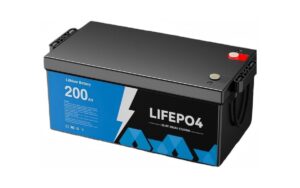
When paralleling, use identical models, similar age and state of charge, equal cable lengths and a fuse on each positive. Two 100Ah units give the same energy as one 200Ah unit with redundancy, but only with symmetrical wiring; otherwise one unit does most of the work and ages first. The 12V 200Ah LiFePO4 model is the single-case option, and the full 12V range covers 10Ah to 300Ah in standard and slim cases.
Want the bank checked before you order? Send your load list, nightly kWh and lowest site temperature; we will return a model count, a wiring sketch and a quote.
Frequently asked questions
The LINEX 12V 100Ah model is rated 6,000 cycles at 80% DoD and 25°C to 80% of original capacity — roughly 6,100 kWh of throughput, or 10–15 years of daily cycling before calendar aging dominates.
Occasionally, yes; the BMS cuts off at 8.8–10V to protect the cells. Doing it daily is outside the 6,000-cycle rating, which is set at 80% DoD. Keep 100% discharges for outages.
Multiply amp-hours by nominal voltage and divide by 1,000: 100Ah × 12.8V = 1,280Wh, or 1.28 kWh. Use 25.6V and 51.2V for 24V and 48V packs; the voltage charts show the per-cell curves.
No. The BMS blocks charging below 0°C to prevent lithium plating, though discharge continues to −20°C. In an unheated space, specify a heated model or charge in the warmest part of the day.
2 kWh ÷ 0.72 = 2.8 kWh nominal, so three 100Ah units (3.84 kWh nominal, 2.76 kWh delivered) or one 300Ah unit. Two units deliver 1.84 kWh, short of the 2 kWh load.
Sources: LINEX 12V 100Ah LiFePO4 datasheet (1,280Wh, 100A continuous, 20A/50A/100A charge limits, 6,000 cycles at 80% DoD, 14.6V absorption, 13.5–13.8V float, 0–50°C charge window); LINEX 12V 200Ah and 300Ah model pages for capacity and weight. The 6,000-cycle figure is the manufacturer rating at 25°C and 80% DoD; calendar-life and 100% DoD cycle ranges are industry-typical and vary by manufacturer.