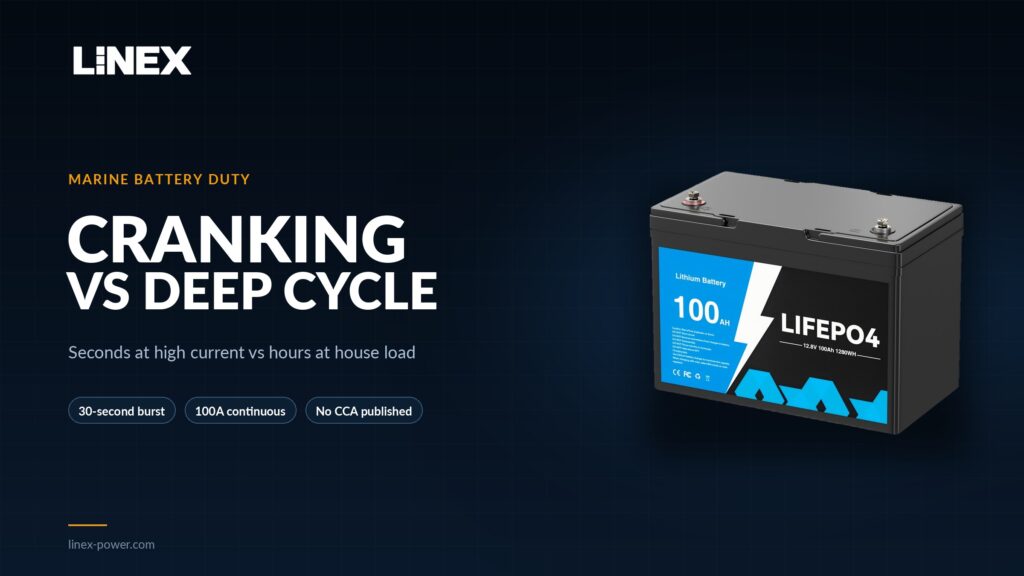
A cranking battery delivers seconds of current, a deep-cycle battery delivers hours
A marine cranking battery is designed to turn an engine: a short, high-current burst followed by an immediate recharge. A deep-cycle battery is designed to run refrigeration, lights, electronics and pumps for hours, then be recharged and discharged again. The duty cycle, not the case size, separates the two.
A starter motor draws a burst that is far above the continuous house load. The cranking battery supplies that burst without a voltage collapse. The deep-cycle battery supplies a lower current for a long time without overheating. The marine and boating battery guide covers how each type fits into a boat’s electrical system.
Plate thickness is the physical difference in lead-acid batteries
A lead-acid cranking battery uses many thin plates. Thin plates have a large surface area, which lowers internal resistance and supports a high current for a few seconds. A deep-cycle battery uses fewer, thicker plates with more active material, which tolerates repeated discharge without warping or shedding.
The trade is visible in the ratings. A cranking battery is sold by cold cranking amps and reserve capacity. A deep-cycle battery is sold by amp-hours at the 20-hour rate and cycle life at a stated depth of discharge. A dual-purpose battery carries both ratings, but it compromises on each.
CCA and Ah measure different jobs
CCA measures the current a 12V battery can deliver for 30 seconds at -18°C while staying above 7.2V. Ah measures capacity: a 100Ah battery at the 20-hour rate delivers 5A for 20 hours before reaching 10.5V at 25°C. A battery can have a high CCA and a modest Ah rating, or the reverse.
| Rating | What it measures | Test basis | Used for |
|---|---|---|---|
| CCA | Cold cranking current | 30 seconds at -18°C to 7.2V (BCI) | Engine starting |
| MCA | Marine cranking current | 30 seconds at 0°C to 7.2V (BCI) | Engine starting in milder conditions |
| Ah (C20) | Capacity | 5A for 20 hours to 10.5V at 25°C | House loads, runtime math |
| Reserve capacity | Minutes at 25A | 25A to 10.5V at 25°C (BCI) | Short backup loads |
| Cycle life | Cycles to 80% capacity | Stated depth of discharge and temperature | House bank service life |
LINEX does not publish CCA for its deep-cycle models. The datasheet lists capacity, continuous discharge current, charge voltage and cycle life, not a cranking rating. That is the correct set of numbers for a house bank and the wrong set for an engine start.
A deep-cycle bank does not replace a start battery without a starting rating
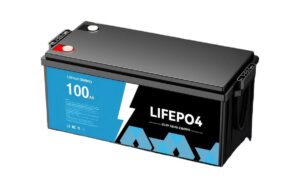
A 12V 100Ah LiFePO4 pack has a 100A continuous discharge limit. That is enough for a 1,000W inverter at continuous output and a house load, but it is not a cranking rating. Starter inrush is a short event outside the continuous limit, and a BMS that disconnects during cranking can leave the engine without power.
The same rule applies to lead-acid deep-cycle batteries. Thick plates resist deep discharge but do not deliver the high surface area current that a starter expects. If the boat has one battery, use a dual-purpose battery that carries a published cranking rating. If it has two, keep a dedicated start battery. The marine lithium house bank sizing guide covers pack count and inverter current for the house side.
A start battery cannot run a house bank for long
A cranking battery has thin plates and a shallow discharge design. Running a fridge or an inverter from it for hours uses the part of the battery that wears fastest. Its reserve capacity is measured in minutes at 25A, not in hours of house load.
The cycle life of a cranking battery is also low. It is built for many short starts, not hundreds of deep cycles. A house bank needs a battery rated for the depth of discharge the boat actually uses.
Dual-purpose batteries sit between the two
A dual-purpose marine battery carries both a CCA and an Ah rating. It can start an engine and run a modest house load, which suits small boats with one battery. It does not match a dedicated deep-cycle bank for cycle life, and it does not match a dedicated cranking battery for cold starting.
For a boat with two batteries, the better split is a cranking battery for the engine and a deep-cycle bank for the house. A voltage-sensitive relay or a DC-DC charger keeps the two banks separate and charges each with the right profile.
The charging system has to match the battery type
A start battery and a house bank want different charge profiles. A lead-acid start battery accepts a direct alternator charge. A LiFePO4 house bank needs 14.6V absorption for a 12V pack and 13.5V to 13.8V float, and its BMS blocks charging below 0°C.
Use a DC-DC charger or an external regulator for the house bank. A direct alternator feed regulated for lead-acid can leave the lithium bank at 70% to 80% state of charge and can overheat the alternator at low rpm. Keep the start battery on the original circuit.
| Charging item | Start battery | LiFePO4 house bank |
|---|---|---|
| Alternator | Direct feed, short high-current bursts | DC-DC charger or external regulator |
| Shore charger | Small maintenance charger is enough | Multi-stage charger with 14.6V absorption |
| Solar | Not typical | MPPT controller with lithium profile |
| Charging below 0°C | Allowed with capacity loss | Blocked by the BMS |
| Float voltage | 13.2V to 13.6V typical | 13.5V to 13.8V |
What to check on a marine battery label
The label should state the rating that matches the job. A cranking battery needs a published CCA or MCA and a reserve capacity. A deep-cycle battery needs Ah at a stated rate, cycle life at a stated depth of discharge and a continuous discharge current. A label that lists only “marine battery” without a rating is not enough to compare.
| Label field | Cranking battery | Deep-cycle battery | What to verify |
|---|---|---|---|
| CCA | Published | Usually not published | Test temperature and cut-off voltage |
| Ah (C20) | Secondary | Primary | Discharge rate and temperature |
| Reserve capacity | Published | Sometimes | Minutes at 25A |
| Cycle life | Not rated | Primary | Depth of discharge and temperature |
| Continuous current | Not applicable | BMS limit | Amps and duration |
For a LINEX deep-cycle model, the datasheet lists “Maximum Continuous Discharge Current (A): 100” and a 6,000-cycle rating at 80% depth of discharge and 25°C. It does not list a CCA. That is the honest set of specifications for a house bank. The 12V 100Ah marine battery page carries the full datasheet, and the marine deep cycle battery guide covers chemistry and maintenance.
Frequently asked questions
No, not unless the manufacturer publishes a cranking rating for that exact model. A deep-cycle BMS or plate design is built for sustained loads, and starter inrush can exceed its continuous limit. Keep a dedicated start battery for the engine.
CCA is measured at -18°C and MCA at 0°C, both for 30 seconds down to 7.2V on a 12V battery. MCA is the milder-weather version of the same test. Neither rating tells you how long the battery will run a fridge or an inverter.
It can cover both jobs on a small boat with one battery, but it compromises on cycle life and cold cranking. A boat with two batteries is better served by a dedicated cranking battery and a dedicated deep-cycle bank.
The BMS protects the cells from over-current. A 12V 100Ah pack rated at 100A continuous delivers 1,280W, which suits a 1,000W inverter. A 2,000W inverter needs two packs in parallel or a 24V pack. The continuous limit is not a cranking rating.
Use a DC-DC charger or an external regulator set for LiFePO4. A standard alternator regulator targets lead-acid voltages and can leave the bank at 70% to 80% state of charge. Check the alternator’s spare capacity and the charger’s current limit before relying on it.
Sources: LINEX 12V 100Ah, 12V 200Ah and 24V 100Ah datasheets (continuous discharge current, charge voltage, temperature limits and cycle life); LINEX marine and boating application page (house versus start duty, alternator charging and installation checks); LINEX deep cycle battery guide (CCA, C20 and reserve-capacity definitions, BCI test basis); LINEX marine deep cycle battery guide (chemistry and maintenance). Calculated values: continuous power = nominal voltage × continuous current. Last updated 2026-11-01.