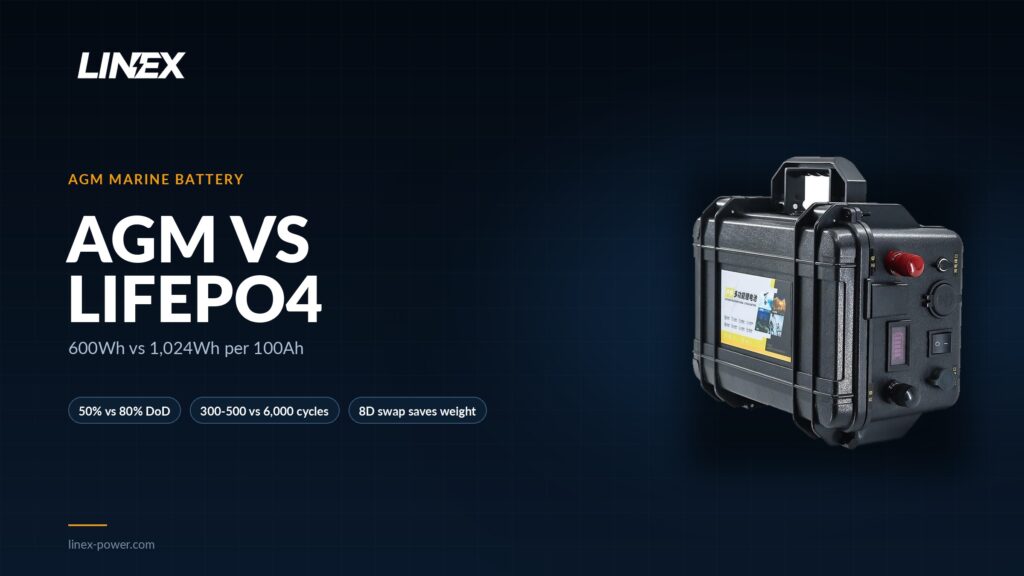
AGM uses a glass-mat separator and still runs lead-acid chemistry
An AGM marine battery holds its electrolyte in an absorbent glass mat, and the sealed case makes it spill-proof. The glass-mat design lowers internal resistance, so the battery can deliver a high current for a short burst. It is still a lead-acid battery with a 20-hour capacity rating, not a lithium chemistry with a BMS.
The lead plates and paste behave like other lead-acid designs. Repeated discharge leaves sulfate on the plates, and a battery that sits partly charged loses capacity that does not come back. AGM reduces water loss and vibration damage compared with a flooded battery, but it does not remove the depth-of-discharge limit that shapes a house bank.
A 100Ah AGM gives about 600Wh of planned house capacity
A 12V 100Ah AGM stores 1,200Wh at its rated capacity, and 50% depth of discharge leaves about 600Wh for daily use. That 50% figure is the planning number for a marine house bank, even though an AGM can be pushed to 80% on an occasional deep cycle. Cycle life falls as depth of discharge rises, so the extra energy comes out of service life.
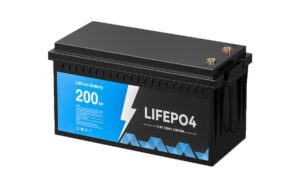
The same arithmetic applies at every size. A 200Ah AGM stores 2,400Wh and gives about 1,200Wh at 50% depth of discharge. A 100Ah LiFePO4 unit stores 1,280Wh and gives 1,024Wh at 80%, because the BMS reserves the bottom of the pack and the cells tolerate deeper cycling. The table compares the two chemistries at the same label ratings.
| Battery | Rated energy | Planned usable | Weight | Rated cycles |
|---|---|---|---|---|
| 12V 100Ah AGM | 1,200Wh | 600Wh at 50% DoD | 30kg to 33kg | 300 to 500 at 50% DoD |
| 12V 100Ah LiFePO4 | 1,280Wh | 1,024Wh at 80% DoD | about 10kg | 6,000 at 80% DoD |
| 12V 150Ah LiFePO4 | 1,920Wh | 1,536Wh at 80% DoD | about 15kg | 6,000 at 80% DoD |
| 12V 200Ah AGM (8D) | 2,400Wh | 1,200Wh at 50% DoD | 60kg to 70kg | 300 to 500 at 50% DoD |
| 12V 200Ah LiFePO4 | 2,560Wh | 2,048Wh at 80% DoD | about 22kg | 6,000 at 80% DoD |
AGM keeps two advantages: burst current and cold-weather charging
AGM delivers a high burst current because its internal resistance is low, which is why an AGM boat battery remains common for engine starting and thruster or windlass duty. A starting battery is rated in CCA or MCA, both measured for 30 seconds at a stated temperature. That rating describes a short burst, not a house load.
LINEX deep-cycle models do not publish cold cranking ratings and are not sold for engine starting. A separate start battery should handle the engine, and the house bank should run the fridge, lights and electronics. The marine cranking versus deep cycle guide explains the plate and rating differences.
AGM also has no BMS that opens the charge circuit at 0°C. A lead-acid charger can continue with voltage compensation in cold weather, provided the battery is not frozen. A LiFePO4 BMS blocks charging below 0°C unless the pack has internal heating, which matters for a boat that sits in a freezing yard.
LiFePO4 delivers 1.7 times the usable energy at one third of the weight
The 12V 100Ah LiFePO4 case gives 1,024Wh at 80% depth of discharge and weighs about 10kg, against 600Wh and 30kg to 33kg for a 100Ah AGM. Planned energy per kilogram is about 102Wh/kg for the lithium unit and 18Wh/kg to 20Wh/kg for the AGM.
The larger models stay near 100Wh/kg: the 12V 150Ah LiFePO4 gives 1,536Wh at about 15kg, and the 12V 200Ah gives 2,048Wh at about 22kg. The datasheet line “Cycle Life (25°C, 80% DoD): 6000” is the basis for the cycle comparison in the table above. AGM cycle life is typically 300 to 500 cycles at 50% depth of discharge, and it falls further at deeper discharge.
The 8D AGM swap is where the weight difference is largest
An 8D AGM marine battery is typically 200Ah to 250Ah and weighs 60kg to 70kg. The BCI 8D envelope is about 527 × 283 × 251mm, and published case heights vary by model. The LINEX 12V 200Ah LiFePO4 case measures 524 × 245 × 220mm and weighs about 22kg, so it sits within the 8D footprint at or below the envelope on all three dimensions and needs blocking or a new hold-down.
The energy gap follows the weight gap. A 200Ah 8D AGM gives about 1,200Wh at 50% depth of discharge. The 12V 200Ah LiFePO4 gives 2,048Wh at 80%, which is 1.7 times the usable energy from a case that weighs 38kg to 48kg less. Check the terminal type and cable length, then confirm the charger profile before ordering, because a smaller case still needs a secure mount.
| Parameter | 8D AGM (200Ah) | 12V 200Ah LiFePO4 |
|---|---|---|
| Case (L × W × H) | about 527 × 283 × 251mm (BCI envelope) | 524 × 245 × 220mm |
| Weight | 60kg to 70kg | about 22kg |
| Rated energy | 2,400Wh | 2,560Wh |
| Planned usable | 1,200Wh at 50% DoD | 2,048Wh at 80% DoD |
| Continuous discharge | model-dependent | 100A |
| Cycle rating | 300 to 500 at 50% DoD | 6,000 at 80% DoD |
Charging is the second limit of an AGM house bank
An AGM bank needs a 14.4V to 14.7V absorption stage after every cycle, and leaving it partly charged causes sulfation. The absorption stage can run for 2 to 4 hours, and the charger then drops to a 13.2V to 13.6V float. A charger without temperature compensation can overcharge an AGM in a hot engine room or undercharge it in a cold locker.
A LiFePO4 pack uses 14.6V absorption and 13.5V to 13.8V float, with no equalize cycle. Its BMS balances the cells and disconnects the charge path at the temperature limit. The settings are close enough that some AGM chargers can be reprogrammed, but a charger with a fixed lead-acid profile or an automatic desulfation mode is not suitable.
| Setting | AGM | LiFePO4 |
|---|---|---|
| Absorption | 14.4V to 14.7V | 14.6V |
| Float | 13.2V to 13.6V | 13.5V to 13.8V |
| Equalize | Sometimes required | Never |
| Temperature compensation | Required | BMS cutoff handles low temperature |
| Charge below 0°C | Possible with voltage compensation | Blocked by BMS unless heated |
When an AGM marine battery is still the right choice
AGM remains the practical choice for engine starting, a job rated by CCA at -18°C for 30 seconds, and for a single-battery boat that needs one unit to start the engine and run a small load. It also suits a locker that drops below 0°C without a heated lithium pack, and it costs less at the counter than a lithium bank of the same label capacity.
LiFePO4 is the better fit for a house bank that cycles daily, for a weight-sensitive refit, and for a boat that spends nights at anchor running a fridge and electronics. The purchase price is higher, but the usable energy per cycle is 1.7 times higher and the cycle rating is more than ten times longer.
| Use case | AGM | LiFePO4 |
|---|---|---|
| Engine starting | Yes, with published CCA or MCA | No; LINEX deep-cycle models publish no CCA |
| House bank, daily cycling | 50% DoD, 300 to 500 cycles | 80% DoD, 6,000 cycles |
| Charging below 0°C | Possible with voltage compensation | BMS blocks unless heated |
| Weight-sensitive refit | 30kg to 33kg per 100Ah | about 10kg per 100Ah |
| Lowest purchase price | Lower | Higher |
| 8D replacement | 60kg to 70kg | 22kg, 2,048Wh usable |
The switch needs a charger check, not just a case measurement
A 12V LiFePO4 pack needs 14.6V absorption and 13.5V to 13.8V float, and the charger must not run an equalize or desulfation cycle. If the boat charges from the alternator, use a DC-DC charger or an external regulator set for lithium. A standard alternator regulator targets lead-acid absorption and can leave the lithium bank at 70% to 80% state of charge.
Keep the start battery on its original charging path and fuse each lithium pack separately. The marine lithium house bank sizing guide covers pack count and inverter current. The marine and boating battery guide lists the full model range and installation checks. For an 8D replacement, the 12V 200Ah LiFePO4 battery page carries the datasheet.
Frequently asked questions
Yes for a house bank, if the tray and terminals fit and the charger has a lithium profile. A 100Ah LiFePO4 gives 1,024Wh usable against 600Wh for a 100Ah AGM, at about one third of the weight. Do not use it for engine starting, because LINEX deep-cycle models publish no cold cranking rating.
Typically 300 to 500 cycles at 50% depth of discharge. At one cycle per day that is 10 to 16 months; weekend use stretches the same battery over several years. Heat and partial charging shorten the count.
AGM is better for engine starting and high-current bursts, and it can be charged in freezing conditions with voltage compensation. LiFePO4 is better for a house bank that cycles daily, because it gives 80% depth of discharge and 6,000 cycles at about one third of the weight.
A 12V 100Ah LiFePO4 replaces a 100Ah AGM in usable-energy terms, with 1,024Wh against 600Wh. The case measures 332 × 172 × 218mm and weighs about 10kg. Check the tray and charger before ordering.
Only if the charger has a lithium profile with 14.6V absorption, 13.5V to 13.8V float and no equalize cycle. An AGM charger that runs an equalize or desulfation cycle can overcharge the lithium cells.
Sources: LINEX 12V 100Ah, 12V 150Ah and 12V 200Ah datasheets (rated energy, continuous discharge current, case dimensions, weight, charge voltage, temperature limits and cycle life); LINEX marine and boating application page (house versus start duty, charging and installation checks); LINEX marine cranking versus deep cycle guide (CCA, MCA and plate design); LINEX deep cycle lead-acid versus lithium article (AGM usable energy, weight and 300 to 500 cycle range, industry-typical); Battery University BU-201a (AGM construction, internal resistance and depth of discharge); Battery University BU-403 (lead-acid absorption, float and temperature compensation). Calculated values: planned AGM energy = 12V × Ah × 0.5; usable LiFePO4 energy = rated Wh × 0.8; weight saving = 60kg or 70kg minus 22kg. Last updated 2026-11-02.