Usable energy is 1,020Wh, not 1,280Wh
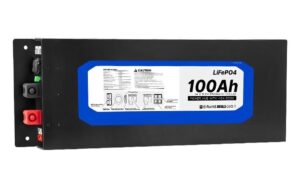
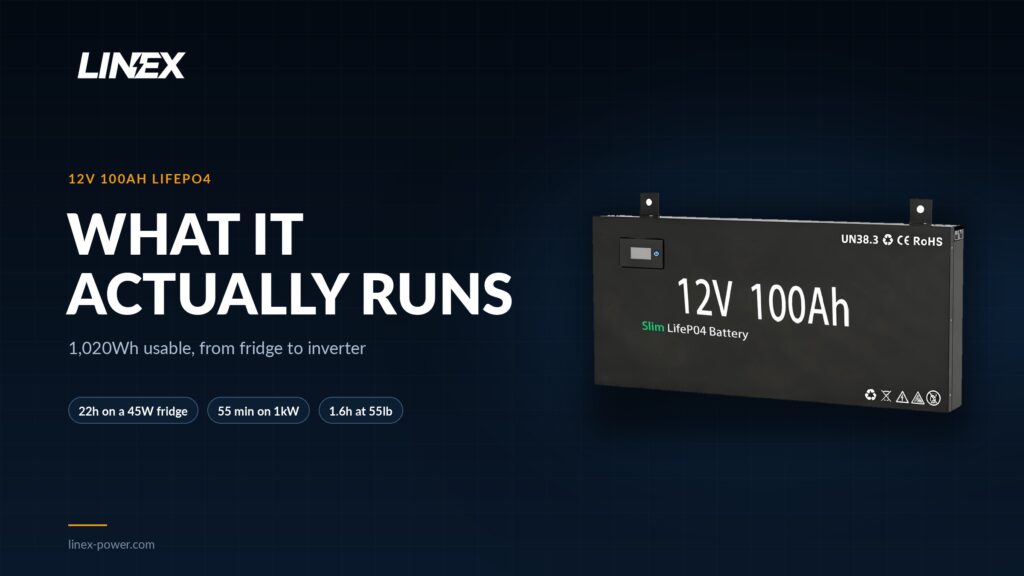
A 12V 100Ah LiFePO4 battery multiplies 100Ah by 12.8V nominal to get 1,280Wh. The BMS cuts off before the cells are fully drained, and the cycle-life rating is measured at 80% depth of discharge, so plan on 80%: about 1,020Wh. A lead-acid battery with the same 100Ah label gives closer to 600Wh at 50% depth of discharge.
That 1,020Wh is the number to use for runtime. Divide it by the load in watts, then adjust for inverter efficiency and duty cycle. The datasheet’s cycle-life line, “Cycle Life (25°C, 80% DoD): 6000”, is measured at that same 80% depth, which is why the planning figure uses it.
Appliance runtime: 15W to 60W loads run for 17 to 68 hours
A 1,020Wh pack runs small DC loads for days, not hours: a 20W light string lasts 51 hours, a 45W fridge lasts 22 hours with the compressor running continuously, and a 60W pump lasts 17 hours. The table uses the full 1,020Wh and a 25°C pack, so a cold battery or a hot fridge will move the numbers.
| Load | Draw | Runtime at 1,020Wh | Notes |
|---|---|---|---|
| LED lights, 5 x 4W | 20W | 51h | Most efficient load on the list |
| 12V compressor fridge | 45W | 22h continuous, about 45h at 50% duty | Duty cycle rises in heat |
| Water pump | 60W | 17h | Intermittent use stretches runtime |
| CPAP machine | 30W | 34h | Four 8-hour nights |
| Laptop via 12V adapter | 60W | 17h | Avoid the AC brick |
| 12V fan | 15W | 68h | Cabin ventilation |
| Phone charging | 10W | 102h | Small load, long tail |
| 55lb trolling motor | 50A at 12.8V | 1.6h | Full throttle |
The fridge is the load that sizes most campervan and boat banks. A 45W compressor running half the time uses 540Wh per day, so one 100Ah pack covers about two days at 80% depth of discharge. A second pack turns that into a long weekend.
Inverter ceiling: 1,000W for about 55 minutes
A 1,000W inverter pulls about 87A from a 12.8V pack after 90% efficiency. The standard 12V 100Ah model is rated at 100A continuous, so it runs at the top of its limit. A 2,000W inverter needs 174A and the BMS disconnects.
| Inverter size | DC current at 12.8V | Runtime at 80% DoD | Works with one unit? |
|---|---|---|---|
| 300W | 26A | 3.1h | Yes |
| 500W | 43A | 1.8h | Yes |
| 1,000W | 87A | 55 min | Yes, near the 100A limit |
| 2,000W | 174A | 28 min | No, exceeds 100A |
| 3,000W | 260A | 18 min | No, move to 24V or 48V |
Two units in parallel raise continuous output to 200A and cover a 2,000W inverter. A native 24V pack does the same job with half the current and thinner cable.
Trolling motor runtime: 1.6 hours at full throttle
A 55lb thrust motor draws about 50A at full throttle. One 100Ah pack lasts about 1.6 hours. At half throttle the draw falls to roughly 25A and runtime doubles to 3.2 hours. A 30lb motor at 30A runs 2.7 hours; a 40lb at 40A runs 2.0 hours.
| Motor thrust | Full-throttle current | Runtime at full throttle | Runtime at half throttle |
|---|---|---|---|
| 30lb | 30A | 2.7h | 5h |
| 40lb | 40A | 2.0h | 4h |
| 50lb | 45A to 50A | 1.8h | 3.5h |
| 55lb | 50A to 52A | 1.6h | 3.2h |
Motors above 55lb are normally 24V or 36V and cannot run from one 12V unit. The 12V 100Ah trolling motor battery is the model built for this duty, with a 100A BMS and a 12kg case.
Parallel doubles the energy; series doubles the voltage
Two 12V 100Ah units in parallel give 200Ah at 12.8V, or 2,560Wh, and 200A of continuous output. Two in series give 100Ah at 25.6V, the same 2,560Wh, for a 24V load.
| Setup | Voltage | Capacity | Energy | Continuous output | Use |
|---|---|---|---|---|---|
| One unit | 12.8V | 100Ah | 1,280Wh | 100A | 12V loads, 1,000W inverter |
| Two in parallel | 12.8V | 200Ah | 2,560Wh | 200A | 2,000W inverter, longer runtime |
| Two in series | 25.6V | 100Ah | 2,560Wh | 100A | 24V motor or inverter |
Parallel keeps the voltage at 12.8V and adds amp-hours. Series doubles the voltage and keeps the amp-hours, so the energy is the same. Series also needs two units of the same model, age and state of charge, plus a balancer. The standard 12V 100Ah page does not publish a series rating, so confirm before wiring; a native 24V pack is the simpler route.
Cold weather cuts capacity and blocks charging below 0°C
Cold raises internal resistance and reduces usable capacity. Battery University’s comparison puts a lead-acid battery at about 50% of its 27°C capacity at -18°C. LiFePO4 cells also lose capacity in the cold, and the BMS stops charging below 0°C. LINEX publishes a 0°C to 50°C charging range for the standard 12V 100Ah model.
Discharge continues to -20°C, so a cold pack can still run a load. It delivers less energy, and it cannot be recharged until it warms up. Treat the 1,020Wh figure as a 25°C number.
What it does not run: engine starting and loads above 100A
LINEX does not publish cold cranking amps for the 12V 100Ah deep-cycle model, so it is not sold for engine starting. A starter motor can pull several hundred amps for a few seconds, far above the 100A continuous rating. Keep a separate start battery.
The same limit rules out a 2,000W inverter from one unit, a large induction cooktop and any load that pulls more than 100A continuously. For those loads, use two units in parallel, a 24V pack, or a smaller load.
Where this battery fits
The 12V 100Ah size suits campervans, small caravans, 12V trolling motors and modest telecom backup. For the exact unit, see the 12V 100Ah LiFePO4 battery. The 12V lithium battery range covers 10Ah to 300Ah in standard, thin and ultra-slim cases, and the marine lithium house bank sizing guide applies the same math to a boat.
Frequently asked questions
About 22 hours with the compressor running continuously, or roughly 45 hours at 50% duty. Hot weather raises the duty cycle and shortens both figures.
No. A 2,000W load draws about 174A at 12.8V, and the BMS limits continuous output to 100A. Use two units in parallel or a 24V pack.
1.28kWh rated, or about 1.02kWh usable at 80% depth of discharge. The Ah to kWh calculator converts other capacities and voltages.
Yes for a 12V motor up to about 55lb thrust that draws under 100A. A 55lb motor at 50A runs about 1.6 hours at full throttle and 3.2 hours at half throttle. A 24V motor needs two units in series or a native 24V pack.
No. LINEX does not publish cold cranking ratings for this model. Use a start battery for the engine and keep the 100Ah pack for house loads.
Sources: LINEX 12V 100Ah, 12V 150Ah and 12V 200Ah datasheets (rated energy, continuous discharge, dimensions, weight, charge voltage, temperature limits, cycle life); LINEX 12V 100Ah trolling motor battery page (100A BMS and trolling runtime table); LINEX 12V lithium battery range; LINEX Ah to kWh calculator; LINEX marine lithium house bank sizing guide; Battery University BU-502 (capacity at low temperature) and BU-410 (charge temperature limits). Calculated values: runtime = 1,020Wh divided by load; inverter current at 12.8V and 90% efficiency. Last updated 2026-11-03.