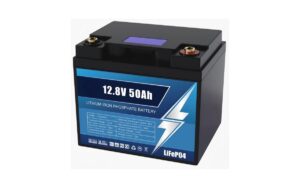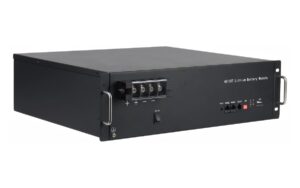
A deep cycle label leads with voltage, capacity and energy
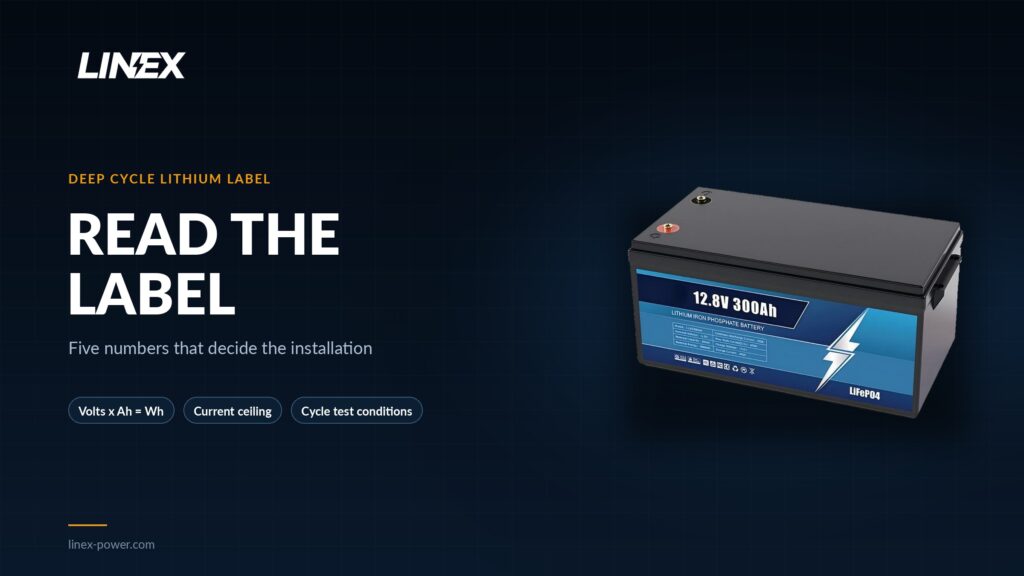
The first three lines on a deep cycle lithium label are nominal voltage, nominal capacity and rated energy, and they have to agree. Multiply 12.8V by 100Ah and the product is 1,280Wh. A label that shows 12.8V, 100Ah and a much lower watt-hour figure is using a different basis, so ask which value the quote is built on.
Nominal capacity is not the same as minimum capacity. The 12V 100Ah datasheet lists 100Ah nominal and 98Ah minimum, so a production unit can test 2% below the headline number and still pass. The 150Ah model lists 145/148Ah minimum, and the 200Ah model lists 195/198Ah. That difference matters when a load calculation has little spare capacity.
Rated energy is the number that crosses voltage classes. It also connects the label to the load table. A 12V 100Ah pack holds 1,280Wh, so a 45W 12V fridge can run for about 22 hours at 80% depth of discharge before duty-cycle credit. That runtime comes from watt-hours, not from the 100Ah figure alone.
| Label field | 12V 100Ah | 12V 150Ah | 12V 200Ah |
|---|---|---|---|
| Nominal voltage | 12.8V | 12.8V | 12.8V |
| Nominal capacity | 100Ah | 150Ah | 200Ah |
| Minimum capacity | 98Ah | 145/148Ah | 195/198Ah |
| Rated energy | 1,280Wh | 1,920Wh | 2,560Wh |
| Maximum continuous discharge | 100A | 145/150A | 100A |
| Recommended charge current | 50A | 72.5/75A | 100A |
| Case length × width × height | 332 × 172 × 218mm | 483 × 170 × 240mm | 524 × 245 × 220mm |
| Weight | about 10kg | about 15kg | about 22kg |
| Cycle life at 25°C, 80% DoD | 6,000 | 6,000 | 6,000 |
Amp-hours alone cannot compare packs at different voltages
A 100Ah pack at 48V stores four times the energy of a 100Ah pack at 12V, so compare watt-hours before amp-hours. The 12V 100Ah pack holds 1,280Wh, the 24V 100Ah pack holds 2,560Wh, and the 48V 100Ah rack pack holds 4,800Wh. All three carry a 100Ah label.
| Pack | Nominal voltage | Capacity | Rated energy |
|---|---|---|---|
| 12V 100Ah | 12.8V | 100Ah | 1,280Wh |
| 24V 100Ah | 25.6V | 100Ah | 2,560Wh |
| 48V 100Ah | 48V | 100Ah | 4,800Wh |
The same logic applies inside a 12V family. A 12V 200Ah pack holds 2,560Wh, which is twice the energy of the 12V 100Ah pack, but it does not automatically deliver twice the current. The 200Ah model is rated 100A continuous, the same as the 100Ah model. Capacity sets runtime; the BMS and cell configuration set the current ceiling.
That distinction matters when a buyer compares a 48V rack unit with a 12V deep cycle unit. The 48V pack is not a bigger version of the 12V pack. It uses a different system voltage, a different BMS, a different charger and different installation rules.
Maximum continuous current is a separate rating from capacity
The 12V 100Ah model is rated 100A continuous, while the 12V 200Ah model is also rated 100A, so a larger pack does not automatically deliver more current. The 12V 150Ah model is the exception in this family: its datasheet prints 145/150A continuous. Confirm which figure applies to the quoted build.
Translate the current rating into a load before choosing a model. A 1,000W inverter pulls about 93A from a 12V pack after losses, which leaves little margin on a 100A BMS. A 2,000W inverter pulls about 185A, which is outside the limit for every 12V model in this table. Two 100Ah packs in parallel, or a native 24V pack, are the correct next step.
The current rating is a ceiling, not a target. A load that sits at 95A for hours leaves no margin for cable heating or a rising cabinet temperature. The 12V 100Ah datasheet gives 100A as the maximum continuous discharge current, and the standard discharge current is 50A. The second number is the one that describes normal use.
Charge voltage and current are printed as a pair
The 12V 100Ah label lists 14.6V fast charge, 13.5V to 13.8V float, 20A standard charge and 100A maximum charge, and those four numbers define the charger. The 14.6V figure is 3.65V per cell across four cells in series. The float figure is lower because a full pack does not need the absorption voltage held indefinitely.
Current ratings scale with capacity. The 100Ah model recommends 50A, which is 0.5C, and allows 100A, which is 1C. The 150Ah model recommends 72.5/75A and allows 145/150A. The 200Ah model recommends 100A and allows 100A. A charger that can deliver 100A to a 100Ah pack is working at the top of the range, not the middle.
Battery University describes 1C as a typical LiFePO4 charge rate, which matches the 100A maximum on the 100Ah model. The recommendation is lower for a reason: charge current and cell temperature together set the aging rate. A 20A charger is the standard rate; a 50A charger is the normal working choice for this pack size.
| Label line | Example on the 12V 100Ah | What it controls |
|---|---|---|
| Operating voltage range | 8.8V to 14.6V | BMS low-voltage and high-voltage cutoff |
| Fast charge voltage | 14.6V | Absorption setting on the charger |
| Standby and float voltage | 13.5V to 13.8V | Long-term maintenance voltage |
| Standard charge current | 20A | Slow charge rate, about 0.2C |
| Recommended charge current | 50A | Normal charger size, about 0.5C |
| Maximum charge current | 100A | Upper limit, about 1C |
| Maximum continuous discharge | 100A | Load and inverter ceiling |
| Charge temperature | 0°C to 50°C | BMS charge cutoff and heater design |
| Discharge temperature | -20°C to 60°C | Cold-weather runtime and cable rating |
| Cell configuration | 4S | Four LiFePO4 cells in series, 12.8V nominal |
Cycle life counts only with a depth of discharge and a temperature
The 6,000-cycle figure for the 12V 100Ah pack is tied to 25°C and 80% depth of discharge, and the 6,000 figure does not apply at 40°C or 100% DoD. The label should show both conditions next to the cycle count. A bare “6,000 cycles” claim is not comparable with a claim that states its test conditions.
Battery University’s cycle table shows how far the number moves with depth of discharge. At 80% DoD, a generic LiFePO4 cell reaches about 900 cycles and an NMC cell about 400 before capacity falls to 70%. At 40% DoD, the same table shows about 3,000 cycles for LiFePO4 and about 1,000 for NMC. The pack rating of 6,000 at 80% DoD is higher than the generic cell figure because the pack rating uses its own cell, BMS and test conditions. Compare pack ratings with pack ratings, not with a cell table.
Battery University states that “A partial discharge reduces stress and prolongs battery life.” That is the reason a 40% DoD cycle count is higher than an 80% DoD count. The same logic applies to a pack sized for daily 80% cycling: check the cycle rating at that depth, not at 100%.
| Depth of discharge | NMC cycles | LiFePO4 cycles |
|---|---|---|
| 100% | about 300 | about 600 |
| 80% | about 400 | about 900 |
| 60% | about 600 | about 1,500 |
| 40% | about 1,000 | about 3,000 |
| 20% | about 2,000 | about 9,000 |
For the 12V 100Ah pack, 6,000 cycles at 80% DoD moves about 6,144kWh over the rated life: 1,280Wh × 0.8 × 6,000. That throughput figure is more useful than the cycle count alone when two packs of different capacity are compared.
The label also carries chemistry, IP rating and case dimensions
A complete label states LiFePO4, IP65, 4S and 332 × 172 × 218mm, and those details decide whether the pack fits the installation. The chemistry line separates LiFePO4 from a generic “lithium ion” label. The 4S line means four cells in series inside the 12V pack, not four batteries that can be connected in series.
The IP rating describes the enclosure, not the terminals. IP65 means dust tight and protected against water jets. It does not mean the pack can be submerged. A marine or washdown installation still needs a sealed box, cable glands and a drip loop.
The case dimensions and weight decide the mounting. The 100Ah model measures 332 × 172 × 218mm and weighs about 10kg. The 150Ah model grows to 483 × 170 × 240mm and about 15kg. The 200Ah model measures 524 × 245 × 220mm and weighs about 22kg. The 200Ah case is 524mm long, so check the tray length and restraint, not just the weight.
The temperature windows belong on the same label. The 12V models charge from 0°C to 50°C and discharge from -20°C to 60°C. A pack stored in a shed at -10°C can discharge, but it cannot charge until the cells warm above 0°C. The BMS enforces that limit even when the charger is still trying.
Five label gaps should trigger a datasheet request
A label that omits the cycle conditions, the continuous current, the charge window, the cell chemistry or the test report is incomplete, and the buyer should ask for the datasheet before ordering. The five gaps matter more than the headline capacity.
| Missing from the label | Risk in the quote | What to request |
|---|---|---|
| Capacity basis | 100Ah could be nominal or minimum | Minimum capacity and the discharge rate used |
| Continuous current | The inverter may exceed the BMS limit | Maximum continuous discharge at 25°C |
| Charge voltage | The charger may use the wrong profile | Absorption, float and cutoff voltages |
| Cycle conditions | 6,000 cycles is not comparable | Temperature, depth of discharge and end-of-life capacity |
| Test report | A CE mark without a document | Certificate number and UN38.3 report reference |
Ask for the datasheet line that matches each row, not a marketing sentence. A supplier who can provide the five values in writing has a product file that can be checked against the purchase order.
The 12V lithium battery range lists the 100Ah, 150Ah and 200Ah cases with their full label data. The 12V 100Ah LiFePO4 product page carries the datasheet values used in this article. The RV and van life application page shows how the same label is read for a campervan bank. For the sizing step after the label, the 12V 100Ah battery guide converts the numbers into runtime, and the Ah to kWh calculator handles the voltage conversion for 12V, 24V and 48V packs.
Frequently asked questions
No. Ah is capacity, and A is current. The 12V 100Ah model is rated 100A continuous, but that is a separate datasheet line. The 12V 200Ah model in the same family is also rated 100A, even though it stores twice the energy.
The BMS and cell configuration set the current limit, not the capacity alone. The 150Ah datasheet lists 145/150A continuous, while the 200Ah model lists 100A. A load above 100A needs a different model or a parallel bank, even if the 200Ah pack has enough energy for the runtime.
The nominal energy is 1,280Wh. At 80% depth of discharge, about 1,024Wh is usable before inverter and wiring losses. The 1,020Wh figure in some runtime tables is a rounded usable-energy estimate, not the label rating.
Four cells in series. Each LiFePO4 cell has a nominal voltage of 3.2V, so 4 × 3.2V gives 12.8V. The 4S marking describes the internal cell layout. It does not mean four 12V batteries can be connected in series, because that depends on the BMS rating.
Yes. 14.6V is the fast charge voltage, and 13.5V to 13.8V is the float range. The recommended charge current is 50A, and the maximum is 100A. Confirm the charger follows the lithium profile and stops charge below 0°C.
IP65 means dust tight and protected against water jets. It does not mean the pack can be submerged. Cable entries, terminals and fuses still need protection in a marine or washdown installation.
Sources: LINEX 12V 100Ah LiFePO4 product page (12.8V nominal, 100Ah nominal, 98Ah minimum, 1,280Wh rated, 8.8V to 14.6V operating range, 14.6V fast charge, 13.5V to 13.8V float, 20A standard charge, 50A recommended, 100A maximum charge, 50A standard discharge, 100A maximum continuous discharge, 0°C to 50°C charge, -20°C to 60°C discharge, 6,000 cycles at 25°C and 80% DoD, 4S, IP65, about 10kg, 332 × 172 × 218mm); LINEX 12V 150Ah product page (150Ah nominal, 145/148Ah minimum, 1,920Wh, 145/150A maximum continuous discharge, 72.5/75A recommended charge, about 15kg, 483 × 170 × 240mm); LINEX 12V 200Ah product page (200Ah nominal, 195/198Ah minimum, 2,560Wh, 100A maximum continuous discharge, 100A recommended charge, about 22kg, 524 × 245 × 220mm); LINEX 24V 100Ah product page (25.6V nominal, 100Ah, 2,560Wh); LINEX 48V 100Ah telecom battery product page (48V nominal, 100Ah, 4,800Wh, 3U rack); 12V lithium battery range; LINEX 12V 100Ah battery guide; LINEX Ah to kWh calculator; Battery University BU-205 (LiFePO4 nominal 3.2V, 1C typical charge); Battery University BU-808 (cycle life by depth of discharge, 70% capacity end point, partial discharge reduces stress). Calculated values: 12.8V × 100Ah, 150Ah and 200Ah; 6,000 × 1,280Wh × 0.8; 1,000W and 2,000W inverter currents at 12V with 90% efficiency. Last updated 2026-11-05.