Marine Deep Cycle Battery: How to Choose One That Lasts
Most marine batteries don’t die. They get killed. By the wrong job, the wrong charging, or the wrong chemistry for how the boat is actually used. The battery that lasts ten years and the battery that dies in eighteen months are often the same product, installed by different people.
Here’s how to be the first person.
Starting or house? Get the job right first
Boats use two very different batteries, and the confusion starts here.
A starting battery delivers a huge burst of current for a few seconds, cranking the engine. Then gets recharged immediately. Thin plates, high surface area, built for short violent bursts.
A house battery (deep cycle) runs the fridge, lights, electronics and pumps for hours, getting drained and recharged every trip. Thick plates, built to be discharged deeply.
Put a starting battery in a house role and it dies in a season. Put a deep cycle in a starting role and it struggles from day one. Some batteries are dual-purpose, but they’re a compromise on both sides. If your boat has room for two, use two.
Why marine batteries die young
Two killers do most of the damage:
Undercharging. The number one cause. A battery that’s cycled down and only ever half recharged slowly sulfates (in lead-acid) and loses capacity. “It still starts the engine” is not the same as “it’s healthy.” Marine batteries live long when they get fully recharged every cycle.
Heat and vibration. Engine rooms are hot, and boats vibrate. Both accelerate aging, and both are reasons why a battery mounted in a ventilated, strapped-down spot outlives one rattling next to an engine.
Flooded, AGM, or LiFePO4: the real comparison
Three chemistries, three sets of trade-offs:
- Flooded lead-acid. Cheapest to buy, needs water checks and ventilation, tolerates abuse poorly, roughly 500 cycles if treated well. Fine for starting; common for house banks on a budget.
- AGM. Sealed, spill-proof, better vibration resistance, more expensive than flooded, still a lead chemistry with the same 50% depth-of-discharge rule.
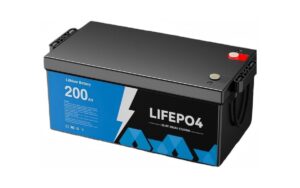
- LiFePO4. Higher energy density and published cycle-life advantages, with an integrated BMS. Compare weight, usable depth of discharge, charging requirements and enclosure rating for the selected model.
A 12.8V 100Ah LiFePO4 battery has 1,280Wh of rated energy. Usable energy depends on the specified depth of discharge, BMS limits, load, temperature and system efficiency. Compare chemistries using the same duty-cycle assumptions.
Size the bank for your nights at anchor
Work backwards from use, not from what fits.
Measure the actual overnight loads: refrigeration, lighting, electronics, pumps and any inverter-powered equipment. Duty cycle and ambient temperature can change daily consumption substantially, so use measured or manufacturer data where possible.
Size the house bank from measured overnight watt-hours, charging availability and reserve requirements. Apply the depth-of-discharge limit and efficiency specified for the selected chemistry and model rather than assuming the full nameplate capacity is available.
Select 12V, 24V or another system voltage from the vessel’s inverter, charger, DC loads and power level. Higher voltage can reduce current for the same power, but every connected device must be compatible. For the full model range and sizing tables, see our 24V lithium battery range.
Charging ashore, at sea, and from the sun
The most underestimated part of any boat battery plan. A battery is only as good as what fills it.
- Shore power. A proper marine charger sized to the bank (roughly 10-20% of bank capacity in amps is a common starting range).
- Engine alternator. Review alternator capacity, regulation and battery charge-current limits. A DC-DC charger or regulator change may be required for the selected system.
- Solar. Size panels and the charge controller from daily energy use, local solar hours, available deck area and the battery’s charging limits.
Whatever the sources, confirm that their combined voltage and current stay within the selected battery’s charging specification.
What changes when you go lithium
When swapping to LiFePO4 on a boat, four things change:
- Weight and placement. Compare the published battery weight and dimensions with the locker structure, mounting points, cable access and vessel balance.
- A BMS comes with it. Over-charge, over-discharge, over-current, short-circuit and temperature protection are built in, but external cabling, fusing, charging and installation still require correct design.
- Temperature rules. Charging stops below 0°C (protection, not a fault); discharge works to -20°C.
- Charging profile. The charger or alternator needs a lithium profile. This is the same “charger upgrade” issue that catches RV owners, and it catches boat owners too.
Maintenance and off-season storage
For lead-acid: check water levels (flooded), keep terminals clean, store fully charged and recharge monthly in the off-season. For the full model range and sizing tables, see our RV and caravan battery guide.
For LiFePO4, follow the model’s storage instructions, disconnect parasitic loads and keep the battery within its specified storage and charging temperatures. Check state of charge periodically during long storage.
Buying for a dealership, marina, or fleet?
If you’re stocking batteries for customers, the checklist shifts to spec sheets and paperwork:
- Weight, dimensions and terminal type (M8 is standard on quality lithium)
- Cycle life at what depth of discharge
- Certifications for transport and sale. UN38.3 (shipping), CE/FCC
- BMS specifications, including low-temperature behavior
- Parallel capability for bigger banks
- What the warranty actually covers
LINEX supplies 12V and 24V LiFePO4 batteries from 50Ah to 300Ah, including standard, thin and ultra-slim cases. Provide the vessel loads, system voltage, charging sources, locker dimensions and quantity for model selection.
The short version
Match the battery to the job, size the house bank from measured energy use, and verify the charging system, current limits, installation environment and protection. These factors determine performance and service life.