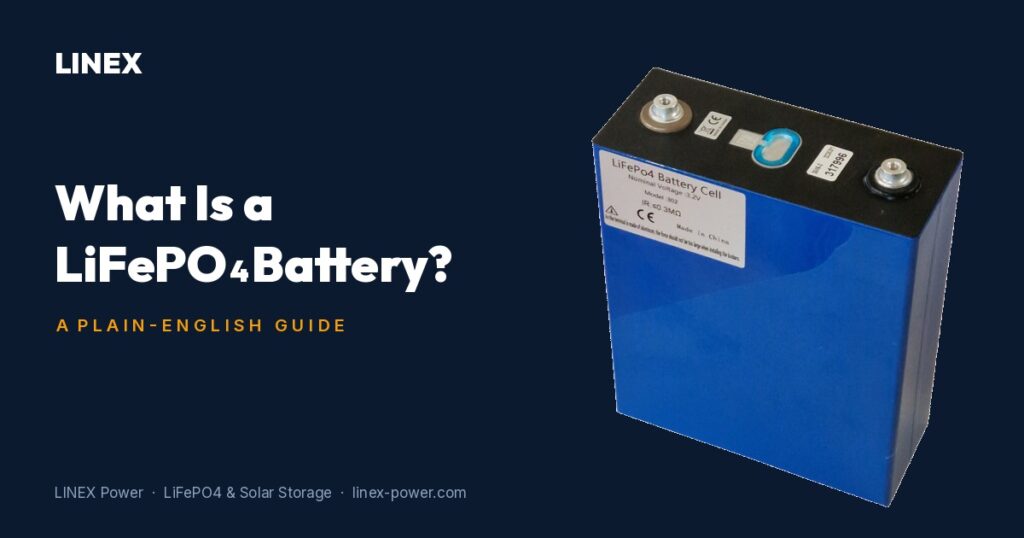
What LiFePO4 Actually Is
LiFePO4 batteries use lithium iron phosphate as the cathode material, graphite or another carbon material as the anode, and a lithium-based electrolyte to move lithium ions between them. During charging, lithium ions move to the negative side. During discharge, they move back and release electrical energy.
The important point is the phosphate structure. The chemical bond between iron, phosphorus, and oxygen is relatively stable. If the battery is damaged, overheated, or overcharged, the cathode is less likely to release oxygen than many other lithium chemistries. Less released oxygen means a lower risk of thermal runaway and fire.
That does not mean every LiFePO4 battery is automatically safe. The battery still needs a properly designed battery management system, quality cells, correct wiring, reliable protection components, and controlled manufacturing. A good BMS protects against overcharge, over-discharge, short circuit, excessive current, and abnormal temperature.
Why LiFePO4 Took Over
1. Long Cycle Life
Many quality LiFePO4 batteries are rated for 6,000+ cycles at suitable charging and discharging conditions. If a battery is used once every day, that can represent more than 16 years of theoretical cycling. In real projects, service life depends on temperature, charging voltage, discharge rate, and maintenance, but LiFePO4 normally lasts much longer than lead-acid batteries.
2. Strong Safety Margin
LiFePO4 has better thermal and chemical stability than many conventional lithium chemistries. A well-designed battery can commonly work in discharge temperatures from around -20°C to 60°C, while charging may require a narrower range, often around 0°C to 45°C. Low-temperature charging protection is essential in cold regions.
3. Lower Weight Than Lead-Acid
LiFePO4 batteries usually offer an energy density of roughly 90-160 Wh/kg, depending on the cell design and pack structure. That is lower than some high-energy lithium batteries, but still far better than typical lead-acid systems at around 30-50 Wh/kg. A LiFePO4 battery can therefore provide similar usable energy with much less weight and floor space.
4. Better Total Cost
The purchase price of LiFePO4 can be higher than lead-acid, but total ownership cost is often lower. A LiFePO4 battery can use around 80-90% of its rated capacity regularly, while lead-acid is often limited to about 50% depth of discharge for reasonable life. With fewer replacements, lower maintenance, and higher usable capacity, the cost per delivered kilowatt-hour becomes more attractive over a project’s lifetime.
How It Compares to Other Lithium Batteries
Compared with ternary lithium, also called NMC or nickel-manganese-cobalt lithium, LiFePO4 normally offers better thermal stability and a longer cycle life. NMC usually has higher energy density, often around 150-250 Wh/kg at cell level, so it can be useful where size and weight are the top priorities. LiFePO4 is generally heavier for the same rated capacity, but it is well suited to stationary storage, commercial backup, RV systems, and other applications that value safety and daily cycling. The right choice depends on the operating environment, space limits, power demand, and expected service life.
Where LiFePO4 Is Used Today
- Solar energy storage: Home and commercial systems use LiFePO4 to store daytime solar power for evening loads, with a typical usable depth of discharge of 80-90%.
- RV and marine power: Motorhomes, caravans, yachts, and workboats use lighter LiFePO4 packs for 12V, 24V, or 48V appliances, inverters, refrigeration, and onboard electronics.
- Telecom base stations: Telecom operators use LiFePO4 backup batteries to support communication equipment during grid outages, often in outdoor cabinets with remote monitoring.
- PayGo energy systems: In emerging markets, PayGo solar products use LiFePO4 for household lighting, small appliances, and mobile payments because long life reduces service visits and battery replacement costs.
- Portable power: Portable power stations and mobile work equipment use LiFePO4 for reliable backup energy, camping, emergency response, field service, and outdoor events.
What to Check When You Buy
- Cell quality: Ask whether the pack uses cells from “EVE, CATL and other tier-one makers.” The supplier should be able to provide cell model information, batch records, and capacity test data.
- Real cycle-life conditions: Confirm what “6,000+ cycles” means. Check the test temperature, charge and discharge rate, depth of discharge, and end-of-life capacity. A useful standard is 80% remaining capacity under a clearly stated test condition.
- BMS protection: Check the continuous charge and discharge current, peak current, balancing function, low-temperature charging cutoff, short-circuit protection, and communication options such as CAN or RS485.
- Usable capacity: Do not compare only the nameplate Ah rating. Confirm the usable energy, recommended DoD, inverter compatibility, and whether the battery can deliver the required power for your equipment.
- Certifications and transport: For export projects, request UN38.3 test documentation and confirm the relevant CE and RoHS compliance. The supplier should also provide safe packing and shipping instructions for the destination market.
- Warranty and after-sales support: Look for a clear 5-year warranty that defines capacity retention, covered faults, operating conditions, and response procedures. Also check production lead time, spare parts, technical documents, and support for installation or troubleshooting.
A Practical Choice for Long-Term Projects
For distributors, the strongest LiFePO4 product is not simply the one with the lowest factory price. It is the one with consistent cells, honest specifications, stable supply, clear documents, and a failure rate your service team can manage.
When those details are handled properly, LiFePO4 becomes more than a battery chemistry. It becomes a dependable platform for products that need to work every day, in different countries, and for many years.