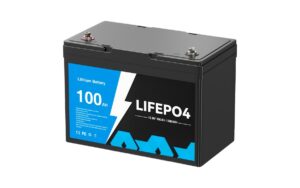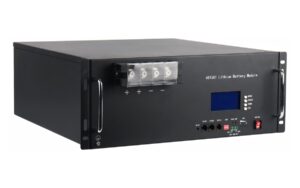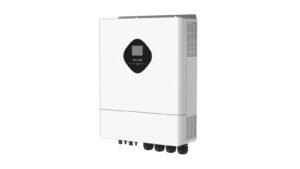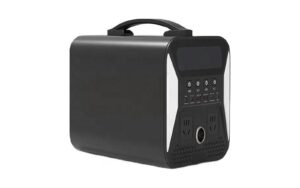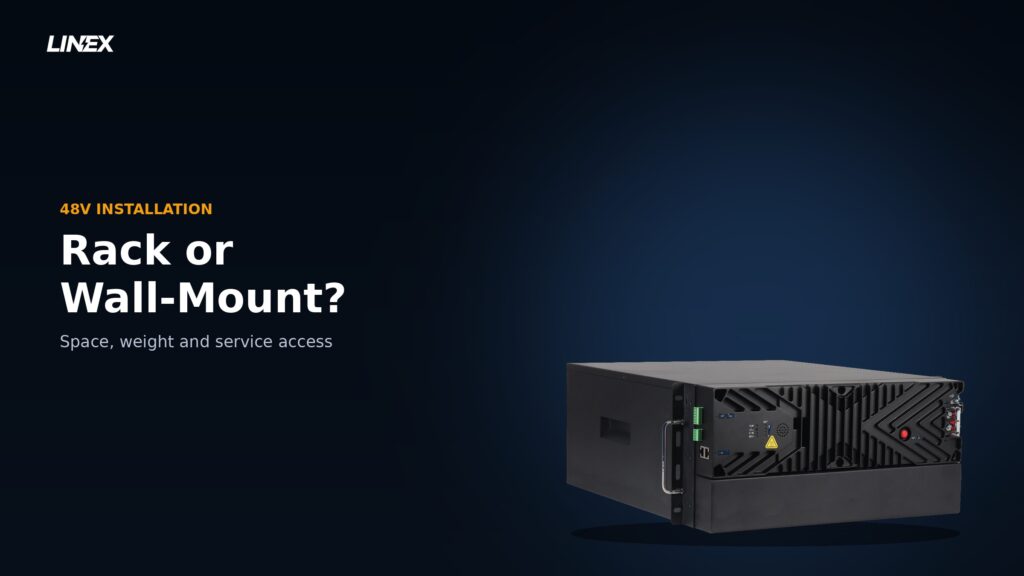
A rack battery is built around a 19-inch cabinet
The 48V 100Ah telecom battery is 3U high and fits a standard 19-inch rack. Its case measures 442mm wide, 420mm deep and 133mm high, with 482mm depth including handles and terminals. One module weighs 43kg and stores 4.8kWh. The cabinet carries the weight, provides the enclosure and keeps modules aligned on the rails.
A 19-inch rack fixes the width, so capacity grows by adding modules rather than changing the cabinet. The 48V 100Ah datasheet lists RS485 and RS232 ports, 100A charge and discharge, IP20 protection and a 10-year design life.
Rack capacity grows in 4.8kWh to 9.6kWh modules
A 48V 100Ah module adds 4.8kWh, a 48V 150Ah module adds 7.2kWh and a 48V 200Ah module adds 9.6kWh. The 200Ah case is 482mm wide, 610mm deep and 178mm high, and weighs 78kg. The smart 48V 200Ah version weighs 82kg and measures 442.6mm by 570mm by 220mm.
| Model | Energy | Dimensions (W×D×H) | Weight | Max charge / discharge | Mount |
|---|---|---|---|---|---|
| 48V 100Ah | 4.8kWh | 442×420×133mm (482mm with handles) | 43kg | 100A / 100A | 3U rack |
| 48V 150Ah | 7.2kWh | 482×440×178mm | 60kg | 150A / 150A | rack |
| 48V 200Ah | 9.6kWh | 482×610×178mm | 78kg | 100A / 100A | rack |
| Smart 48V 200Ah | 9.6kWh | 442.6×570×220mm | 82kg | 100A / 100A | rack |
The 150A rating belongs to the standard 48V 150Ah model. The smart 48V 150Ah model lists 100A charge and discharge, so check the model code before sizing the breaker.
A wall unit saves floor space but loads the wall
The wall-mounted 5kWh ESS is 410mm wide, 185mm deep and 610mm high, and weighs 46kg. It stores 5,324Wh at 51.2V nominal and accepts up to 100A charge and discharge. The wall face it covers is 0.25m², while its floor footprint is 0.076m² if it stands on the floor. The mounting surface must carry 46kg plus the pull of the cables.
The wall unit charges from 0°C to 60°C and discharges from -20°C to 70°C. Its operating range is 42V to 57.6V. The 48V telecom rack datasheet lists a 40.5V cutoff and 53.3V equalization. The two products are not interchangeable on the same charger setting.
| Question | 48V rack | Wall-mount 5kWh |
|---|---|---|
| Mount | 19-inch rack, 3U per 100Ah | wall bracket |
| Floor area | 0.19m² to 0.29m² per module | 0.076m² if it stands on the floor |
| Wall area | 0 | 0.25m² |
| Weight | 43kg to 82kg per module | 46kg |
| Energy per unit | 4.8kWh to 9.6kWh | 5.3kWh |
| Expansion | add modules in the cabinet | another wall position |
| Service access | front | front |
| Protection | IP20 | IP20 |
The floor area column uses the case footprint, not the cabinet footprint. A cabinet adds its own depth and service clearance.
Working space and floor loading set the real footprint
In a workplace installation, a rack cabinet needs 3 ft of clear working space in front, and OSHA 1910.303(g)(1) sets that as the minimum depth for equipment up to 600V to ground. The same rule requires the space to be at least 30 inches wide or the width of the equipment, whichever is greater, and says the space “shall permit at least a 90-degree opening of equipment doors or hinged panels.” A wall unit needs the same clear front zone even though it uses no floor area.
Floor loading matters when a cabinet holds several 78kg modules. Three 48V 200Ah modules weigh 234kg before the cabinet, the shelves and the cabling. Put the cabinet on a concrete floor or a structure rated for the load, and keep the working space free of storage.
A 5kWh wall unit is one block, not a scalable rack
The wall unit stores 5,324Wh, about 5.3kWh. A 48V rack module starts at 4.8kWh and reaches 9.6kWh per module. A site that needs 15kWh can use three 48V 100Ah rack modules at 14.4kWh or two 48V 200Ah modules at 19.2kWh. The wall unit would need three separate wall positions to reach the same energy, so the rack is the better fit when the load grows.
A wall unit fits a small backup load with one mounting point. A rack fits a site with an existing cabinet, a growing load or a requirement to add capacity without using more wall space.
Cable entry and service access follow the mount
A 3U rack module slides out from the front, and the 48V 100Ah datasheet lists RS485 and RS232 ports for monitoring. A 600mm deep cabinet leaves about 118mm behind a 482mm deep module for cables and connectors. The wall unit mounts at a height that puts the terminals within reach; its 46kg weight needs two people or a lift. Both products are IP20, so both need a dry indoor location.
Check the cable bend radius at the terminals and leave a service loop. A rack with a rear cable tray needs rear access or a cabinet that can be pulled out. A wall unit with bottom-entry cables needs the conduit to line up with the case entry.
What to put on the site drawing
Write seven items on the site drawing: mount type, dimensions, weight, working space, cable route, ventilation and spare capacity. For a rack, add the cabinet depth, the number of modules and the floor load. For a wall, add the wall material, the backer or stud spacing and the height of the bottom edge. A drawing that lists only the battery model does not show whether the site can carry it.
The 48V lithium battery line lists the rack models and current ratings. The 48V 100Ah telecom battery gives the 3U dimensions, 43kg weight and 53.3V equalization setting. The wall-mounted 5kWh ESS lists the 410mm by 185mm by 610mm case and 46kg weight. The telecom remote sites page covers the rest of the site equipment, and the home energy storage battery page covers the residential side.
Frequently asked questions
No. The 48V 100Ah rack model is 3U high and weighs 43kg, and it is designed for rack rails rather than a wall bracket. Use the wall-mounted ESS when the site has no cabinet.
The rack datasheet uses 48V nominal with 53.3V equalization and 51.0V float. The wall unit uses 51.2V nominal with a 42V to 57.6V operating range. Match the charger and inverter to the model, not to the nominal label.
One module needs 3U of height, 442mm of width and 482mm of depth including handles. A 600mm deep cabinet leaves about 118mm behind the module for cables.
The wall-mounted 5kWh ESS weighs 46kg. The wall must carry that weight plus cable pull, so use a backer that spans the studs.
The 5kWh unit is a single block, so expansion means another wall position or a rack. A rack scales in 4.8kWh to 9.6kWh modules inside the same cabinet.
A rack. The 48V telecom models are 3U or rack-mounted, use RS485 or RS232 for monitoring and fit the existing cabinet and rectifier room. A wall unit suits a small backup load with no cabinet.
Sources: LINEX datasheets: 48V 100Ah telecom (48V, 100Ah, 4.8kWh, 3U, 442×420×133mm, 482mm depth with handles, 43kg, 100A charge and discharge, 53.3V equalization, 51.0V float, 40.5V cutoff, RS485, RS232, IP20, 10-year design life, 6,000 cycles at 25°C and 80% DoD, checked 2026-11-14); 48V 150Ah telecom (48V, 150Ah, 7.2kWh, 482×440×178mm, 60kg, 150A charge and discharge, checked 2026-11-14); 48V 200Ah telecom (48V, 200Ah, 9.6kWh, 482×610×178mm, 78kg, 100A charge and discharge, checked 2026-11-14); Smart 48V 200Ah (48V, 200Ah, 9.6kWh, 442.6×570×220mm, 82kg, 100A charge and discharge, CAN and RS485, checked 2026-11-14); wall-mounted 5kWh ESS (51.2V, 104Ah, 5,324Wh, 410×185×610mm, 46kg, 100A maximum charge and discharge, 42V to 57.6V operating range, 0°C to 60°C charge, -20°C to 70°C discharge, IP20, checked 2026-11-14); OSHA 29 CFR 1910.303(g)(1), working space about electric equipment, 30-inch minimum width, Table S-1 depth and 90-degree door opening (checked 2026-11-14); 48V lithium battery line (checked 2026-11-14); telecom remote sites page (checked 2026-11-14); home energy storage battery page (checked 2026-11-14). Last updated 2026-11-14.
Related: the home battery capacity guide shows how many kWh a wall-mounted or rack bank needs for a 3kWh to 10kWh daily essential load.