Most 5kW solar questions mix three ratings: array watts, inverter watts and battery kWh. They are related, but none sets the others directly. This guide separates them using published LINEX figures for the 48V rack series and the MKSII 5KW off-grid inverter; the 48V lithium battery for solar guide covers the wider selection logic.
Related tool: Ah to kWh calculator. Convert amp-hours to kilowatt-hours for 12V, 24V, 48V and 51.2V batteries.
What Does “5kW” Refer To: Array or Inverter?
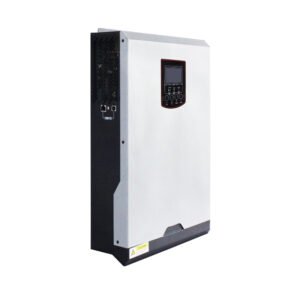
The MKSII 5KW is a 5,000W inverter with a 48Vdc battery input, 4,500W maximum PV array power and an 80A maximum solar charge current. Peak efficiency is 90–93%, and AC charging is also limited to 80A.
If the plan is a 5,000W array, the inverter’s 4,500W PV limit is below it. The controller cannot use more than its published limit, and charge current stops at 80A regardless of panel count. If the plan is a 5,000W inverter, check the array against 4,500W rather than assuming the labels match.
The battery must match the 48V DC window. A 24V bank will not start the inverter, and a 51.2V pack uses a different charge profile. Most 48V hybrid inverters accept a DC window of roughly 40–60V, so a 51.2V pack sits near the top of the range while a 48V nominal pack sits in the middle. Check the inverter’s charge profile before mixing the two voltage classes on one site. For the full model range and sizing tables, see our 24V lithium battery range.
How Many kWh Does a 5kW System Need at Night?
Size from nightly consumption: nominal kWh = nightly kWh ÷ (depth of discharge × system efficiency). At 80% depth and 90% efficiency the divisor is 0.72, so a 5kWh night needs 6.9kWh nominal.
The 80% depth figure is not arbitrary: the 48V modules are rated for 6,000 cycles at 80% depth of discharge, and the 90% efficiency is a system-level allowance for conversion and wiring losses. Sizing at 100% depth would use energy outside the published cycle rating.
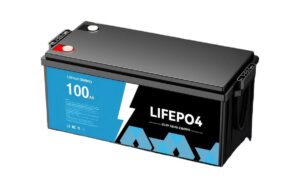
That is the 48V 150Ah module at 7.2kWh. The 100Ah module delivers about 3.4kWh at the load; the 200Ah delivers about 6.9kWh. The table applies the same factor to typical nightly loads and adds the current check.
| Nightly load | Nominal needed (÷0.72) | Recommended bank | Delivered at load (×0.72) | Sum of module ratings | Full 5kW load? |
|---|---|---|---|---|---|
| 3.0 kWh | 4.2 kWh | 1 × 48V 100Ah | 3.46 kWh | 100A | No — about 112A demand |
| 5.0 kWh | 6.9 kWh | 1 × 48V 150Ah | 5.18 kWh | 150A | Yes |
| 6.5 kWh | 9.0 kWh | 2 × 48V 100Ah | 6.91 kWh | 200A | Yes |
| 9.0 kWh | 12.5 kWh | 2 × 48V 150Ah | 10.37 kWh | 300A | Yes |
| 12.0 kWh | 16.7 kWh | 2 × 48V 200Ah | 13.82 kWh | 200A | Yes |
The delivered column assumes 80% depth and 90% efficiency. Discharge current is the sum of module ratings; confirm the BMS parallel limit before adding a third module. The two-day 48V solar bank example works the same method over a longer outage.
Why Current, Not Just Capacity, Rules a 5kW Bank
A 5,000W load at 48V draws about 112A at 93% efficiency and about 116A at 90%. The 100Ah module is rated 100A continuous, so it cannot carry a full 5kW output on its own.
The 150Ah module at 150A covers the full load. The 200Ah stores more energy but is still rated 100A continuous, so it does not solve the current problem alone. Two 100Ah modules in parallel give 200A and 9.6kWh.
The MKSII allows 2× rated power for 5 seconds; the BMS must tolerate the surge current, and published module ratings are continuous only. Confirm the peak limit for the exact BMS before relying on surge performance.
| Model | Nominal energy | Usable at 80% DoD | Max charge / discharge | Weight | Rack height |
|---|---|---|---|---|---|
| 48V 50Ah | 2.4 kWh | 1.92 kWh | 50A / 50A | 29kg | 3U |
| 48V 100Ah | 4.8 kWh | 3.84 kWh | 100A / 100A | 43kg | 3U |
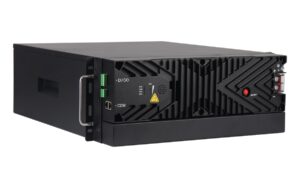
| 48V 150Ah | 7.2 kWh | 5.76 kWh | 150A / 150A | 60kg | 4U |
| 48V 200Ah | 9.6 kWh | 7.68 kWh | 100A / 100A | 78kg | 4U |
How Fast Will It Recharge, and Which Model Fits?
The MKSII caps solar charge current at 80A. At 48–53.3V that is roughly 3.8–4.3kW into the battery, so a 5kW array never sends 5kW to the pack; surplus serves daytime loads or is limited by the charger.
The inverter can also charge from AC at 80A. On a generator-backed site that is the same current limit as solar, so a 100Ah module still needs about 45 minutes for a 20–80% swing, while a 150Ah module needs about 1.1 hours at 80A.
A 100Ah module needs 60Ah, or 2.88kWh, to move from 20% to 80%. At 80A the constant-current phase is under an hour; absorption adds time, and cold cells can extend it near 0°C. The 150Ah equivalent is 90Ah, or 4.32kWh.
Match the bank to the nightly load, then check continuous current. The 150Ah is the smallest single unit covering full 5kW; the 100Ah suits lighter loads or a parallel pair; the 200Ah suits a 6.5kWh night without sustained full load.
Rack space follows the same step: 3U for the 50Ah and 100Ah modules, 4U for the 150Ah and 200Ah, before the rectifier, breakers and cable management are counted.
Keep the heaviest modules low and leave the fan path clear. The 43kg module is a two-person lift; the 78kg unit needs equipment or a temporary platform, and the shelf must be rated for the layout.
Physical fit: the 100Ah is 442 × 420 × 133mm with 482mm installed depth and 43kg; the 150Ah is 482 × 440 × 178mm and 60kg; the 200Ah is 482 × 610 × 178mm and 78kg. The 200Ah’s 610mm depth catches installers who measured the external cabinet footprint. Full details are on the 48V 150Ah LiFePO4 product page.
Set the charge profile to the battery datasheet: 53.3V equalization, 51.0V float and 40.5V cutoff. The MKSII lists 54V float, so do not leave the inverter default in place.
Need a 48V bank sized for a 5kW system? Send your nightly load, inverter model and site temperature to our team for a module count and a quote.
Frequently asked questions
Not at full output. A 5,000W load at 48V and 93% efficiency draws about 112A, above the module’s 100A continuous rating. It can run lower loads; for full 5kW, use the 150Ah module or two 100Ah modules in parallel.
For a 5kWh nightly load, one 150Ah module is the direct fit. If you standardize on 100Ah, two in parallel give 9.6kWh and 200A continuous, covering both the energy and the full-load current.
The charger, not the array, sets the current. The MKSII 5KW limits solar charge current to 80A, below the 100Ah module’s 100A maximum, so the battery does not see the array’s full output.
Use the battery datasheet: 53.3V equalization, 51.0V float and 40.5V cutoff. The MKSII’s listed float is 54V, so set the profile deliberately rather than leaving the inverter default.
Yes, it is a 48V LiFePO4 pack rated for 6,000 cycles at 80% depth of discharge. The rack format suits a power room, and the IP20 rating needs a protected indoor location or a suitable cabinet. Standard models use RS485 and RS232; Smart models use CAN and RS485. For the full model range and sizing tables, see our telecom battery backup guide.