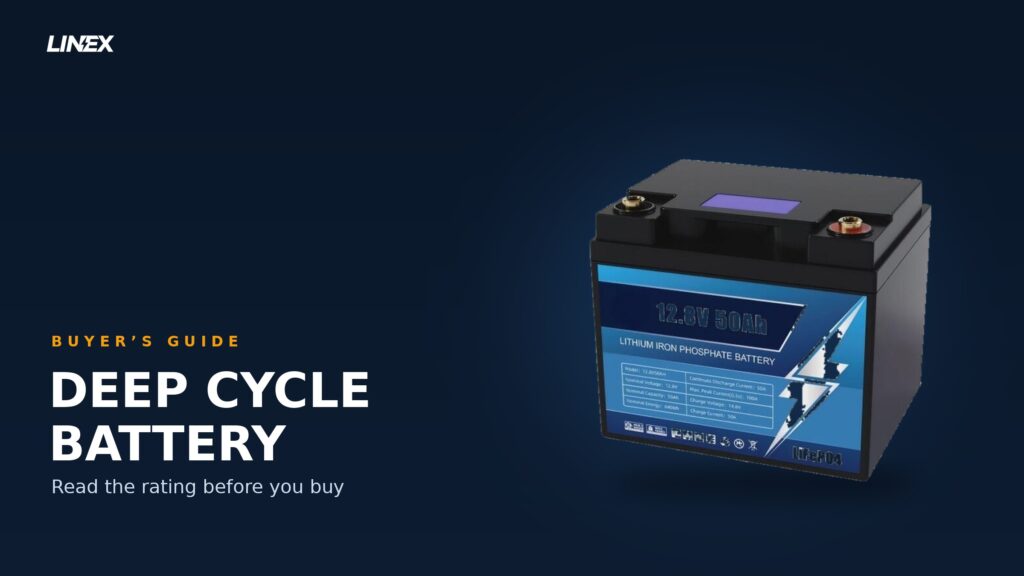
Most buyers compare amp-hours and stop there, which is why two “100Ah” batteries can deliver 1.28 kWh and 0.6 kWh. The label only means something once you know the discharge rate it was measured at, the depth of discharge expected and the temperature. This guide decodes those numbers for flooded, AGM and deep cycle lithium battery designs, then turns them into a sizing method.
What Do the Numbers on a Deep Cycle Battery Mean?
Three ratings do most of the work: amp-hours at the 20-hour rate, watt-hours, and cycle life at a stated depth of discharge. C20 is the standard capacity basis under IEC 60095-1: a 100Ah rating means 5A for 20 hours before the battery falls to 10.5V at 25°C.
Discharge faster and you get less. That is Peukert’s effect, published in 1897: lead-acid exponents typically sit between 1.1 and 1.3, while LiFePO4 stays close to 1.0, so its capacity holds up better under load. Watt-hours matter more than amp-hours once a load runs through an inverter: 12.8V × 100Ah = 1,280Wh.
| Rating | What it measures (standard) | Example, 12V 100Ah | Use it for |
|---|---|---|---|
| Ah at C20 | Amps × hours at the 20-hour rate to 10.5V at 25°C (IEC 60095-1) | 100Ah = 5A for 20h | Comparing capacity like for like |
| Wh | Nominal voltage × amp-hours | 1,280Wh | Inverter loads and runtime math |
| Reserve capacity | Minutes at 25A to 10.5V at 25°C (BCI) | About 4 hours on paper | House loads in RV, marine and telecom |
| CCA | 30 seconds at −18°C down to 7.2V (BCI) | Not published for deep cycle | Cranking — not this battery’s job |
| Cycle life | Full cycles to 80% of original capacity, at a stated DoD | 6,000 at 80% DoD, 25°C | Service life and cost per kWh |
The same 100Ah label covers 1.28 kWh in LiFePO4 and about 1.2 kWh in a lead-acid block — and only half of the lead-acid figure is usable by design.
How Deep Can You Discharge Before Life Drops?
Depth of discharge is the share of capacity removed in a cycle. A lead-acid deep cycle battery is usually cycled to 50% DoD to reach its published life; LiFePO4 tolerates 80–100% because the BMS stops discharge at a cell-level cutoff instead of letting voltage collapse.
Cycle life must be read with its DoD. The LINEX 12V 100Ah datasheet claims 6,000 cycles at 80% DoD and 25°C; a typical AGM block is rated 300–500 cycles at 50%. Multiply cycles by usable kWh to compare throughput: 6,000 × 1.02 kWh is roughly 6,100 kWh per 100Ah unit. The arithmetic behind that rating is worked through in our LiFePO4 cycle and depth-of-discharge guide.
Temperature moves both numbers. Capacity falls in the cold, and LiFePO4 charging is blocked below 0°C, so an unheated compartment needs heat or a charge schedule that waits for warmer hours.
Lead-Acid, AGM or LiFePO4: What Changes in Practice
Chemistry changes weight, usable energy and maintenance more than the label. The table compares a 12V 100Ah block in each family, with published LINEX figures for LiFePO4 and industry-typical figures for AGM.
| Factor | 12V 100Ah LiFePO4 | 12V 100Ah AGM (typical) | What it means on site |
|---|---|---|---|
| Usable energy | 1.02 kWh at 80% DoD | About 0.6 kWh at 50% DoD | The LFP block replaces a 200Ah AGM bank |
| Weight | About 10 kg | 30–33 kg | One-person lift instead of two |
| Cycle life | 6,000 at 80% DoD, 25°C | 300–500 at 50% DoD | About 25× the lifetime throughput per unit |
| Charge profile | 14.6V absorption, 13.5–13.8V float | 14.4–14.7V absorption, 13.2–13.6V float | The charger must be set, not assumed |
| Charging below 0°C | Blocked by the BMS | Allowed, with capacity loss | Cold-climate installs need heat or timing |
| Maintenance | Terminal check once a year | Terminal cleaning; sulfation risk if left partial | Lower labor cost over 10 years |
A 100Ah LiFePO4 therefore replaces a 200Ah AGM bank in usable terms at about a third of the weight. Charging is the other difference: a lead-acid charger with equalize or desulfation mode must not be used on a lithium ion deep cycle battery, which needs 14.6V absorption and 13.5–13.8V float. A lithium deep cycle pack also accepts up to 1C, where an AGM of the same size is limited to roughly 20–25A.
How to Choose the Best Deep Cycle Battery
There is no universal “best deep cycle battery” — only the best match for a discharge profile. Four things separate a good unit: a capacity rating that states its C-rate and temperature, a BMS with published continuous limits, a cycle-life claim tied to a DoD, and test data for the exact model rather than the cell. Ask for the datasheet: a lifepo4 deep cycle battery should list absorption and float voltages, cutoff, temperature windows and current limits. For a deep cycle lifepo4 battery in a vehicle or boat, check the IP rating and whether the model is series-rated.
Then size it: list every load in watts and hours, divide by system efficiency (about 0.9 with an inverter), divide by the DoD you plan to use (0.8 for LiFePO4, 0.5 for lead-acid), and convert to amp-hours at the system voltage. Check continuous current against the BMS, not just energy.
A 1.5 kWh nightly load at 12V needs 1.5 ÷ 0.72 = 2.08 kWh nominal, or about 163Ah. One 12V 200Ah unit (2.56 kWh, 2.05 kWh usable) covers it with margin; two 100Ah units in parallel give the same energy with redundancy. The 12V lithium battery range lists case sizes, the 12V 200Ah LiFePO4 model page carries the datasheet, and the 12V 100Ah buying guide covers the smaller case.
Need a bank sized from your own load list? Send the daily kWh, system voltage and site temperature and we will return a model count and a quote.
Frequently asked questions
No. Deep cycle describes the duty, not the chemistry: flooded, AGM, gel and LiFePO4 can all be deep cycle. A deep cycle lithium battery simply uses a lithium chemistry, with 80–100% usable capacity instead of about 50%.
The LINEX 12V 100Ah LiFePO4 model delivers 100A continuous, which is 1C and 1,280W at 12.8V. A comparable AGM block is typically rated 0.2–0.3C for continuous deep-cycle duty, so 20–30A.
Only in an emergency. Deep cycle models are not rated for cold cranking amps, and starter inrush can trip the BMS or damage a lead-acid deep cycle plate. Use a starting battery for engines.
LiFePO4: 6,000 cycles at 80% DoD and 25°C is about 16 years at one cycle a day, though calendar aging usually ends service at 10–15 years. AGM: 300–500 cycles at 50% DoD — about 1–1.5 years of daily cycling, or 3–5 years of weekend use.
LiFePO4 is one lithium-ion chemistry, not a separate family. It suits deep cycle work because of its 6,000-cycle rating at 80% DoD, thermal stability and flat discharge curve; NMC trades cycle life for energy density.
Sources: LINEX 12V 100Ah LiFePO4 datasheet (1,280Wh, 100A continuous, 6,000 cycles at 80% DoD, 14.6V absorption, 13.5–13.8V float); IEC 60095-1 for the C20 rating basis; BCI definitions for reserve capacity and cold cranking amps; Peukert (1897). AGM figures are industry-typical and vary by manufacturer.