Usable energy: 0.6kWh from a 100Ah lead-acid block
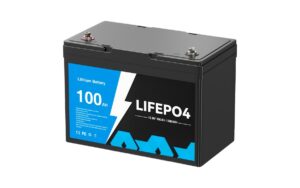
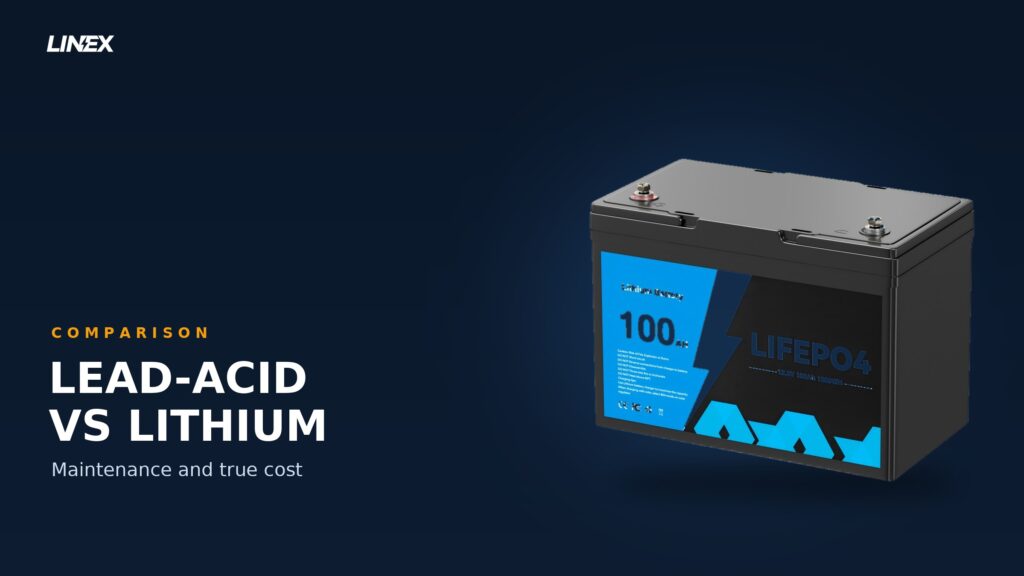
A 100Ah lead-acid block gives about 0.6kWh of usable energy per cycle at 50% depth of discharge: 12V x 100Ah x 0.5. Lead-acid capacity is quoted at the 20-hour rate, and discharging below 50% leaves sulfate crystals on the plates. The 12V 100Ah LiFePO4 battery runs to 80% DoD, which is 1.02kWh from the same label.
Discharge rate adds a second loss. Peukert’s equation from 1897 describes how lead-acid capacity falls as current rises, with an exponent typically between 1.1 and 1.3. LiFePO4 sits near 1.0, so a 100A load takes less out of its rated capacity.
Weight follows the same pattern: about 10kg for the lithium unit against 30kg to 33kg for an AGM block of the same label.
| Metric | 12V 100Ah AGM (typical) | 12V 100Ah LiFePO4 (LINEX) |
|---|---|---|
| Nominal energy | 1.2kWh | 1.28kWh |
| Usable per cycle | 0.6kWh at 50% DoD | 1.02kWh at 80% DoD |
| Rated cycles | 300 to 500 | 6,000 |
| Lifetime delivered energy | 180 to 300kWh | 6,120kWh |
| Weight | 30 to 33kg | about 10kg |
| Cycle life test conditions | 25°C, 50% DoD | 25°C, 80% DoD |
Maintenance: watering, equalizing and terminal care
Flooded lead-acid is the only common battery that needs water. Cells lose water to gassing near the end of absorption, so the plates must stay covered and the level checked every one to three months.
Use distilled water, not tap water, which adds minerals.
AGM and gel are valve-regulated and need no water, but they still need clean, tight terminals and a full recharge after each discharge. A partial state of charge leaves the plates sulfated, and the lost capacity does not come back. LiFePO4 needs no watering or equalization; the BMS balances the cells, and the annual check is terminal torque plus the BMS log.
| Task | Flooded | AGM | LiFePO4 |
|---|---|---|---|
| Water level check | every 1 to 3 months | none | none |
| Terminal cleaning and torque | every 6 months | every 6 to 12 months | every 12 months |
| Full recharge after discharge | within 24 hours | within 24 hours | avoid storage below 20% |
| Equalization charge | monthly to quarterly | generally not recommended | not applicable |
| Specific gravity check | monthly | not possible | not applicable |
| Ventilation | hydrogen gas, vented space | vented space | none |
Replacement cadence: nine lead-acid blocks against one lithium pack
At one cycle per day, a 400-cycle lead acid deep cycle battery lasts about 13 months. Ten years of that duty needs nine blocks, eight of them replacements, plus the labor to swap each one.
A 6,000-cycle LiFePO4 pack reaches 16.4 years at the same rate, so one pack covers the decade, and calendar aging rather than cycle count ends its service.
Weekend use changes the arithmetic but not the direction. At 100 cycles a year, the AGM block lasts four years and needs two replacements in ten years; the lithium pack is still on its first. The 12V lithium battery range covers 10Ah to 300Ah for both duty patterns.
True cost per delivered kWh: lithium wins unless it costs 25 times more
The LiFePO4 block costs less per kWh delivered unless it costs more than 25 times the AGM price. Divide the purchase price by lifetime energy: 400 cycles x 0.6kWh gives 240kWh for the AGM block, and 6,000 x 1.02kWh gives 6,120kWh for LiFePO4, or 25.5 times more throughput. The datasheet line “Cycle Life (25°C, 80% DoD): 6000” underlies that figure.
That comparison excludes labor, chargers and downtime. Add them and the gap widens: eight swaps against one install. LiFePO4 needs 14.6V absorption and 13.5V to 13.8V float, with no equalize cycle, so an old charger without a lithium setting needs replacement or reprogramming. The ten-year LiFePO4 cost comparison walks through the same method.
Purchase prices move with cells, freight and order size, so no figures appear here. Run both on a quote.
Charging habits that decide lead-acid life
In RV and marine service, lead-acid dies from undercharging more often than from overcycling. A battery left at 70% state of charge for weeks sulfates, and the lost capacity cannot be reversed. Charge after every use, and hold absorption until current falls to about 2A on a 100Ah block. The 12V 100Ah LiFePO4 buying guide covers the lithium swap.
Temperature splits the two chemistries. Lead-acid accepts charge below 0°C, with reduced capacity and a risk of freezing if discharged. LiFePO4 blocks charging below 0°C at the BMS to prevent lithium plating, so an unheated compartment needs a heated model or a charge window above freezing. Both lose usable capacity in the cold.
Ventilation matters for flooded blocks. Charging produces hydrogen, so the compartment needs an opening at the top and the bottom and no spark source. AGM releases less gas but still needs a vented space.
Where a deep cycle lead acid battery still makes sense
Lead-acid is cheaper for shallow cycling, standby backup and sites that cannot charge lithium above freezing. It tolerates a high-current burst and a dumb charger, though a long sit at partial charge sulfates the plates.
The trade is weight, service time and a shorter replacement cycle.
LiFePO4 fits daily cycling, deep discharges and tight compartments. A lead acid battery for an RV house bank is the clearest case: 1.02kWh usable per 10kg against 0.6kWh per 30kg, and no watering in a cramped space. A lead acid RV battery also needs a full recharge every day; the lithium pack can wait. The RV and van electrical guide covers the charger and DC-DC changes.
Neither chemistry is a starting battery. Deep cycle models publish no cold cranking ratings, and starter inrush can trip a lithium BMS or warp a lead-acid plate. Keep a dedicated starting battery. Send daily kWh, bank voltage and site temperature for a model count and a quote.
Frequently asked questions
At the counter, yes. Per kWh delivered, no. A 100Ah AGM block delivers about 240kWh over its rated life against 6,120kWh for a LiFePO4 block of the same label, so the lithium unit wins unless it costs more than 25 times as much.
Check every one to three months, more often in hot weather or daily cycling. Top up with distilled water after charging, just enough to cover the plates.
Yes, if the charger has a lithium profile at 14.6V absorption and 13.5V to 13.8V float, and the alternator feed is limited with a DC-DC charger. Check the compartment temperature, because charging stops below 0°C.
Only if the existing charger cannot be set to 14.6V absorption and 13.5V to 13.8V float, or if it runs an equalize or desulfation cycle. Those modes overcharge lithium cells.
AGM: 300 to 500 cycles at 50% DoD, or 10 to 16 months of daily cycling. LiFePO4: 6,000 cycles at 80% DoD, about 16 years at one cycle a day, though calendar life usually lands at 10 to 15 years.
Sources: LINEX 12V 100Ah LiFePO4 datasheet (1,280Wh, 100A continuous, 6,000 cycles at 80% DoD and 25°C, 14.6V absorption, 13.5V to 13.8V float, 0°C to 50°C charge window, about 10kg); IEC 60095-1 for the 20-hour capacity basis; Peukert (1897). AGM and flooded figures are industry-typical and vary by manufacturer.