A 48V lead-acid string has 24 cells; the LiFePO4 pack has 15
A 48V lead-acid plant is 24 cells at 2V each. A 48V LiFePO4 pack is 15 cells at 3.2V each, so the two chemistries share a nominal voltage but not a charge profile. A 16S LiFePO4 pack at 51.2V is a different product and needs its own settings.
The cell count explains the float gap. Twenty-four lead-acid cells float at 2.25V each, or 54.0V, while 15 LiFePO4 cells float at 3.4V each, or 51.0V. A rectifier set for the lead-acid plant will hold the lithium pack 3V above its float specification.
Telecom plants often run as a -48V DC system with the positive terminal bonded to ground. Confirm that the battery, BMS and rack insulation suit the site grounding arrangement before ordering. Nominal voltage alone does not settle that question.
A 100Ah module replaces a 150Ah lead-acid string
Usable energy decides the swap, not the Ah label. A 150Ah lead-acid string at 48V gives 3.6kWh at 50% depth of discharge. A 100Ah LiFePO4 module gives 3.84kWh at 80% depth, so it matches the duty with a little headroom.
The lead-acid string also loses capacity as it ages and as discharge current rises. A string at end of life may deliver half its rated Ah, which is why operators replace on measured capacity rather than the nameplate.
| Item | 48V 150Ah VRLA string | 48V 100Ah LiFePO4 |
|---|---|---|
| Cells in series | 24 x 2V | 15 x 3.2V |
| Nominal energy | 7.2kWh | 4.8kWh |
| Usable energy | 3.6kWh at 50% DoD | 3.84kWh at 80% DoD |
| Weight | about 180kg | 43kg |
| Rack format | four blocks on one shelf | 3U, 19-inch rack |
| Float / equalize | 54.0V / 56.4V | 51.0V / 53.3V |
| Cycle rating | 300 to 500 at 50% DoD | 6,000 at 80% DoD |
| Monitoring | voltage and current only | RS485 and RS232 |
| Design life | 3 to 5 years typical | 10 years |
The 100Ah module is rated 100A continuous, which covers a 4.8kW DC site load at 48V. A site with a 6kW peak needs the 48V 150Ah telecom lithium battery at 150A, or two 48V 100Ah modules in parallel.
The rectifier float setpoint moves from 54.0V to 51.0V
A rectifier set for a lead-acid plant holds the bus at 54.0V float and raises it to 56.4V for equalize. The LiFePO4 module specifies “Floating Charge Voltage: 51.0Vdc” and “Equalization Charge Voltage: 53.3Vdc”, so both setpoints must come down. An equalize timer left active sends 56.4V into a pack whose datasheet equalize figure is 53.3V.
Temperature compensation must be disabled. A lead-acid charger shifts voltage with temperature, and the LiFePO4 BMS already manages cell voltage. Check the low-voltage alarm and disconnect settings as well, because a lead-acid site often treats 43.2V as empty while the LiFePO4 pack can run to 40.5V.
| Parameter | Lead-acid setting | LiFePO4 setting | Action |
|---|---|---|---|
| Float voltage | 54.0V | 51.0V | Lower the setpoint |
| Equalize voltage | 56.4V | 53.3V | Disable automatic equalize |
| Low-voltage disconnect | 43.2V typical | Above the 40.5V cutoff | Confirm with a discharge test |
| Temperature compensation | About -3mV/°C/cell | Off | Disable |
| Charge current limit | 0.1C to 0.2C | 100A per 100Ah module | Set the rectifier limit |
A low-voltage disconnect at 43.2V gives up usable capacity, while one below 40.5V lets the BMS open first. Keep the site disconnect above the battery cutoff and prove it during commissioning. The telecom remote site battery guide lists the rectifier settings for a 48V plant.
Charge current is limited to 100A per 100Ah module
The module accepts 100A charge and 100A discharge at 25°C. A rectifier bay rated 200A or 300A can exceed that when the site load is light and the battery is deeply discharged, so the rectifier current limit must follow the module count.
Two modules accept 200A and three accept 300A. The 150Ah module accepts 150A, while the 200Ah module stays at 100A, so a larger case does not always mean a faster charge. At 51V, 100A is about 5.1kW of charge power.
Check the DC breaker against the module rating as well. A breaker sized for a 150Ah lead-acid string may be too large to protect one 100Ah module, and an AC breaker is not a substitute for a DC-rated device.
The rack footprint drops from four blocks to 3U
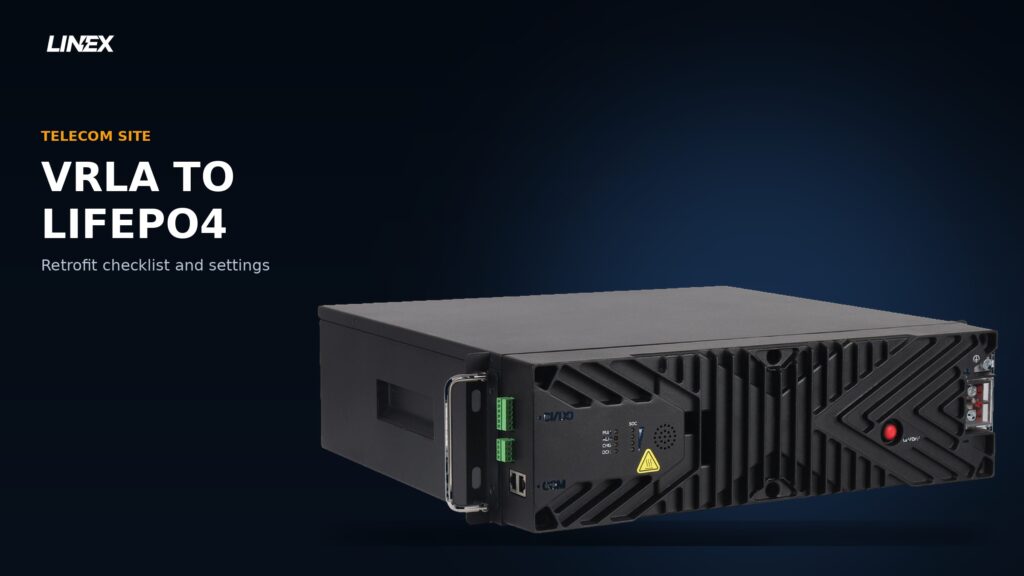
Four 12V 150Ah VRLA blocks need a shelf and clearance for terminal access. The 48V 100Ah LiFePO4 module is 442mm wide, 420mm deep and 133mm high, or 482mm deep with handles and terminals, and fits a 19-inch rack at 3U.
Weight falls from about 180kg to 43kg, which changes the lifting plan and the floor loading. Two people can move the module; the old string usually needs a pallet truck. The case is IP20, so the retrofit suits an indoor power room or a cabinet, not a pole. Keep one U clear above and below for airflow.
Commissioning needs a float check, a load test and an alarm test
After the rectifier is set to 51.0V float and 53.3V equalize, charge the pack to float and confirm the bus holds within 0.2V of the setpoint. Apply the site load with AC off and log the discharge current and runtime against the calculated figure. Finish with a BMS alarm test and a cell delta reading at rest.
A 100Ah module at a 1kW load should run about 3.6 hours at 80% depth and 95% DC efficiency. A short runtime usually points to an unlisted load, such as a cabinet heater or an air conditioner, before it points to the battery.
Staged migration keeps the old string off the new bus
Do not parallel a lead-acid string and a LiFePO4 pack on the same DC bus. Their charge profiles and internal resistance differ, and the lead-acid string will sit at a voltage the lithium BMS reads as full or empty. Move one string at a time and keep the old string on its own rectifier and load path until it is removed.
A two-string site can run one of each during the changeover if the rectifiers are separate and the load transfer is planned. Install the lithium string, commission it on a test load, then transfer the site load and retire the lead-acid string. Label the DC cables and update the site drawing before the swap. The 48V rack battery installation checklist covers the mechanical items.
What changes after the retrofit
Maintenance visits drop from capacity tests and equalize checks to terminal torque and BMS log review. The module reports cell voltage, temperature and state of charge over RS485 or RS232, which a site controller can poll. The 6,000-cycle rating at 80% depth is well beyond the cycling a typical telecom site sees, so calendar life and cabinet temperature set the replacement date.
The datasheet gives a 10-year design life. A VRLA string in the same cabinet is typically replaced at three to five years, so the retrofit spreads the replacement over a longer window. Request a quote with the site load, backup hours and rectifier model rather than a module count alone.
Frequently asked questions
Yes if it can be set to 51.0V float and 53.3V equalize, and if its current limit can follow the module count. Check the low-voltage disconnect and alarm thresholds as well. A rectifier whose minimum float setting sits above 53.3V is not suitable for a 15S LiFePO4 pack.
A 200Ah lead-acid string gives about 4.8kWh usable at 50% depth. One 100Ah LiFePO4 module gives 3.84kWh at 80%, so two modules give 7.68kWh. For a like-for-like match, one 150Ah module at 5.76kWh usable is closer.
Check the breaker against the module’s 100A continuous rating and the cable ampacity. A breaker sized for a 150Ah lead-acid string may be too large for one 100Ah module. Use a DC-rated breaker, not an AC breaker.
The BMS blocks charging below 0°C. Discharge continues to -20°C. A site that charges from a rectifier in an unheated cabinet needs a heating option or a temperature-controlled room.
Not on the same bus without an engineering review. The two chemistries have different charge profiles and internal resistance. Run them on separate rectifiers and transfer the load, or take the site off battery during the swap.
Sources: LINEX 48V 100Ah, 150Ah and 200Ah datasheets (4.8kWh to 9.6kWh, 100A to 150A continuous, 53.3V equalize, 51.0V float, 40.5V cutoff, 6,000 cycles at 80% DoD, 10-year design life); LINEX telecom remote site guide for rectifier and site load figures; LINEX 48V range page for the 48V DC bus and charge settings; Peukert (1897) for lead-acid rate effects. VRLA float, equalize and cycle figures are industry-typical and vary by manufacturer. Last updated 2026-10-25.
For the capacity comparison between case sizes, see the 48V 100Ah vs 200Ah telecom battery guide. The 48V lithium battery range lists every rack model, and the 48V lithium battery systems overview covers telecom, storage and rack use together.