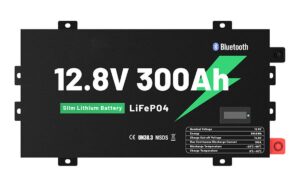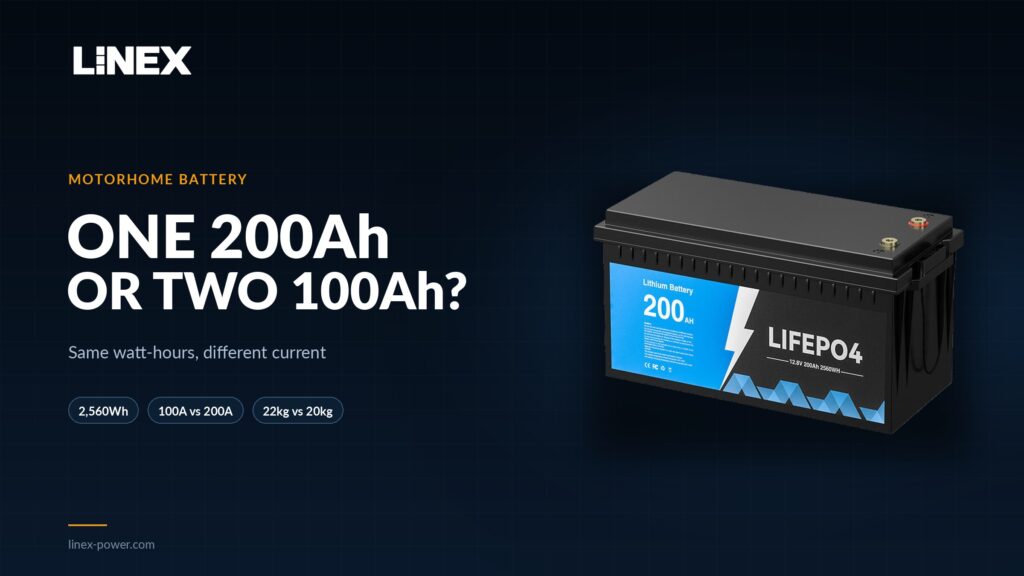
Both options store 2,560Wh, but only the pair doubles current
A 12V 200Ah battery and two 12V 100Ah batteries in parallel both store 2,560Wh. The difference is the BMS. The 200Ah pack has one 100A limit. The pair has two 100A limits, one per pack, for 200A total when the cables share current evenly.
That single number decides the inverter. At 12.8V, 100A delivers 1,280W DC, about 1,150W AC after 90% inverter efficiency. A 2,000W inverter pulls about 174A, so it needs the pair or a 24V pack.
The 100A BMS sets the inverter ceiling
The 12V 200Ah datasheet lists “Maximum Continuous Discharge Current (A): 100”. So does the 12V 100Ah sheet. Capacity doubles, current does not.
| Inverter output | DC current at 12.8V, 90% efficiency | One 12V 200Ah | Two 12V 100Ah |
|---|---|---|---|
| 1,000W | 87A | Yes | Yes |
| 2,000W | 174A | No, over 100A | Yes, 87A per pack |
| 3,000W | 260A | No | No, over 200A |
The 2,000W row is the reason to buy two 100Ah packs. Each pack carries about 87A, inside its 100A limit. One 200Ah pack would carry the full 174A and disconnect.
Two 100Ah packs weigh 20kg and need 664mm of tray length
Two 100Ah packs weigh about 20kg in total, and each unit is about 10kg. One 200Ah pack weighs about 22kg. The pair is 2kg lighter, but the weight is split into two units that are easier to lift into a high locker.
| Layout | Rated energy | Continuous current | Weight | Case footprint | Total volume |
|---|---|---|---|---|---|
| One 12V 200Ah | 2,560Wh | 100A | about 22kg | 524 x 245mm | about 28.2L |
| Two 12V 100Ah | 2,560Wh | 200A | about 20kg | 664 x 172mm | about 24.9L |
The pair is 140mm longer. It fits a 700mm tray or two separate compartments. The single 200Ah fits a 550mm tray but needs 245mm of depth. Measure the opening, the terminal height and the hold-down clearance before choosing.
Parallel wiring adds two fuses and a balance check
Two 100Ah packs need two fuses, one at each battery positive, and equal cable lengths to a common busbar. A 125A fuse per pack is a working size for a 100A BMS. If one cable is shorter, that pack carries more current and may hit its 100A limit first. Use the same model, the same age and a similar state of charge. Do not parallel a new pack with an old one.
One 200Ah pack has one BMS, one fuse and one set of terminals. Fewer connections mean fewer points to check, and there is no current split to balance.
Series wiring makes 24V, not 200Ah
Two 12V 100Ah batteries can also be wired in series to make a 24V 100Ah bank, provided the BMS is rated for series connection. That bank stores the same 2,560Wh, but it is not a 12V 200Ah replacement. Series wiring doubles the voltage and leaves the capacity at 100Ah. Parallel wiring doubles the capacity and leaves the voltage at 12V.
| Wiring | Resulting bank | Rated energy | Continuous current | System voltage |
|---|---|---|---|---|
| Two 12V 100Ah in parallel | 12V 200Ah | 2,560Wh | 200A total | 12V |
| Two 12V 100Ah in series | 24V 100Ah | 2,560Wh | 100A | 24V |
A 24V bank needs a 24V charger, a 24V inverter setting and DC-DC converters for any 12V appliance. The 24V 100Ah datasheet lists an 8S cell configuration and a 29.2V charge voltage, which confirms it is a different pack, not a 12V pack with a different label. The 4S cell configuration on the 12V pack describes its internal layout, not external series support. Use series wiring only when the rest of the system is built for 24V and the BMS is rated for it.
Redundancy is partial, not full
If one 100Ah BMS trips, the other pack keeps the fridge and lights running. That is useful on a trip. It does not save a 2,000W inverter at full load, because the remaining 100A pack cannot carry 174A on its own.
One 200Ah pack has no redundancy. A BMS trip or a failed cell takes the whole bank offline. The trade is simplicity against a single point of failure.
A 100A charger suits both layouts
The 12V 200Ah datasheet lists 100A recommended and 100A maximum charge current. The 12V 100Ah lists 50A recommended and 100A maximum per pack, so a 100A charger splits 50A to each pack in the pair. Both layouts are comfortable at about 100A in total.
| Charger output | One 200Ah | Two 100Ah | Time from 20% to full |
|---|---|---|---|
| 30A | 30A to the pack | 15A per pack | about 6 to 7 hours |
| 50A | 50A to the pack | 25A per pack | about 4 hours |
| 100A | 100A to the pack | 50A per pack | about 2 hours |
Times are calculated from 2,048Wh to replace (80% of 2,560Wh) divided by charger watts at 13.5V, plus an absorption allowance. Cold cells and tail current extend them.
The layout follows the inverter and the locker
The right layout follows the inverter size and the locker dimensions, not the amp-hour label. A single 200Ah pack suits a 1,000W build with one tray. Two 100Ah packs suit a 2,000W build, a full-time van or a locker split into two compartments.
| Build | Better choice | Reason |
|---|---|---|
| 1,000W inverter or less, one tray | One 200Ah | Same energy, one BMS and one fuse |
| 2,000W inverter | Two 100Ah | 200A total; one 200Ah caps at 100A |
| Full-time use, fridge and lights | Two 100Ah | Partial redundancy if one BMS trips |
| Tray under 550mm long | One 200Ah | Two 100Ah need 664mm |
| Two 350mm side compartments | Two 100Ah | The 200Ah case cannot be split |
| New build with a 2,000W inverter | 24V 100Ah | 2,560Wh and 100A at 25.6V, one pack |
A 24V 100Ah pack is the third option for a new build with a 2,000W inverter. It stores the same 2,560Wh as both 12V options and delivers 2,560W continuous at 100A. It needs a 24V charging chain, which the campervan 12V versus 24V guide covers.
For the full range, see the 12V lithium battery line and the 24V lithium battery line. The exact units are on the 12V 100Ah product page, the 12V 200Ah product page and the 24V 100Ah product page. For charging and tray checks, the RV, van and 4WD battery page covers the rest of the build.
Frequently asked questions
It depends on the load. One 200Ah is simpler to wire and fits a shorter tray. Two 100Ah packs give 200A continuous instead of 100A, so they can run a 2,000W inverter. For loads under 1,000W, the single 200Ah does the same job with fewer parts.
Yes, if they are the same model and wired in parallel with equal cable lengths. Each pack carries about 87A, inside its 100A limit. Fuse each pack with a 125A fuse and use a 250A fuse at the inverter.
Yes, in parallel. The bank has 200Ah at 12.8V, or 2,560Wh. The continuous current is 200A only when both packs share the load evenly. A loose cable or an older pack can push one BMS over its limit.
No. Parallel packs should match model, age and state of charge so the current splits predictably. A mixed bank can overwork the smaller pack and trip its BMS. Use two 100Ah packs or one 200Ah pack, not one of each.
A 45W to 60W compressor fridge uses about 0.5kWh to 0.8kWh per day in moderate weather. A 2,560Wh pack with 80% usable capacity gives about 2,048Wh, so it covers two to four days without charging. Hot weather and a second fridge shorten that.
Sources: LINEX 12V 100Ah and 12V 200Ah datasheets (rated energy, continuous discharge current, charge current, weight and case dimensions); LINEX 24V 100Ah datasheet (rated energy and continuous current); LINEX RV, van and 4WD application page (100Ah versus 200Ah fit, parallel redundancy and inverter current); LINEX 12V versus 24V RV battery guide (voltage choice). Calculated values: DC current = AC watts / 12.8V / 0.90, usable energy = rated Wh x 0.8, charge time = usable Wh / (charger amps x 13.5V), case volume = length x width x height. Last updated 2026-10-31.
For the system-level voltage decision, read the campervan 12V versus 24V guide. For a lead-acid replacement, the travel trailer battery upgrade guide covers tray sizes and converter settings.