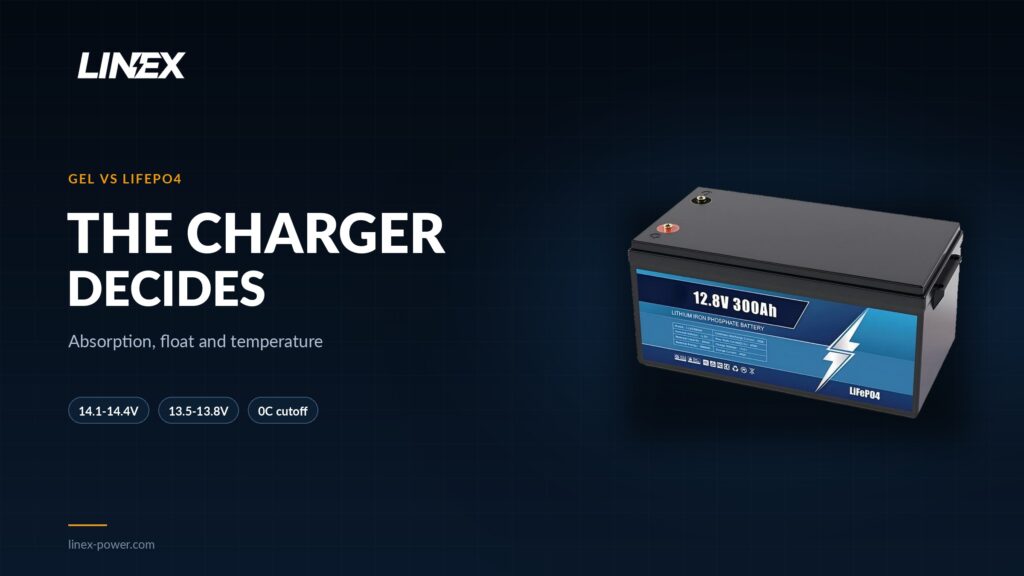
The 12V setpoints overlap, the control logic does not
Both chemistries use a constant-current, constant-voltage charge, and their 12V absorption and float ranges overlap. The difference is what ends the charge. A gel charger holds absorption for a timed period and then drops to float, with a temperature sensor adjusting the voltage. A LiFePO4 charger stops when the BMS reaches its cell or pack limit, and it must not run a lead-acid equalize cycle.
| Setting | 12V gel (6 cells) | 12V LiFePO4 (4S) |
|---|---|---|
| Absorption | 14.1V to 14.4V (2.35V to 2.40V/cell) | 14.2V to 14.6V (3.55V to 3.65V/cell) |
| Float | 13.5V to 13.8V (2.25V to 2.30V/cell) | 13.5V to 13.8V |
| Temperature compensation | About -3mV/°C/cell | Off |
| Equalize | Not recommended | Not required |
| Charge termination | Timed absorption, then float | BMS cell and pack limits |
| Low-temperature charging | No BMS cutoff; charger sets the limit | BMS blocks below 0°C |
Read the table as a starting point, not a universal datasheet. Gel battery manufacturers publish their own absorption and float figures, and the label on the battery overrides any generic range. The LiFePO4 figures come from the 12V 100Ah datasheet.
Gel sits at the low end of the lead-acid voltage window
A lead-acid cell can be charged from 2.30V to 2.45V, and the setting trades service life against capacity. Battery University’s lead-acid guide puts 2.30V to 2.35V per cell in the maximum-service-life column and 2.40V to 2.45V in the higher-capacity column that costs water and grid life. Gel is a sealed VRLA design, so it sits at the lower end: about 2.35V to 2.40V per cell absorption (14.1V to 14.4V for 12V) and 2.25V to 2.30V per cell float (13.5V to 13.8V).
Temperature changes the target. The lead-acid coefficient is about -3mV per °C per cell, so a 12V gel battery at 35°C needs roughly 0.18V less absorption voltage than the same battery at 25°C. A charger without a temperature sensor will overcharge gel in summer and undercharge it in winter.
| Battery temperature | Change from 25°C | Absorption target at 2.35V/cell |
|---|---|---|
| 15°C | +0.18V | 14.28V |
| 25°C | 0V | 14.10V |
| 35°C | -0.18V | 13.92V |
LiFePO4 uses a higher absorption voltage and a BMS cutoff
The 12V 100Ah datasheet lists 14.6V fast charging, 13.5V to 13.8V float, 20A standard charge and 50A recommended charge. The BMS allows up to 100A and blocks charging below 0°C. The pack is 4S, so 14.6V is 3.65V per cell, at the top of the LiFePO4 window. The charger should stop at that point rather than hold it for hours.
A lead-acid charger with a fixed 14.4V profile leaves the pack at roughly 90%, according to the product page. That is usable, but the last 10% needs a lithium profile. A charger with a gel or flooded setting may also run an equalize or desulfation cycle, which a LiFePO4 BMS is not designed to accept.
| Parameter | 12V 100Ah |
|---|---|
| Nominal energy | 1,280Wh |
| Fast charge voltage | 14.6V |
| Float voltage | 13.5V to 13.8V |
| Standard / recommended charge | 20A / 50A |
| Maximum charge | 100A |
| Charge temperature | 0°C to 50°C |
| Cycle life | 6,000 at 80% DoD |
| Weight | About 10kg |
A gel charger leaves a LiFePO4 pack short of full
A gel profile tops out at 14.1V to 14.4V. A LiFePO4 pack wants 14.2V to 14.6V, so the low end of the gel range stops before the pack is full. The product page puts the result at roughly 90% state of charge on a fixed 14.4V lead-acid profile. The pack will run, but the missing 10% shows up as shorter runtime and more frequent charging.
The reverse is worse. A lithium charger holds 14.6V and has no temperature compensation. A gel battery at 14.6V is 0.2V above the top of its absorption window, and the excess goes into gassing and heat. Gel is sealed, so lost water cannot be replaced. Battery University notes that gel is sensitive to overcharging and has higher internal resistance than AGM, which makes heat build up faster at the same current.
Charge current: gel is slower, lithium accepts more
Gel has higher internal resistance than AGM, so it charges at a lower rate. Many gel batteries are charged at 0.1C to 0.2C, or 10A to 20A for a 100Ah battery. The label sets the actual limit. The LINEX 12V 100Ah LiFePO4 lists a 20A standard charge and a 50A recommended charge, with a 100A maximum. The higher acceptance cuts recharge time, but a gel charger sized for 10A will take most of a day to refill a lithium pack.
Do not raise the current on a gel charger to compensate. The charger’s current limit is part of the battery’s thermal design. If the pack needs a faster turnaround, use a charger with a lithium profile and a current rating the pack supports.
Usable energy and cycle life decide the swap
A 100Ah gel battery delivers about 0.6kWh at 50% depth of discharge. A 100Ah LiFePO4 pack delivers about 1.0kWh at 80% to 90% depth. The lithium pack also weighs 10kg to 13kg against 28kg to 33kg for the gel block, and its charging efficiency is 95% to 98% against 80% to 85% for gel.
| Metric | 100Ah gel | 100Ah LiFePO4 |
|---|---|---|
| Usable energy | About 0.6kWh at 50% DoD | About 1.0kWh at 80% DoD |
| Cycle life | 500 to 1,000 at 50% DoD | 3,000 to 6,000 at 80% DoD |
| Weight | 28kg to 33kg | 10kg to 13kg |
| Charging efficiency | 80% to 85% | 95% to 98% |
| Daily-cycle replacement | Every 2 to 4 years | 8 to 16 years |
The purchase price of gel is lower. The cost per usable kWh over ten years usually favors LiFePO4 because the gel bank needs two to four replacements in that window. That calculation changes if the site cycles rarely or the gel bank is already paid for.
What to change when a gel bank is replaced
The physical swap is the easy part. The charger or solar controller needs a lithium profile at 14.6V absorption and 13.5V to 13.8V float, with temperature compensation off and equalize disabled. The alternator or DC-DC charger needs a lithium setting, and the inverter low-voltage cutoff needs to move from the lead-acid range to the LiFePO4 range.
Keep the charge current within the pack’s limit, and do not connect the new pack to a charger that has a desulfation mode. If the system has a shunt or battery monitor, reset it to the new capacity so state of charge reads correctly. Check the mounting space as well: a 100Ah LiFePO4 is about 332 x 172 x 218mm and 10kg, smaller and lighter than the gel block it replaces.
| Item | Gel setting | LiFePO4 setting |
|---|---|---|
| Absorption | 14.1V to 14.4V | 14.6V |
| Float | 13.5V to 13.8V | 13.5V to 13.8V |
| Temperature compensation | On | Off |
| Equalize | Per manufacturer | Off |
| Low-temperature charge | No BMS cutoff | BMS blocks below 0°C |
| Charge current | 0.1C to 0.2C | 20A standard, 50A recommended |
Where the 12V 100Ah pack fits
The 12V 100Ah LiFePO4 pack is 1,280Wh, 100A continuous, about 10kg and 332 x 172 x 218mm. It fits the same 12V role as a 100Ah gel block, but the charger and low-voltage settings must change first. For the full chemistry comparison, see the LiFePO4 vs gel battery page. For the model, see the 12V 100Ah lithium battery. For voltage settings, see the battery voltage charts. The 12V lithium battery line covers 50Ah to 300Ah, and the Ah to kWh calculator converts capacity for a different load.
Frequently asked questions
At 14.1V to 14.4V, a gel profile stops below the 14.6V absorption voltage of a LINEX 12V LiFePO4 pack. The pack will reach roughly 90%, not full. Use a lithium profile if the charger supports one.
No. A lithium charger holds 14.6V and does not compensate for temperature. That is above the 14.1V to 14.4V gel absorption window and can overcharge a sealed gel battery.
About 13.5V to 13.8V at 25°C, or 2.25V to 2.30V per cell, with the exact figure from the battery label. Lower it in hot weather.
No. The BMS manages cell voltage. Turn temperature compensation off and do not use a lead-acid equalize cycle.
Only if it has a lithium profile with 14.6V absorption, 13.5V to 13.8V float and no equalize. Many controllers list a LiFePO4 setting, so check the manual before connecting the pack.
Sources: LINEX LiFePO4 vs gel battery page (usable capacity 50% against 80% to 90%, 500 to 1,000 cycles against 3,000 to 6,000, weight 28kg to 33kg against 10kg to 13kg, charging efficiency 80% to 85% against 95% to 98%, checked 2026-11-21); LINEX 12V 100Ah lithium battery page (1,280Wh, 14.6V fast charge, 13.5V to 13.8V float, 20A standard and 50A recommended charge, 100A maximum, 0°C to 50°C charging, checked 2026-11-21); LINEX battery voltage charts (12V LiFePO4 absorption 14.2V to 14.6V and float 13.5V to 13.6V, lead-acid rest voltage, checked 2026-11-21); Battery University BU-403 (lead-acid charge window 2.30V to 2.45V per cell, float 2.25V to 2.27V, temperature coefficient -3mV/°C/cell, checked 2026-11-21); Battery University BU-201b (gel is sensitive to overcharge and has higher internal resistance than AGM, checked 2026-11-21); LINEX 12V 150Ah lithium battery page (1,920Wh, 14.6V charge, checked 2026-11-21); LINEX 12V 200Ah lithium battery page (2,560Wh, 14.6V charge, checked 2026-11-21); LINEX Ah to kWh calculator (12V conversions, checked 2026-11-21). Last updated 2026-11-21.