IP65 covers dust and water jets, not salt
An IP code has two digits. The first digit rates protection against solid objects, from 0 to 6. The second rates protection against water, from 0 to 9. IP65 is a 6 for dust and a 5 for water jets. The IPX5 test directs a 6.3mm nozzle at the enclosure from any direction at 12.5 litres per minute and 30 kPa for at least 3 minutes.
The test uses fresh water. Salt water adds chloride, and chloride drives corrosion on terminals, fasteners and any exposed metal. West Marine puts the limit plainly. An IP rating “does not by itself establish how a product will withstand long-term exposure to saltwater, corrosion, UV radiation, aging seals or conditions outside the specified test.”
The second digit sets the water exposure limit
IPX0 has no water protection. IPX4 handles splashes. IPX5 handles jets. IPX6 handles powerful jets. IPX7 handles immersion to 1m for 30 minutes. IPX8 covers continuous immersion at a depth the manufacturer specifies. The ratings above IPX6 are not cumulative: an IPX7 product is not automatically rated for IPX5 or IPX6 jets.
| IP rating | Dust protection | Water test | Typical marine location |
|---|---|---|---|
| IP20 | No dust rating | None | Indoor cabinet or dry cabin |
| IP54 | Dust protected | Splashes from any direction | Sheltered locker |
| IP65 | Dust tight | 6.3mm jet, 12.5 L/min, 3 minutes | Exposed deck or open cockpit |
| IP67 | Dust tight | Immersion to 1m for 30 minutes | Tender or dinghy |
| IP68 | Dust tight | Continuous immersion, depth set by maker | Not a normal battery rating |
A pack rated IP65 can sit in rain and spray. It cannot sit in bilge water. The difference matters when a boat heels and water collects in the lowest locker.
Salt mist is a separate test
IEC 60068-2-52 runs a cyclic salt mist test with a sodium chloride solution. It is not part of IEC 60529, the IP code standard. A supplier can claim IP65 without running any salt test. If the installation sees salt air every day, ask for the salt mist report, the test duration and the acceptance criteria.
If there is no report, specify the parts that resist chloride: tinned copper terminals, A4 or 316 stainless fasteners, a sealed cable gland and a case material that does not chalk or crack in UV. Then inspect at fixed intervals. A salt mist report is evidence. A “marine grade” label is not.
A sealed case is only as good as its cable entries
The IP65 rating applies to the enclosure as tested. A cable gland that is not sealed will leak. So will a missing terminal cover or a blocked breather. On a boat, the cable entry often sits lower than the terminals, so water runs toward the gland.
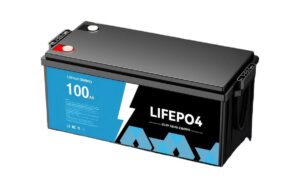
Use a drip loop, seal the gland and mount the pack where water drains away. The 12V 100Ah case is 332 x 172 x 218mm and the terminals sit on top. A top-mounted install needs a cover or a locker with a lid. The 12V 200Ah case is 524 x 245 x 220mm, so it needs more clearance above the terminals for cable bends.
LINEX models carry different IP ratings
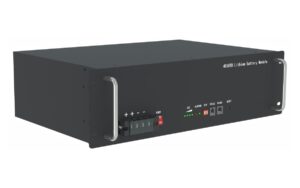
The 12V 100Ah, 12V 150Ah and 12V 200Ah packs are rated IP65. The 48V 50Ah pole-mounted telecom pack is also IP65, with a die-cast aluminium case for outdoor sites. The 48V 100Ah rack module is IP20, so it belongs in a 19-inch cabinet, not on an open deck.
| Model | IP rating | Case size (mm) | Weight | Where it fits |
|---|---|---|---|---|
| 12V 100Ah | IP65 | 332 x 172 x 218 | about 10kg | Open marine locker |
| 12V 150Ah | IP65 | 483 x 170 x 240 | about 15kg | Larger locker |
| 12V 200Ah | IP65 | 524 x 245 x 220 | about 22kg | Bench or deep locker |
| 48V 50Ah pole | IP65 | 298.3 x 170.2 x 311 | about 22.2kg | Pole or outdoor cabinet |
| 48V 100Ah rack | IP20 | 442 x 420 x 133 | 43kg | Indoor 19-inch cabinet |
An IP20 rack module in a damp marina room needs a sealed cabinet or a dehumidifier. The IP rating protects the module from fingers, not from dust or humid air that condenses on a cold case.
Inspection finds corrosion before the BMS does
A corroded terminal raises resistance. The BMS measures voltage and temperature, not the resistance of a lug. The first sign may be a warm terminal, a voltage drop under load or a charger that finishes early. Check the terminals monthly: look for white or green powder, dark pitting, loose nuts and swollen cable insulation.
Rinse the case with fresh water after salt exposure, keep pressure away from seals, dry it and apply a thin film of dielectric grease to the terminals. Replace lugs that are pitted or discolored. Do not sand a plated terminal down to bare copper, because the plating is the corrosion barrier.
What to specify for a salt-air install
Specify the IP rating for the enclosure, the terminal material, the fastener grade, the cable gland and the mounting height. Ask for the salt mist test report if the supplier claims marine use. Keep the pack out of standing water and direct spray.
For a marine house bank, the 12V 100Ah LiFePO4 battery is the base unit, and two units in parallel give 200Ah and 200A continuous. The 12V 200Ah model gives the same energy in one case. The marine and boating application page covers house-bank sizing, and the 48V 50Ah pole-mounted battery lists the IP65 enclosure and 16-cell pack.
Frequently asked questions
IP65 handles dust and water jets, which covers rain and spray on deck. It does not cover immersion, and it does not test salt corrosion. A pack in a bilge or a low locker needs IP67 or a sealed enclosure, plus terminals and fasteners specified for salt air.
No. IP testing uses fresh water and measures ingress, not chemical attack. Salt mist is tested separately under IEC 60068-2-52. Ask for that report, or specify tinned copper, 316 stainless and sealed cable entries.
IP65 protects against dust and 6.3mm water jets. IP67 protects against dust and temporary immersion to 1m for 30 minutes. IP67 is not automatically rated for jets, because the water tests above IPX6 are not cumulative.
A 48V rack module is IP20 and needs a dry cabinet. Use it below deck in a sealed 19-inch cabinet, not in an open cockpit or a wet locker. The 48V 50Ah pole-mounted pack is IP65 and built for outdoor sites, but its mounting bracket and cable entries still need a salt-air review.
Check them monthly during the season and before winter storage. Look for white or green powder, pitting, loose nuts and heat damage. Rinse the case with fresh water after salt exposure and apply dielectric grease to clean terminals.
Sources: LINEX 12V 100Ah datasheet (12.8V, 100Ah, 1,280Wh, IP65, about 10kg, 332 x 172 x 218mm, 100A maximum continuous discharge, checked 2026-11-15); LINEX 12V 150Ah datasheet (12.8V, 150Ah, 1,920Wh, IP65, about 15kg, 483 x 170 x 240mm, checked 2026-11-15); LINEX 12V 200Ah datasheet (12.8V, 200Ah, 2,560Wh, IP65, about 22kg, 524 x 245 x 220mm, checked 2026-11-15); LINEX 48V 50Ah pole-mounted datasheet (48V, 50Ah, 2,400Wh, 16 x 3.2V/50Ah cells, IP65, about 22.2kg, 298.3 x 170.2 x 311mm, checked 2026-11-15); LINEX 48V 100Ah telecom datasheet (48V, 100Ah, 4,800Wh, 3U, 43kg, IP20, 442 x 420 x 133mm, checked 2026-11-15); West Marine, Understanding IP Ratings (IP ratings do not establish saltwater or corrosion resistance, checked 2026-11-15); Wikipedia, IP code (IEC 60529 test conditions and fresh water test limits, checked 2026-11-15); IEC 60529:1989+AMD1:1999+AMD2:2013, Degrees of protection provided by enclosures (IP code). Last updated 2026-11-15.