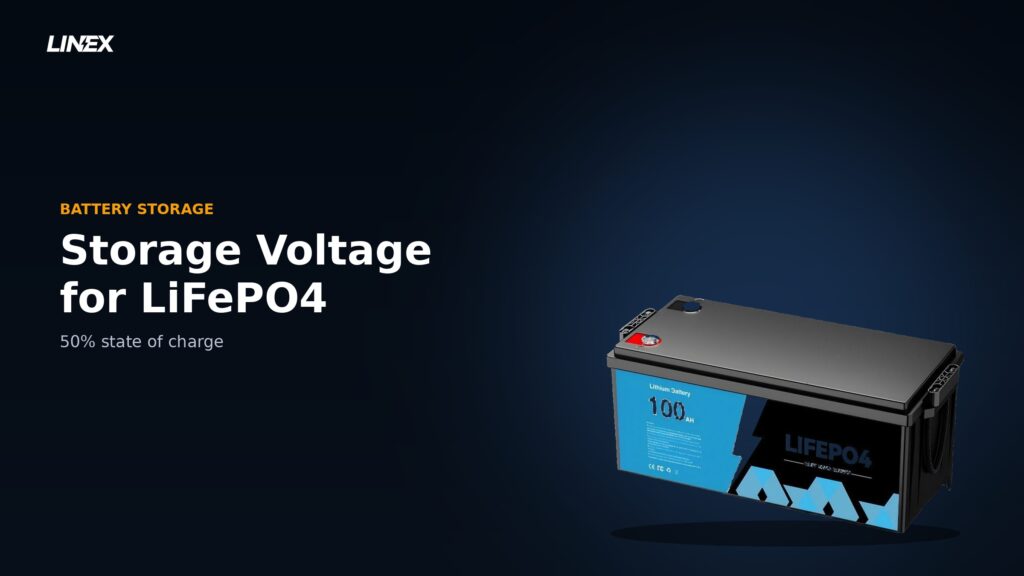
50% state of charge is the storage point
A LiFePO4 pack stored at 50% state of charge has enough energy to avoid the low-voltage cutoff and enough headroom to absorb a few months of self-discharge. At rest, 50% reads about 13.0V on a 12V pack and 26.0V on a 24V pack. A 16S 48V pack reads about 52.0V; a 15S LINEX telecom pack reads about 48.8V because it has one fewer cell in series.
The 50% target is a compromise. A full pack holds more energy but sits at a higher cell voltage, which speeds calendar aging. An empty pack avoids the high voltage but leaves little margin for the BMS standby draw. Battery University’s storage table shows the difference: at 25°C, a Li-ion cell stored at 40% charge retained 96% of its capacity after one year, while the same cell at 100% charge retained 80%.
Rest voltage maps to state of charge
The voltage chart for a 4S 12V pack gives the rest values. Multiply by 2 for a 24V pack and by 4 for a 16S 48V pack. Measure after the pack has rested for at least 30 minutes with no charge or load.
| State of charge | 12V pack | 24V pack | 48V pack (16S) |
|---|---|---|---|
| 100% | 13.6V | 27.2V | 54.4V |
| 90% | 13.4V | 26.8V | 53.6V |
| 80% | 13.2V | 26.4V | 52.8V |
| 50% | 13.0V | 26.0V | 52.0V |
| 20% | 12.8V | 25.6V | 51.2V |
| 10% | 12.5V | 25.0V | 50.0V |
LiFePO4 holds a flat curve between about 20% and 90%, so voltage alone cannot tell you the exact state of charge in that band. A 0.1V difference can mean 10% or more. Use a shunt-based monitor if you need a precise number, or count the energy that went in and out.
Self-discharge is under 5% in 90 days
The 48V 100Ah datasheet rates self-discharge below 5% in 90 days at 25°C. A pack parked at 50% therefore loses about 2.5 percentage points of charge in three months, which leaves it near 47.5%. That is still inside the safe storage band.
A 12V or 24V pack uses the same LiFePO4 cells and a similar BMS, so the same order of magnitude applies. Check the voltage every three months. If a 12V pack falls below 12.8V (about 20%), charge it back to 13.0V. If it falls below 12.0V, charge it before storage, not after.
Temperature drives calendar aging
Battery University notes that “high temperature and dwelling in a full state-of-charge for an extended time can be more stressful than cycling.” Its storage table shows the effect at 40% charge: a Li-ion cell retained 98% after one year at 0°C, 96% at 25°C, 85% at 40°C and 75% at 60°C. The same cell at 100% charge retained 94%, 80%, 65% and 60%, with the 60°C figure measured after three months rather than one year. A cool, half-full pack is the low-stress case.
LiFePO4 charges between 0°C and 50°C on the 12V and 24V models, and between 0°C and 65°C on the 48V models. Discharge is rated from -20°C to 60°C on the 12V and 24V packs, and to 65°C on the 48V packs. For storage, a stable 10°C to 25°C room is better than a hot container. A shed that reaches 40°C in summer will age a pack faster than a cool basement.
Disconnect the load and the BMS standby draw
Take a 50mA standby draw as an example: it removes 1.2Ah per day, or about 36Ah in a month. On a 100Ah pack parked at 50%, that is most of the 50Ah reserve. A connected inverter, radio or clock can draw far more.
Disconnect the negative terminal before long storage, or install a battery disconnect switch. If the pack has a smart BMS with Bluetooth, check whether the app still wakes the BMS. A BMS that stays awake for Bluetooth can drain a small pack in weeks.
Wake the pack with a low-current charge
A 12V pack cutoff is around 8.8V to 10V, a 24V pack around 17.6V to 20V and a 48V pack around 40.5V. If the pack voltage is below the cutoff, the BMS may block charging. Do not use a fast charger on a deeply discharged pack. Use a low-current charge at 0.05C to 0.1C until the pack reaches 10V, 20V or 40.5V, then switch to the normal profile.
A 100Ah pack at 0.1C is 10A. At 0.05C it is 5A. A 5A charge on a 12V pack adds about 64W, so the first hour returns only a small amount of energy. The low current gives the BMS time to balance and keeps a weak cell from heating.
Storage voltage for 12V, 24V and 48V packs
The storage table gives 13.0V for a 12V pack, 26.0V for a 24V pack and 52.0V for a 16S 48V pack at 50% state of charge. A 15S LINEX telecom pack stores near 48.8V, because its 48V nominal voltage uses 15 cells instead of 16.
| Pack | 50% rest voltage | Recharge at | Full charge | Float |
|---|---|---|---|---|
| 12V (4S) | 13.0V | 12.8V | 14.6V | 13.5V to 13.8V |
| 24V (8S) | 26.0V | 25.6V | 29.2V | 27.0V to 27.6V |
| 48V (16S) | 52.0V | 51.2V | 58.4V | 54.0V to 54.4V |
| 48V (15S LINEX) | 48.8V | 48.0V | 53.3V | 51.0V |
The 12V and 24V full-charge and float values come from the product datasheets. The 48V 16S values come from the voltage chart. The 15S values come from the 48V telecom datasheet: 53.3V equalization, 51.0V float and 40.5V cutoff. The 50% voltage for the 15S pack is 15 x 3.25V, or about 48.8V.
What to record on the storage label
Write five items on the storage label: date, rest voltage, state of charge, room temperature and next check date. A pack stored in a warehouse for a year needs a record that a new employee can read. The label should also say whether the pack is at 50% for storage or at 100% for dispatch.
Check the voltage at the terminals, not at the lugs of a connected system. A charger or load will pull the reading away from the rest voltage. If the pack has a Bluetooth BMS, record the app reading and the multimeter reading. A mismatch of more than 0.2V means one of them needs calibration.
The 12V 100Ah LiFePO4 battery lists the 14.6V charge voltage, the 13.5V to 13.8V float and the 0°C to 50°C charge range. The 12V lithium battery line covers the rest of the 12V range. The LiFePO4 voltage charts give the full state-of-charge table. The charging below 0°C guide explains why a cold pack should not be charged. The battery bank sizing guide covers the capacity side if the pack is being sized for a known load.
Frequently asked questions
Store a 12V LiFePO4 battery at about 13.0V, which is roughly 50% state of charge. Check it every three months and recharge if it falls below 12.8V.
You can, but it ages faster. Battery University’s storage table shows a Li-ion cell at 100% charge retained 80% after one year at 25°C, against 96% at 40% charge. Use 100% only when the pack is going into service soon.
Every three to six months is enough for a healthy LiFePO4 pack. The 48V datasheet rates self-discharge below 5% in 90 days at 25°C. A pack in a hot room or with a connected load needs a shorter interval.
Storage at 0°C is not the same as charging at 0°C. The pack can sit at 0°C, but charge it only after it warms above 0°C. The 12V and 24V datasheets rate charging from 0°C to 50°C; the 48V models rate charging from 0°C to 65°C.
Do not disconnect the BMS from the cells. Disconnect the load from the battery, or use a disconnect switch on the negative cable. The BMS needs to stay connected to protect the cells and to balance them.
A 16S 48V pack stores at about 52.0V. A 15S LINEX telecom pack stores at about 48.8V. Check the datasheet before you charge a 48V pack, because a 16S charger can overcharge a 15S pack.
Sources: LINEX LiFePO4 voltage charts, state-of-charge and charging tables (checked 2026-11-13); LINEX 12V 100Ah datasheet (12.8V, 100Ah, 1,280Wh, 14.6V charge, 13.5V to 13.8V float, 0°C to 50°C charge, -20°C to 60°C discharge, 6,000 cycles at 25°C and 80% DoD, checked 2026-11-13); LINEX 24V 100Ah datasheet (25.6V, 100Ah, 2,560Wh, 29.2V charge, 27.0V to 27.6V float, 0°C to 50°C charge, checked 2026-11-13); LINEX 48V 100Ah datasheet (48V, 100Ah, 4.8kWh, 53.3V equalization, 51.0V float, 40.5V cutoff, self-discharge <5% in 90 days at 25°C, 0°C to 65°C charge, -20°C to 65°C discharge, checked 2026-11-13); Battery University BU-808, How to Prolong Lithium-based Batteries, Table 3 storage capacity loss at 0°C, 25°C, 40°C and 60°C (checked 2026-11-13). Last updated 2026-11-13.
Related: the LiFePO4 charging voltage guide gives the 14.6V, 29.2V and 53.3V setpoints for 12V, 24V and 48V packs.