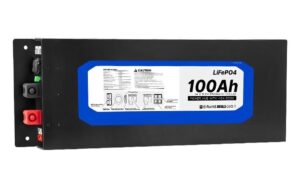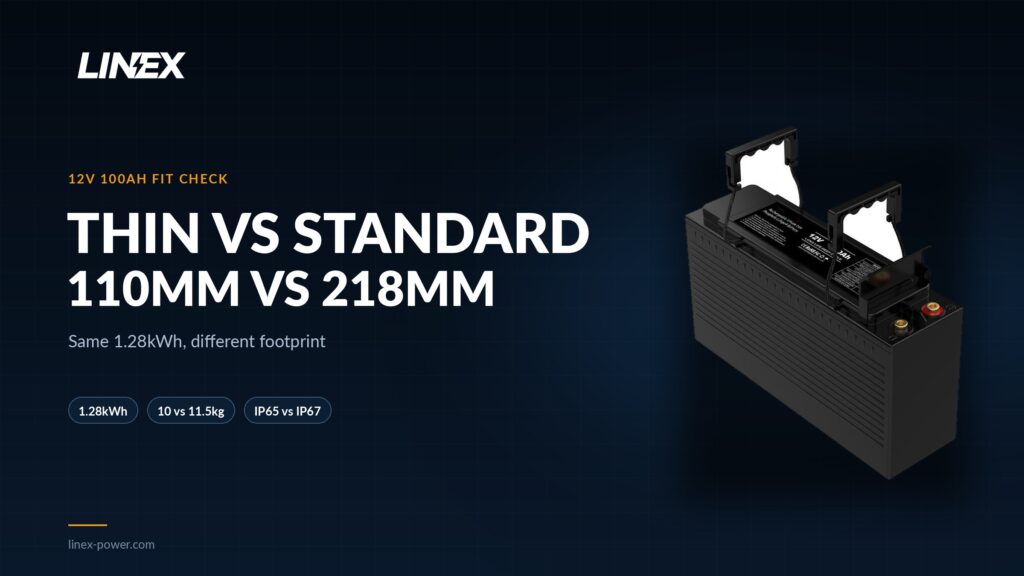
Both cases store 1.28kWh at the same 100A continuous limit
The thin and standard 12V 100Ah packs are both 4S LiFePO4 batteries rated at 12.8V and 100Ah, so each stores 1,280Wh. At 80% depth of discharge, each delivers about 1,024Wh, which means the same runtime on the same load. The standard case weighs about 10kg and the thin case about 11.5kg.
| Model | Nominal energy | Usable at 80% DoD | Continuous discharge | Weight | Case (L × W × H) | Protection |
|---|---|---|---|---|---|---|
| Standard 12V 100Ah | 1,280Wh | 1,024Wh | 100A | ≈10kg | 332 × 172 × 218mm | IP65 |
| Thin 12V 100Ah | 1,280Wh | 1,024Wh | 100A | ≈11.5kg | 395 × 285 × 110mm | IP67 |
The thin model is heavier despite the lower height. The extra 1.5kg does not buy extra capacity because both packs are 100Ah. Both publish at least 6,000 cycles, and both are 4S packs built for 12V systems.
The thin case trades height for footprint
The thin case is 110mm tall against 218mm for the standard, a 108mm reduction. It is 395mm long and 285mm deep against 332mm and 172mm, so the footprint grows from 0.057m² to 0.113m². Case volume is almost identical: 12.38 litres for the thin model and 12.45 litres for the standard.
| Measure | Standard | Thin | Difference |
|---|---|---|---|
| Height | 218mm | 110mm | 108mm lower |
| Length | 332mm | 395mm | 63mm longer |
| Depth | 172mm | 285mm | 113mm deeper |
| Footprint | 0.0571m² | 0.1126m² | 0.0555m² larger |
| Case volume | 12.45L | 12.38L | 0.07L smaller |
The shape change is the whole point. A 110mm case can slide under a seat or a bed platform that a 218mm case cannot enter. The cost is a footprint that is nearly twice as large, so the thin model needs a longer, deeper tray rather than a taller box.
Discharge ratings match, but the peak figure does not
Both models publish a 100A maximum continuous discharge current, which is 1,280W at 12.8V. The thin model also lists a “200A peak discharge current”. The standard model lists 100A continuous and no separate peak figure. The 200A figure is a peak rating, not a continuous one, and the datasheet does not publish a duration for it.
| Load through 90% inverter | DC current at 12.8V | Standard 100A | Thin 100A continuous |
|---|---|---|---|
| 500W | 43.4A | Within limit | Within limit |
| 1,000W | 86.8A | Within limit | Within limit |
| 1,500W | 130.2A | Exceeds continuous | Exceeds continuous |
| 2,000W | 173.6A | Exceeds continuous | Peak only, not continuous |
A 2,000W inverter can ask for about 174A at 12.8V after losses. The thin model’s 200A peak rating is above that surge current, but the datasheet does not publish a duration for the peak, so it is not a continuous 2,000W rating. Use two packs in parallel or a 24V or 48V bank for that load. Neither model is sold for engine starting because the datasheet does not publish cold cranking amps for either one.
Charging current separates the two models
The standard model accepts up to 100A of charge current and recommends 50A. The thin model lists a 50A maximum charge current. A 50A charger works with both; a 100A charger only reaches its full output on the standard model. From 20% to full, either pack needs about 80Ah returned, which is 1.6 hours at 50A before the absorption phase.
| Charger current | Standard 12V 100Ah | Thin 12V 100Ah |
|---|---|---|
| 20A | 4.4h | 4.4h |
| 30A | 2.9h | 2.9h |
| 50A | 1.8h | 1.8h |
| 100A | 0.9h | 1.8h (capped at 50A) |
The times assume a 20% starting state of charge, 80Ah returned and 10% added for the absorption phase. The thin model’s 50A limit is the number that matters on a large alternator or a high-current charger. The standard model’s 100A maximum gives it more headroom for a fast recharge between trips.
IP67 against IP65 changes the installation envelope
The standard case is IP65 and the thin case is IP67. IP67 is the higher water rating on the product label, but the cable entry, fuse holder and terminal cover still decide whether water reaches the cells. Neither rating replaces a dry, ventilated compartment. The thin model’s flat case fits under a seat or bench where the standard case’s 218mm height will not.
| Rating | Standard | Thin | Practical meaning |
|---|---|---|---|
| Dust | IP6X | IP6X | Dust-tight |
| Water | IPX5 | IPX7 | Jets against brief immersion |
| Typical location | Battery box, locker, under-bed | Under-seat, shallow floor, low-clearance tray | Check cable entry either way |
An IP67 case can survive a brief dunk, not a flooded bilge. A marine installation still needs the battery above the bilge line, with sealed cable glands and a fuse close to the positive terminal. The same rule applies to an RV: road spray and condensation are the everyday risks, not a swimming pool. The RV vs marine battery guide covers the other installation differences between the two.
The fit check starts with three measurements
Measure the clear height, the clear depth and the diagonal opening before choosing either case. A 110mm case needs about 130mm to 150mm of clear height once terminals and cable bends are included. A 218mm case needs about 240mm. The thin case’s 285mm depth is 113mm more than the standard, which can rule it out of a narrow locker even when the height fits.
| Space | Clear size | Standard | Thin |
|---|---|---|---|
| Under-seat compartment | 150mm high | No | Yes |
| Battery box | 350 × 200mm | Yes | No |
| Rear locker | 420 × 300mm | Yes | Yes, check height |
| Vertical wall locker | 250mm deep | Yes | No |
| Under-bed tray | 400 × 300mm, 130mm high | No | Yes |
The table uses the case dimensions plus a small allowance for terminals. It does not include the fuse, shunt, hold-down strap or cable bend. Add those to the drawing before ordering, because a case that fits the opening can still fail on the last 30mm of cable clearance.
Which build should buy which
Choose the thin model when height is the constraint and the floor area is available, such as under a campervan seat, under a bed platform or in a shallow compartment. Choose the standard model when the battery box is compact, the installation is vertical or the charger can deliver more than 50A. Both are 1.28kWh packs with a 100A continuous limit, so the choice changes the fit, not the energy.
| Build | Pack | Why |
|---|---|---|
| Campervan under-seat, 150mm clearance | Thin | 110mm case height |
| Campervan rear locker, 350 × 250mm | Standard | 332 × 172mm footprint |
| Boat battery box, 420 × 300mm | Either | Check height and cable access |
| Off-grid cabinet with 100A charger | Standard | 100A max charge |
| Vertical compartment, 250mm deep | Standard | 172mm depth |
| Under-bed flat tray, 130mm clear | Thin | 110mm height, 285mm depth |
A 12V 100Ah pack is often the first unit in a larger bank. If the plan is to add a second pack later, buy the same model and keep the cable lengths equal. A thin and a standard case can be paralleled in principle, but the two models have different case volumes and charge limits, so use two packs of the same model unless the factory confirms the pairing. The series and parallel guide covers fuse placement and cable equalisation.
Frequently asked questions
No. The thin model weighs about 11.5kg and the standard model about 10kg. The thin case is 108mm lower, but it is longer and deeper, and the case volume is almost the same.
No. The continuous rating is 100A, which is 1,280W at 12.8V. The 200A peak rating is a short pulse, not a continuous 2,000W rating. Use two packs in parallel or a 24V or 48V bank.
No. The thin case measures 395 × 285mm, so it needs a larger footprint than a 350 × 250mm tray. The standard case measures 332 × 172mm and fits that tray if the height is available.
No. The thin model lists a 50A maximum charge current. The standard model accepts up to 100A and recommends 50A, so a 100A charger only reaches full output on the standard model.
Either can serve a 12V house bank with a 100A continuous limit. The standard IP65 case has the smaller footprint; the thin IP67 case is flatter. Neither is a starting battery because the datasheet does not publish cold cranking amps for either model.
The thin 12V 100Ah battery page lists the 110mm case and the 50A charge limit. The standard 12V 100Ah battery page lists the 332 × 172 × 218mm case and the 100A charge maximum. The 12V lithium battery range covers 10Ah to 300Ah. For installation context, see the RV and van life page and the 12V 100Ah battery guide. The Ah to kWh calculator converts a daily load into pack capacity if the 1.28kWh figure needs checking against a different duty cycle.
Sources: LINEX product pages for the Thin 12V 100Ah (1.28kWh, 395 × 285 × 110mm, about 11.5kg, IP67, 100A continuous, 200A peak, 50A maximum charge, ≥6,000 cycles) and the standard 12V 100Ah (1,280Wh, 332 × 172 × 218mm, about 10kg, IP65, 100A continuous, 100A maximum charge, 50A recommended, 6,000 cycles), plus the 12V lithium battery range page, the RV and van life page, the 12V 100Ah battery guide, the Ah to kWh calculator and the series and parallel wiring guide, all checked 2026-11-28. Last updated 2026-11-28.