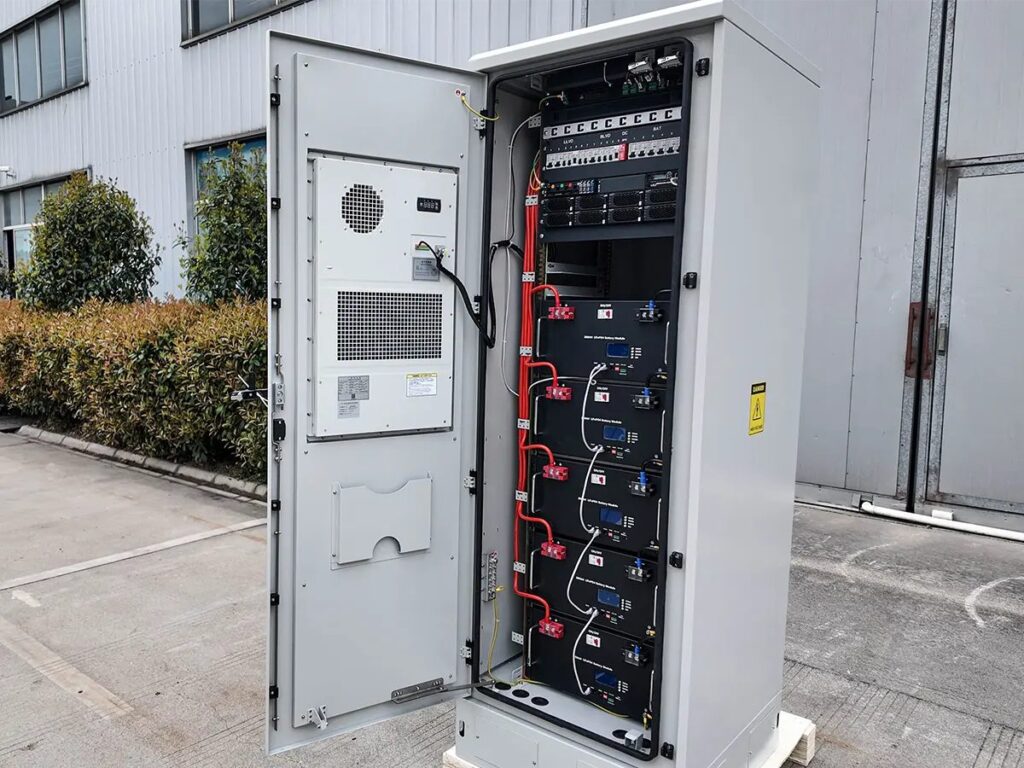
Most base station backup projects don’t fail because the battery was wrong. They fail at the second visit — when the load grew, someone added a fourth battery to a bank of three, and now the BMS units argue with each other until one shuts down in the middle of a rainy Tuesday night.
We build 48V telecom batteries in Shenzhen and ship them to integrators who do exactly this work. Here’s how parallel expansion actually goes, and how to plan the rack and cabinet around it from day one.
Why telecom sites run 48V, and what that means for your bank
Telecom plants standardized on 48V DC decades ago — it’s the voltage the rectifiers, radios and legacy equipment all expect, and it keeps cable sizes reasonable over long runs. The amp-hour number is just the building block. What matters for a site survey is the energy in kWh and the current the load actually pulls during an outage.
Our rack lineup covers the common sizes: 50Ah (2.4kWh), 100Ah (4.8kWh), 150Ah (7.2kWh) and 200Ah (9.6kWh) at 48V nominal. Two 100Ah units in parallel give you 9.6kWh with redundancy — if one BMS trips, the site stays up on the other. That redundancy angle is usually why integrators parallel at all, not just for capacity.
If you’re still sizing the bank itself, start with how long a 48V battery lasts under load, then come back here for the expansion plan.
The parallel rules that keep a 48V bank healthy
Parallel expansion is simple in principle and unforgiving in detail. Four rules cover most of it:
- Same model, same age, same batch. Mixing a 100Ah with a 150Ah on the same bus works on paper and fails in practice — the BMS units fight over current sharing and the weaker pack does the dying.
- Equal cable runs from each battery to the busbar. Unequal lengths mean unequal resistance, which means one battery does more of the work. Same gauge, same length, same torque on the terminals.
- Charge voltage stays inside the model spec. The floating charge voltage on our 48V models is 51.0V and equalization is 53.3V. Don’t let a misconfigured rectifier push past that because “it charges faster.”
- Communication protocol has to match the site controller. This is where projects actually stall. Our Standard 48V batteries speak RS485 and RS232; the Smart series uses CAN and RS485. If the rectifier or site controller expects one and the battery speaks the other, the BMS alarm never reaches anyone until the site goes dark.
What fits on a 19-inch rack
All four standard models mount in a standard 19-inch rack. The physical envelope is what surprises people:
| Model | Energy | Format | Weight | Communication |
|---|---|---|---|---|
| 48V 50Ah | 2.4kWh | 3U (19″) | 29kg | RS485, RS232 |
| 48V 100Ah | 4.8kWh | 3U (19″) | 43kg | RS485, RS232 |
| 48V 150Ah | 7.2kWh | 4U (19″) | 60kg | RS485, RS232 |
| 48V 200Ah | 9.6kWh | 4U (19″) | 78kg | RS485, RS232 |
The 100Ah sits in 3U — 133mm tall, 442mm wide, 420mm deep before you count handles and terminals. The 150Ah and 200Ah are 4U, 178mm tall, and the 200Ah is deeper at 610mm. Check the cabinet’s usable depth against those numbers, not the marketing “rack compatible” label.
A 12U outdoor cabinet swallows three 100Ah units with room for the rectifier, breakers and a bit of air. A 9U is tight with two. If the project might grow, size the cabinet for the end state now — a cabinet swap in year two costs more than the extra 3U today.
Outdoor cabinets: the part that decides your maintenance visits
An outdoor site is not an indoor site with a lid on it. The cabinet carries the battery’s environmental load, and it lives or dies on three things: thermal management, sealing, and access.
Our IP65 outdoor cabinet comes in 6U through 26U, built from galvanized cold-rolled steel with 45mm EPS insulation, and runs a temperature-controlled exhaust fan with AC power redundancy — 600W on the 650mm cabinet, 1500W from 750mm up. That fan sizing matters in places where the cabinet bakes in direct sun: battery cycle life is rated at 25°C, and every 10°C above that quietly shaves years off the pack. The cabinet doesn’t make heat, it manages it — but it can’t fix a site where the cabinet itself is in an oven.
For urban and roadside sites with controlled entry, the indoor cabinet range goes 10U to 42U in 19-inch format, IP20, tempered glass door, 600×800mm or 800×800mm. Same planning logic, different weather.
Communication and monitoring are not optional
Every backup bank we ship has protection built in — over-temperature, over-current, short circuit, over-discharge. But protection the site can’t see is only half useful. Match the BMS interface to the rectifier and the alarm system, and test the telemetry path in commissioning, not the first outage.
The battery specs also tell you the operating envelope: charge from 0°C to 65°C, discharge from -20°C to 65°C, humidity up to 95%. If a site runs outside those numbers, fix the site — a battery that’s charged below freezing will lose capacity quietly and permanently.
What to send us for a backup bank quote
When integrators ask us to quote a parallel bank, the fastest path is a short brief: site load in amps or kW, required autonomy hours, rack or cabinet preference, rectifier make and its communication interface, expected fleet size, and destination. That’s enough for us to compare 50Ah/100Ah/150Ah/200Ah configurations and come back with the rack layout and cabinet sizing instead of a generic spec sheet.
Start from the 48V telecom range, or see the full deployment picture on the remote-site telecom page. Working through it as a project? Send the site details and we’ll lay out the bank on paper first.
Quick answers
Technically the voltages match, but current sharing between mismatched capacities is uneven and the BMS units don’t coordinate. Use identical models, and add capacity in matched pairs or sets.
Three 100Ah units (3U each = 9U) with room left for the rectifier and breakers. Two 150Ah or 200Ah units (4U each) leave more headroom for cabling.
Communication protocol. Standard models use RS485/RS232; Smart models use CAN/RS485. The correct choice is the one your site controller and rectifier actually talk to.
Check voltage balance across units at rest, torque all terminals to spec, and verify BMS telemetry from every unit in the bank during commissioning. A 5% voltage spread between units at rest is worth investigating before the site goes live.