Parallel connection looks like two cables and a busbar. Electrically it is a current-sharing problem, and most failures on a paralleled 48V bank start with a mismatch nobody measured: a different batch, a longer cable run, a breaker missing on one string. The datasheets give per-module limits, not a bank limit, so the installer has to close that gap deliberately.
This guide uses the published figures for the LINEX 48V rack series, 50Ah to 200Ah, and the charge settings printed on every model: 53.3V equalization, 51.0V float and 40.5V cutoff. For the wider range, see the 48V lithium battery page.
What Has to Match Before You Connect Anything?
Four things must match: model, capacity, age and firmware. A 100Ah and a 150Ah module on the same bus hold the same voltage but do not share current evenly; the smaller pack works harder and its BMS reaches its limit first. Identical modules from different batches running different firmware behave the same way.
Check the pack voltage, not the label. A 48V-class LiFePO4 pack is built from a fixed number of cells. The IP65 pole-mounted 50Ah unit is specified as 16 cells plus BMS. Two packs with different cell counts have different charge profiles even though both are sold as 48V.
Then match state of charge. A full module and a module at 60% will exchange current the moment the breaker closes, limited only by cable resistance and BMS protection. Bring each module to the same open-circuit voltage first.
How Should the Parallel Wiring Be Run?
Use a common busbar and give every module its own pair of cables of the same gauge and length. Current divides in inverse proportion to resistance, so a string with more cable resistance carries less current and its neighbour carries more. Over a few years that shows up as one module dying first.
Do not daisy-chain. In a chain the cable between the first two modules carries the current of every module downstream, so the strings see different resistances and the first module works hardest. A busbar with equal-length drops avoids this and lets you isolate one string for service.
| Model | Nominal energy | Max charge / discharge | Weight | Rack height | Communication |
|---|---|---|---|---|---|
| 48V 50Ah | 2.4 kWh | 50A / 50A | 29kg | 3U | RS485 / RS232 |
| 48V 100Ah | 4.8 kWh | 100A / 100A | 43kg | 3U | RS485 / RS232 |
| 48V 150Ah | 7.2 kWh | 150A / 150A | 60kg | 4U | RS485 / RS232 |
| 48V 200Ah | 9.6 kWh | 100A / 100A | 78kg | 4U | RS485 / RS232 |
Note the 200Ah row: twice the energy of the 100Ah module but the same 100A, because the limit is set by the BMS and cell configuration, not capacity. Two 100Ah modules give 200A; one 200Ah gives 100A.
What Breaker and Cable Protection Does Each String Need?
Every string gets its own DC breaker or fuse, sized above the module’s continuous current and below the cable ampacity. The breaker protects the cable; the BMS protects the cells. One breaker on the busbar cannot isolate a faulted module, and the rest of the bank will feed a short circuit through it.
The table applies a 125% continuous-load margin to the module ratings. The common sizing rule for continuous DC loads. It is arithmetic for the design, not a substitute for protection coordination: confirm the final breaker with the DC distribution manufacturer and the local code, and specify DC-rated breakers. For the full model range and sizing tables, see our choosing a lithium battery manufacturer in China.
| Parallel configuration | Nominal energy | Usable at 80% DoD | Bank continuous current | Breaker per string (125%) | Bank weight | Rack space |
|---|---|---|---|---|---|---|
| 2 × 48V 100Ah | 9.6 kWh | 7.7 kWh | 200A | 125A | 86kg | 6U |
| 3 × 48V 100Ah | 14.4 kWh | 11.5 kWh | 300A | 125A | 129kg | 9U |
| 2 × 48V 150Ah | 14.4 kWh | 11.5 kWh | 300A | 188A | 120kg | 8U |
| 2 × 48V 200Ah | 19.2 kWh | 15.4 kWh | 200A | 125A | 156kg | 8U |
| 4 × 48V 50Ah | 9.6 kWh | 7.7 kWh | 200A | 63A | 116kg | 12U |
Two checks follow. The busbar and main cable must carry the bank current. 300A for three 100Ah modules, three times the rating on one datasheet. And the per-string breaker stays the same as you add strings; only the busbar and main protection grow.
Which BMS Settings Apply, and How Do You Commission the Bank?
All four rack models use the same charge profile: 53.3V equalization, 51.0V float and 40.5V cutoff. Set the rectifier to those figures before the bank is connected and check again after commissioning; a rectifier left on a lead-acid profile will never fully charge a LiFePO4 bank, or will push above the BMS cutoff and trip the string. The 100Ah module also lists a 10A charging-current limit.
Standard models report over RS485 and RS232; Smart versions add CAN and a DC-DC boost to 57V. In a parallel bank every module needs a unique address, and the controller must read each one. The datasheet gives per-module current and protocol, not a maximum number of parallel units, so ask the factory to confirm the limit for the exact model and firmware and record the answer. The 6,000-cycle rating is for one module at 25°C and 80% depth of discharge; a hot cabinet and an unbalanced bank both shorten it.
Commission in order: polarity and torque, open-circuit voltage per module, breakers closed one at a time, charge to float, then telemetry and alarms on every unit. Open one string breaker and confirm the controller reports that module rather than a bank fault. Finally run the site load for an hour and compare delivered energy with the 7.7kWh usable figure for two 100Ah modules.
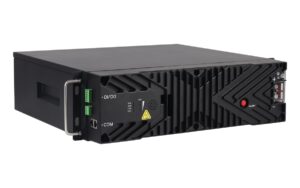
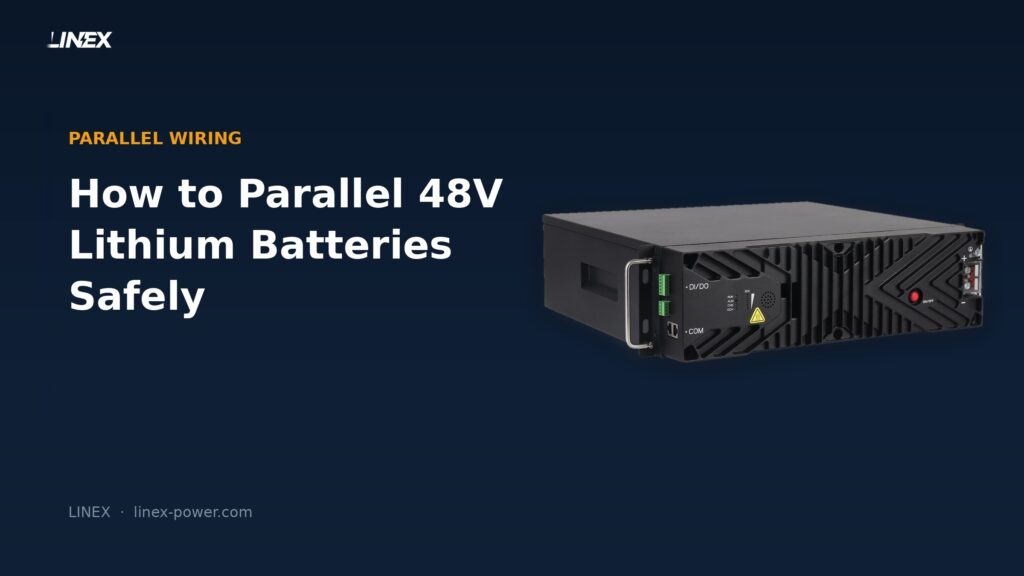
For the upstream choice of capacity and format, see how to choose a 48V battery for a base station. The module used in these examples is the 48V 100Ah rack battery, 43kg in 3U with RS485 and RS232 telemetry. For the full model range and sizing tables, see our telecom battery backup guide.
Frequently asked questions
No. A 100Ah and a 150Ah module hold the same voltage but do not share current evenly, and the smaller pack reaches its BMS limit first. Use identical models, or choose a larger single module if the site needs more energy in one case.
The datasheet gives per-module current and communication, not a maximum bank size. Two modules give 9.6kWh and 200A continuous; confirm the permitted number of parallel units with the factory for the exact model and firmware.
Yes. Each string needs a DC breaker or fuse rated above the module’s continuous current and below the cable ampacity, so a faulted module can be isolated. One breaker on the busbar leaves the other modules feeding a short circuit.
Cable size depends on string current, run length and installation method, so it is set by local code and the cable manufacturer’s table, not by the battery datasheet. Keep every string the same gauge and length, and match the lugs to the module terminals.
Only with the same model, similar age and matched firmware, and after equalizing state of charge. LINEX Smart models are built for phased expansion and hybrid operation with lead-acid, but the configuration must be reviewed as a system first.
Planning a parallel bank? Send the site load, the required autonomy and the rack space to our team, and we will confirm the module count, breaker arrangement and charge settings against the actual 48V configuration. Send your site details and we will reply with a configuration and the matching UN38.3, CE and RoHS documentation.