A 5kW load draws 137A at the 40.5V cutoff
A 5,000W inverter load pulls 116A from a 48V bank at nominal voltage and 137A when the pack reaches its 40.5V cutoff, assuming 90% inverter efficiency. Current rises as voltage falls because the load holds its power draw. Size the BMS, fuse and cable for the 40.5V figure.
A 10kW load follows the same curve: 232A at 48V and 274A at 40.5V. A 15S LiFePO4 pack runs from 53.3V at full charge to 40.5V at cutoff, so the current at the bottom of the window is 18% higher than at nominal voltage.
| Load (continuous) | Current at 53.3V | Current at 48V | Current at 40.5V |
|---|---|---|---|
| 5kW | 104A | 116A | 137A |
| 10kW | 208A | 232A | 274A |
The table assumes a unity power factor and 90% inverter efficiency. A motor or compressor runs at a power factor below 1, which raises the DC current for the same wattage. Check the inverter’s continuous DC input rating as well as its surge rating.
Two 100Ah modules carry 5kW; three carry 10kW
A 48V 100Ah module is rated 100A continuous, so one unit cannot carry 5kW at any point in the discharge window. Two modules in parallel give 200A, which covers the 137A worst case and stores 9.6kWh nominal. Three modules give 300A, which covers the 274A a 10kW load draws at cutoff.
The 150Ah module is the smallest single unit that covers 5kW: 150A against a 137A worst case. The 200Ah module stores more energy but stays at 100A continuous, so it does not solve a 10kW current problem on its own.
| Bank | Continuous current | Nominal energy | Usable at 80% DoD | Runtime at 5kW | Runtime at 10kW |
|---|---|---|---|---|---|
| 1 x 100Ah | 100A | 4.8kWh | 3.84kWh | not permitted | not permitted |
| 2 x 100Ah | 200A | 9.6kWh | 7.68kWh | 1.4h | not permitted |
| 3 x 100Ah | 300A | 14.4kWh | 11.52kWh | 2.1h | 1.0h |
| 1 x 150Ah | 150A | 7.2kWh | 5.76kWh | 1.0h | not permitted |
| 2 x 150Ah | 300A | 14.4kWh | 11.52kWh | 2.1h | 1.0h |
| 2 x 200Ah | 200A | 19.2kWh | 15.36kWh | 2.8h | not permitted |
| 3 x 200Ah | 300A | 28.8kWh | 23.04kWh | 4.1h | 2.1h |
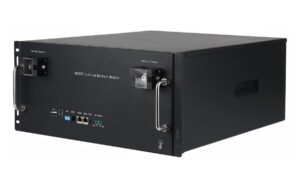
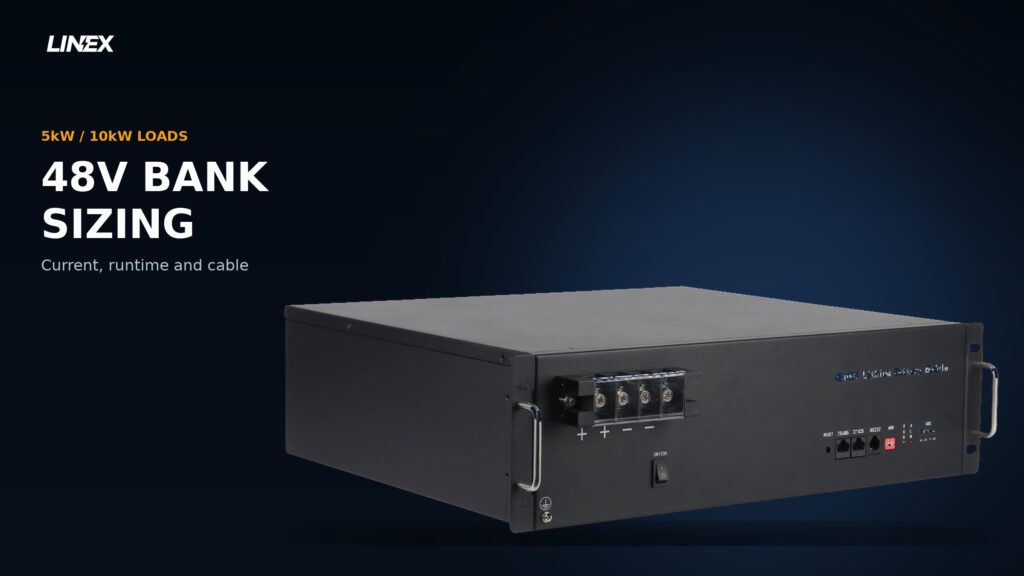
Runtime assumes 90% inverter efficiency and the full 80% depth of discharge. A bank marked not permitted exceeds its continuous current before the load reaches rated power. The 48V 100Ah telecom lithium battery is the module used for the 100Ah rows.
Hours at load set the bank size, not the inverter label
Energy sizing starts from delivered kWh. Divide the delivered energy by 0.72, the product of 80% depth of discharge and 90% inverter efficiency, to get the nominal bank. A 5kW load held for four hours needs 20kWh delivered, so the bank must be rated 27.8kWh.
| Load | Runtime | Delivered energy | Nominal bank needed | Example bank |
|---|---|---|---|---|
| 5kW | 1h | 5kWh | 6.9kWh | 1 x 150Ah |
| 5kW | 4h | 20kWh | 27.8kWh | 3 x 200Ah |
| 5kW | 8h | 40kWh | 55.6kWh | 6 x 200Ah |
| 10kW | 1h | 10kWh | 13.9kWh | 2 x 150Ah |
| 10kW | 2h | 20kWh | 27.8kWh | 4 x 150Ah |
| 10kW | 4h | 40kWh | 55.6kWh | 8 x 150Ah |
The example bank is a standard combination that passes both the energy and the current check. At 10kW, a 4 x 150Ah bank gives 600A continuous and 28.8kWh nominal, so it covers the 274A cutoff current and the two-hour runtime.
Parallel modules share current only when cable lengths match
Two modules in parallel do not split current evenly if one has a shorter cable run. The module with the lower resistance carries more, and the BMS that reaches its limit first trips the whole bank. Use equal cable lengths, separate fuses and modules of the same model and age.
A 400A busbar suits a three-module bank and keeps the share close when the feeds are short and equal. Fuse each module at its own continuous rating rather than one fuse for the whole bank, so a single module fault does not take the site down. Confirm the parallel limit with the manufacturer before adding a fourth module, because the product documentation treats expansion as an engineered configuration. The parallel 48V lithium battery guide covers cable and fuse practice in more detail.
Motor starts need a BMS surge check
A 3kW pump can draw three times its running current for a few seconds at startup, which is 9kW or 188A at 48V. Two 100Ah modules are rated 200A continuous, so the start leaves about 6% margin. At the end of the discharge window the same start draws 222A, above the 200A continuous rating. The module datasheet publishes a continuous figure only: “Max Charge / Discharge Current: 100A / 100A @25°C”.
Ask for the peak current and its duration before sizing a pump or compressor on a two-module bank. If the peak is not published, add a module or fit a soft starter. Air conditioners carry the same check, since their locked-rotor current is several times the running figure.
An 80A charger puts about 4kW into the bank
At 51V, an 80A charger delivers about 4.1kW. Replacing 20kWh delivered at 90% efficiency takes about 5.4 hours from empty, before the absorption phase. A 5kW/4h bank therefore needs a charger in the 80A class, not a 30A unit.
Charge current limits follow the module: 100A for the 100Ah, 150A for the 150Ah and 100A for the 200Ah. Two 100Ah modules accept 200A, but the charger is usually the bottleneck. The pack charges between 0°C and 65°C, and the BMS blocks current below 0°C.
Commissioning: three checks before the load connects
Set the charger to 53.3V equalize, 51.0V float and 40.5V cutoff before the first charge. After the bank reaches float, apply a resistive load and log the current against the calculated figure. Finish with a BMS alarm test and a cell delta reading at rest.
A 5kW bank that draws 116A should split that current across the modules within a few percent. A module that carries noticeably more than its share points to a cable or terminal problem, not a cell problem. The 48V rack battery installation checklist lists the torque and clearance items to close out before the load is connected.
Frequently asked questions
Two. One module is rated 100A continuous and a 5kW load draws up to 137A at cutoff. Two modules give 200A and 9.6kWh nominal, about 1.4 hours at full load.
No. The 200Ah module is rated 100A continuous, while a 10kW load draws 232A at 48V and 274A at cutoff. Use three 200Ah modules, two 150Ah modules or three 100Ah modules.
Not necessarily. A 48V bank can carry 10kW at 232A with 50mm² cable and a 250A fuse on a short run, but the modules, busbar and breaker must all be rated for that current. A higher-voltage bank lowers the current and needs an inverter built for it.
About 1.4 hours at 80% depth of discharge and 90% inverter efficiency. The calculation is 9.6kWh nominal x 0.8 x 0.9 divided by 5kW.
No. Parallel modules should be the same model and similar age, with equal cable lengths and separate fuses. Mixed capacities share current unevenly and the smaller module reaches its limit first.
Sources: LINEX 48V 100Ah, 150Ah and 200Ah datasheets (4.8kWh, 7.2kWh and 9.6kWh nominal; 100A, 150A and 100A continuous; 53.3V equalize, 51.0V float, 40.5V cutoff; 6,000 cycles at 80% DoD and 25°C); LINEX 48V range page for fuse and cable figures; Peukert (1897) for the lead-acid rate effect. Runtime figures assume 80% depth of discharge and 90% inverter efficiency. Last updated 2026-10-25.
For the wider selection logic, see the 48V lithium battery for solar guide and the 48V lithium battery range. The Ah to kWh calculator converts bank sizes at 12V, 24V and 48V.