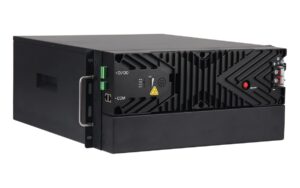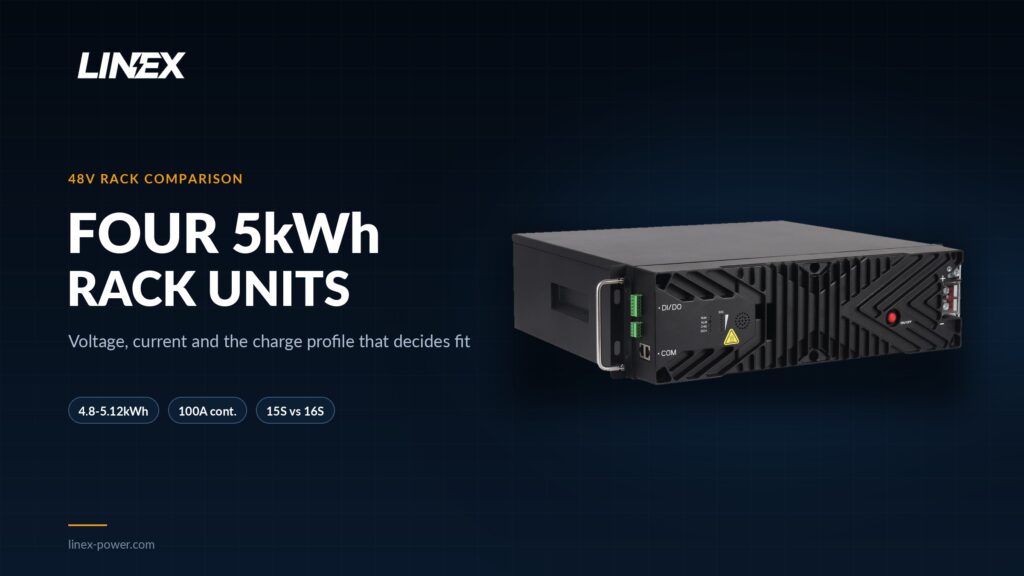
The four units share a 19-inch rack format, not a voltage class
All four batteries fit a 19-inch rack and sit near 5kWh, but they split into two voltage classes. The EG4 LL-S, Chargex CXR-48-100 and Epoch SR48100H are 51.2V packs. The 48V 100Ah pack sits in the 48V class and uses a 53.3V equalization setting. The rack width is the same; the charger settings are not.
The 51.2V label comes from 16 LiFePO4 cells in series at 3.2V each. A 48V pack uses 15 cells, which lands at 48.0V nominal and a lower charge voltage. Both are sold as 48V-class products, so the label on the front panel does not tell you which profile the BMS expects. The 48V vs 51.2V guide walks through the cell math and the equipment check.
| Model | Nominal voltage | Capacity | Nominal energy | Continuous charge / discharge | Peak discharge | Communication |
|---|---|---|---|---|---|---|
| EG4 LL-S | 51.2V | 100Ah | 5.12kWh | 100A / 100A | Not published | RS485, CAN |
| Chargex CXR-48-100 | 51.2V | 100Ah | 5.12kWh | 100A / 100A | 110A, duration not stated | CAN, RS485, UART |
| Epoch SR48100H | 51.2V | 100Ah | 5.12kWh | 70A / 100A | 119A for 5 min, 200A for 15 s | CAN, RS485 |
| 48V 100Ah | 48V | 100Ah | 4.8kWh | 100A / 100A at 25°C | Not published | RS485, RS232 |
Usable energy ranges from 3.84kWh to 4.10kWh per unit
Nominal energy is volts times amp-hours. The 51.2V packs give 51.2 × 100 = 5,120Wh. The 48V pack gives 48 × 100 = 4,800Wh. The gap is 320Wh, or 6.7% per unit.
At 80% depth of discharge, the usable figures are 4,096Wh for the 51.2V units and 3,840Wh for the 48V unit. A 1,000W load runs about 4.1 hours on one 51.2V pack and 3.8 hours on the 48V pack, before inverter losses. For a 20kWh usable bank, five 51.2V units reach 20.48kWh; five 48V units reach 19.2kWh, so the 48V bank needs a sixth unit or a lower load target.
Epoch publishes a 4.92kWh usable figure at 96% depth of discharge. That is a different test condition from the 80% figure used above, and it shows why the usable number has to be read with its DoD. The 48V 100Ah vs 200Ah comparison covers the same math for larger modules.
Continuous current is 100A on all four, peak ratings are not
Every unit in this group lists 100A continuous discharge. The charge ceiling separates them: EG4, Chargex and the 48V pack list 100A, while Epoch lists 70A. On a 100Ah pack, 100A is 1C, so a full bulk charge takes about one hour at the ceiling; 70A takes about 1.4 hours before the absorption phase.
Peak ratings need a duration. Epoch publishes 119A for five minutes and 200A for 15 seconds. Chargex publishes 110A without a duration. EG4 and the 48V pack publish no peak rating at all. EG4’s spec sheet prints the limit as “100A (Max. continuous)” and leaves the surge figure out. A peak number without a time limit cannot be sized against a motor start or an inverter surge.
| Model | Continuous charge | Continuous discharge | Peak discharge | Recommended continuous |
|---|---|---|---|---|
| EG4 LL-S | 100A | 100A | Not published | 50A |
| Chargex CXR-48-100 | 100A | 100A | 110A, no duration | 20A to 50A charge |
| Epoch SR48100H | 70A | 100A at ≤30°C start | 119A 5 min, 200A 15 s | 50A or less |
| 48V 100Ah | 100A at 25°C | 100A at 25°C | Not published | Not stated |
A 5,000W inverter at 51.2V draws about 98A before losses and about 108A at 90% efficiency. That is already over the 100A continuous rating, so one battery is not enough for a 5kW load even though the label says 5.12kWh. At 48V the same load draws 104A before losses and 116A after. The current limit, not the energy limit, decides the inverter size per unit.
Charge voltage is the first compatibility check
The charge profile is where a 48V pack and a 51.2V pack stop being interchangeable. The 51.2V units charge at 56.0V to 58.4V absorption and float at 54.0V to 54.6V. The 48V unit charges at 53.3V equalization and floats at 51.0V. The 3.5V gap is the difference between a 16-cell and a 15-cell profile.
A charger set for 16 cells will push a 15-cell pack above its intended cell voltage. A charger set for 15 cells will leave a 16-cell pack undercharged. Neither failure shows up on the first cycle, which is why the profile has to be checked before the order, not after the first alarm.
| Model | Absorption / bulk | Float | Discharge cutoff | Profile note |
|---|---|---|---|---|
| EG4 LL-S | 56.8V | 54.0V ±0.2V | Not stated | BMS recommends 56.2V ±0.2V |
| Chargex CXR-48-100 | 58.4V | Not stated | 47.0V | 51.2V pack |
| Epoch SR48100H | 56.0V | 54.6V | 48.0V | 16S1P, 96% DoD usable |
| 48V 100Ah | 53.3V equalization | 51.0V | 40.5V | 48V, 15-cell profile |
The same guide covers the full equipment check. Confirm the inverter’s charge voltage range, low-voltage cutoff and lithium profile before comparing capacity.
Weight and depth decide whether the rack closes
All four units weigh between 43kg and 46kg, so each one needs two people or a lift. The difference is in the depth and height. The 48V and Epoch units are 3U and 133mm tall. The EG4 unit is 155mm tall, and the Chargex unit is 177mm tall. Two EG4 units need more than 6U of vertical space; two Chargex units need 8U.
| Model | Rack height | H × W × D (mm) | Depth with handles (mm) | Weight (kg) |
|---|---|---|---|---|
| EG4 LL-S | Not stated, 155mm tall | 155 × 442 × 490 | 490 | 45.2 |
| Chargex CXR-48-100 | 19-inch rack, 177mm tall | 177 × 425 × 482 | 482 | 46 |
| Epoch SR48100H | 3U | 133.5 × 442 × 460 | 510 | 46 |
| 48V 100Ah | 3U | 133 × 442 × 420 | 482 | 43 |
Manufacturers list dimensions in different orders. The table normalizes them to height, width and depth, and keeps the handle depth separate because that is the number that hits the cabinet door. A 600mm deep cabinet leaves 90mm to 118mm behind a 482mm to 510mm module for cables, terminals and bend radius. Check the door and the cable entry before the rack is ordered.
Cycle life claims use different test conditions
A cycle count is only comparable when the datasheet states the C-rate, depth of discharge, temperature and end-of-life capacity. The four sheets in this group do not use the same conditions.
| Model | Cycle claim | Conditions listed |
|---|---|---|
| EG4 LL-S | More than 7,000 deep cycles | 80% DoD daily; C-rate and end-of-life capacity not stated |
| Chargex CXR-48-100 | At least 6,000 cycles | Test conditions not stated on the product page |
| Epoch SR48100H | 6,000+ cycles | 0.2C, 90% DoD, 25°C, to 60% of initial capacity |
| 48V 100Ah | 6,000 cycles | 25°C, 80% DoD; C-rate and end-of-life capacity not stated |
Epoch’s 90% DoD is a harder cycle than an 80% DoD test, but its 60% end-of-life threshold is a lower bar than 80%. The two effects push in opposite directions. Without the missing fields, the four cycle counts cannot be ranked. The datasheet guide shows how to read the same line across suppliers.
Certification and warranty separate the four
EG4 lists UL 1973 and UL 9540A on its spec sheet and backs the LL-S with a 10-year warranty. Epoch lists UL 1973 at pack level through ETL, states that UL 9540 is pending, and has an 11-year limited warranty with three years of free replacement. Chargex lists a limited warranty on the product page without a term and does not list a UL or IEC file in the specification table. The 48V pack lists UN38.3, CE, RoHS and MSDS documents for the model and a 5-year warranty, with no UL listing stated.
Those lines are not equivalent. UL 1973 is a pack safety standard. UL 9540A is a thermal runaway test method that starts at cell level and scales to module, unit and installation. UL 9540 is the system-level listing. A UN38.3 summary is a transport test summary, not a product safety certificate. Ask for the report number and the model code on each file before you treat it as a check mark.
Listed price runs about $293 to $300 per kWh
At list price, the three 51.2V units land within $39 of each other. The 48V pack is sold by configuration quote, so it has no list price to compare.
| Model | Listed price (USD) | Energy (kWh) | Price per kWh | Note |
|---|---|---|---|---|
| EG4 LL-S | 1,536.99 | 5.12 | 300 | 1,470.99 on sale |
| Chargex CXR-48-100 | 1,497.98 | 5.12 | 293 | Before freight and tax |
| Epoch SR48100H | 1,499.00 | 5.12 | 293 | Before freight and tax |
| 48V 100Ah | Quote | 4.80 | Not published | Price depends on configuration |
Prices checked 2026-11-09 on the pages listed in the sources. Freight, duties and payment terms are excluded. A two-unit 10.2kWh bank costs about $2,996 to $3,074 at list price for the 51.2V models, before those extras. The 48V bank reaches 9.6kWh nominal, so it needs a different unit count for the same usable target.
Which unit fits which project
An existing 48V telecom plant with a 53.3V equalize and 51.0V float setting is the natural home for the LINEX 48V 100Ah. The pack matches the 15-cell profile, uses RS485 or RS232, and fits a 3U slot. Confirm the 100A continuous limit against the site load and the parallel review before ordering.
A modern 51.2V ESS inverter with closed-loop CAN is the natural home for the other three. EG4 publishes 64 parallel units and a 327.7kWh ceiling, which suits a large bank. Epoch publishes self-heating to -25°C and an 11-year limited warranty, which suits a cold site. Chargex publishes a 110A peak and UART, which suits a smaller system that needs a short surge.
The 48V lithium battery range lists the models from 50Ah to 200Ah, and the 48V 100Ah product page has the full datasheet for the unit in this table. Match the voltage class first, the current limit second, and the certification file third. Price comes last because the three 51.2V units are within 2.6% of each other at list.
Frequently asked questions
No. EG4, Chargex and Epoch are 51.2V packs with 56.0V to 58.4V absorption settings. The 48V 100Ah pack is a 48V design with 53.3V equalization and 51.0V float. The rack fits all four, but the charger profile and low-voltage cutoff must match the pack.
All four list 100A continuous discharge. Epoch lists 100A only when the starting temperature is 30°C or lower and limits continuous charge to 70A. EG4 and Chargex list 100A charge and discharge. The 48V pack lists 100A charge and discharge at 25°C.
No. A 15-cell and a 16-cell pack have different charge and cutoff voltages. Parallel strings also share current based on voltage, so mixing the two profiles can push one pack outside its limits. Use one voltage class per bank and get the manufacturer’s approval for the parallel layout.
Epoch publishes self-heating from -25°C to 5°C with at least 8A of incoming current. EG4, Chargex and the 48V pack list a 0°C charge floor, so they need a heated space or a separate heater. A wide discharge range does not mean charging is allowed below freezing.
No. UL 9540A is a thermal runaway test method. UL 9540 is the system-level safety listing. EG4 lists UL 1973 and UL 9540A. Epoch lists UL 1973 and states that UL 9540 is pending. A UL 9540A report alone is not a system listing.
The 48V pack is 48V nominal, so 48 × 100 = 4,800Wh. The 51.2V packs are 16-cell designs, so 51.2 × 100 = 5,120Wh. The 320Wh gap is 6.7% per unit and comes from the cell count.
Sources: EG4 LL-S 48V 100Ah spec sheet, version 1.2.5 (51.2V, 100Ah, 56.8V bulk, 54V float, 100A continuous, 45.2kg, 155 × 442 × 490mm, UL 1973, UL 9540A, 10-year warranty); EG4 LL-S listing at Signature Solar (list price $1,536.99, sale $1,470.99, checked 2026-11-09); Chargex CXR-48-100-5kWh product page (51.2V, 100Ah, 5.12kWh, 58.4V charge, 47.0V cutoff, 100A continuous, 110A peak, 46kg, 482 × 425 × 177mm, CAN/RS485/UART, $1,497.98, checked 2026-11-09); Epoch SR48100H product page (51.2V, 100Ah, 5.12kWh, 4.92kWh usable at 96% DoD, 100A continuous, 119A 5 min, 200A 15 s, 70A charge, 56.0V absorption, 54.6V float, 48.0V cutoff, 46kg, 442 × 460 × 133.5mm, 510mm with handles, UL 1973, UL 9540 pending, 11-year limited warranty, $1,499, checked 2026-11-09); LINEX 48V 100Ah product page (48V, 100Ah, 4.8kWh, 53.3V equalization, 51.0V float, 40.5V cutoff, 100A charge and discharge at 25°C, 43kg, 442 × 420 × 133mm, 482mm with handles, RS485/RS232, 6,000 cycles at 25°C and 80% DoD, UN38.3, CE, RoHS, MSDS, 5-year warranty); LINEX 48V vs 51.2V guide and 48V range (15-cell and 16-cell charge profiles; 50Ah to 200Ah models). Last updated 2026-11-10.
Related: the 48V rack vs wall-mount guide compares cabinet space, weight and working clearance for both formats.