The model code and cell configuration come first
The first page should name the model, the chemistry and the cell configuration. A 16S1P line means 16 cells in series and one parallel string; a 15S pack uses 15 cells. The model code on the datasheet has to match the code on the invoice, the packing list and the UN38.3 summary. If the sheet says “48V 100Ah” but the invoice says “48V 100Ah V2”, the document may not cover the unit in the carton.
Cell brand and grade are often missing. Ask for the cell specification sheet and the incoming inspection record, not just the pack datasheet. The lithium battery manufacturer guide shows the supplier checks that sit behind those documents.
Capacity is a test result, not a fixed number
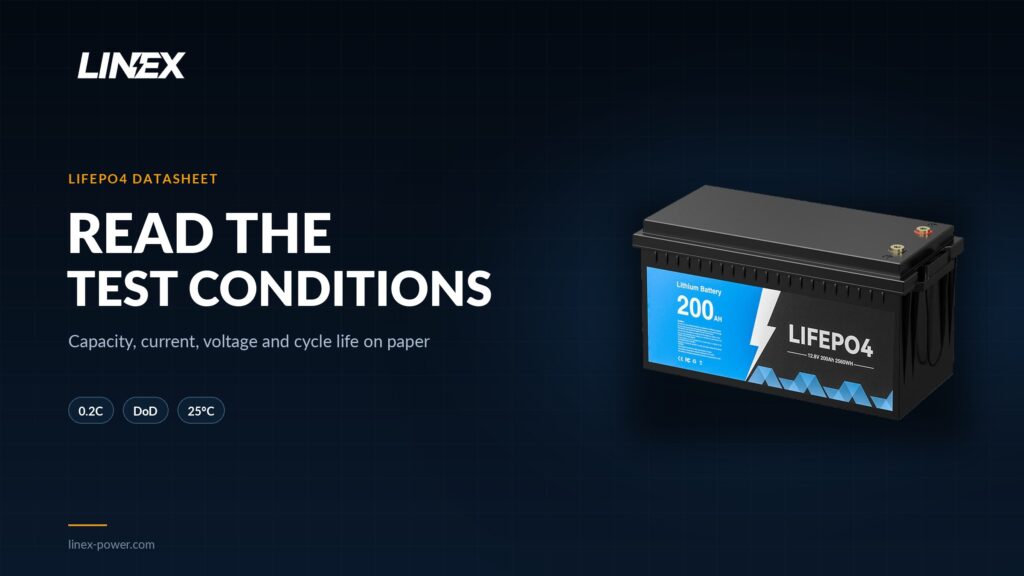
A 100Ah rating is normally measured at a stated C-rate and temperature, often 0.2C at 25°C. At 1C or at 0°C, the delivered capacity is lower. The datasheet should put the test condition next to the Ah number; if it does not, the number cannot be compared with another supplier’s.
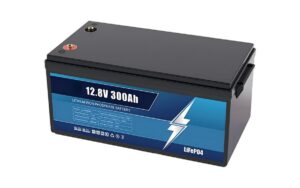
Watt-hours come from nominal voltage times amp-hours. A 48V 100Ah pack gives 4,800Wh. A 51.2V 100Ah pack gives 5,120Wh. A 12V 100Ah pack gives 1,280Wh, so the same 100Ah label covers a 3.75-fold spread in energy. The 12V 100Ah product page shows the 12.8V and 1,280Wh lines on one sheet.
Usable energy adds depth of discharge. At 80% DoD, the 48V pack delivers 3,840Wh and the 51.2V pack delivers 4,096Wh. Epoch publishes 4.92kWh usable at 96% DoD for its 5.12kWh pack. The percentage has to travel with the kWh figure.
| Datasheet line | What it means | What to ask |
|---|---|---|
| 100Ah | Rated capacity at a stated C-rate and temperature | At what C-rate and temperature was it measured? |
| 5.12kWh | Nominal energy at 51.2V × 100Ah | Is this nominal or usable? |
| 4.92kWh usable | Energy at 96% DoD | At what C-rate and temperature? |
| 0.2C | Five-hour discharge rate for a 100Ah pack | Does the capacity hold at 1C? |
| 25°C | Reference temperature | What is the derating at 0°C and 45°C? |
Peak current needs a duration, continuous current does not
Continuous current is the load the BMS can carry indefinitely at the stated temperature. Peak current is a short burst, and it means nothing without a duration. Epoch lists 119A for five minutes and 200A for 15 seconds. Chargex lists 110A peak without a duration. EG4 and the 48V 100Ah rack unit publish no peak rating.
A 5,000W inverter at 51.2V draws about 98A before losses and about 108A at 90% efficiency. That is already above a 100A continuous rating. At 48V the same load draws 104A before losses and 116A after. The continuous line, not the peak line, sets the inverter size per battery.
| Model | Continuous charge | Continuous discharge | Peak discharge |
|---|---|---|---|
| EG4 LL-S | 100A | 100A | Not published |
| Chargex CXR-48-100 | 100A | 100A | 110A, no duration |
| Epoch SR48100H | 70A | 100A at ≤30°C start | 119A 5 min, 200A 15 s |
| 48V 100Ah | 100A at 25°C | 100A at 25°C | Not published |
The charge profile has three numbers
A complete datasheet lists absorption or bulk voltage, float voltage and discharge cutoff. One voltage number is not enough. The absorption stage sets the top of the charge, the float stage holds the pack at rest, and the cutoff protects it from over-discharge.
The cell count sets the profile. A 16S pack charges at 56.0V to 58.4V and floats at 54.0V to 54.6V. A 15S pack charges at 53.3V and floats at 51.0V. A charger configured for one profile will overcharge or undercharge the other. The 48V vs 51.2V guide shows the full table and the equipment check.
| Model | Absorption / bulk | Float | Cutoff | Cell configuration |
|---|---|---|---|---|
| EG4 LL-S | 56.8V | 54.0V ±0.2V | Not stated | Not stated |
| Chargex CXR-48-100 | 58.4V | Not stated | 47.0V | Not stated |
| Epoch SR48100H | 56.0V | 54.6V | 48.0V | 16S1P |
| 48V 100Ah | 53.3V equalization | 51.0V | 40.5V | 15-cell profile |
Cycle life needs four test conditions
A cycle count without a C-rate, depth of discharge, temperature and end-of-life capacity is not a comparable number. Epoch states all four: “6,000+ cycles (0.2C, 90% DoD, 25°C, to 60% of initial capacity)”. The other sheets in this comparison leave at least one field out. EG4 claims more than 7,000 deep cycles at 80% DoD daily but does not state the C-rate or the end-of-life capacity in the spec table. Chargex lists at least 6,000 cycles without test conditions on the product page. The 48V 100Ah unit lists 6,000 cycles at 25°C and 80% DoD without the C-rate or end-of-life capacity.
The end-of-life threshold matters as much as the cycle count. A pack that reaches 60% of its original capacity after 6,000 cycles has lost more capacity than one that reaches 80% after the same count. A 90% DoD cycle is harder on the cells than an 80% cycle. Without all four fields, two 6,000-cycle claims can describe different tests.
Dimensions decide installation space and handling
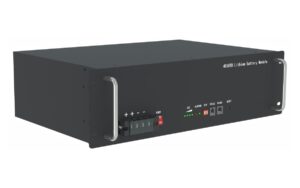
Rack height is measured in U, where 1U is 44.45mm. A 3U module is about 133mm tall; a 4U module is about 178mm. The EG4 LL-S is 155mm tall, which sits between the two, so two units need more than 6U of vertical space. The Epoch and 48V 100Ah units are 3U, so two fit in 6U.
Depth with handles is the number that hits the cabinet door. The Epoch unit is 460mm deep and 510mm with handles; the 48V 100Ah unit is 420mm deep and 482mm with handles. A 600mm cabinet leaves 90mm to 118mm for cables, terminals and bend radius. Weight runs from 43kg to 46kg, so plan a two-person lift and check the rack rail rating.
Ask for a dimension drawing with the handle and terminal positions, not just a L × W × H line.
BMS and communication lines define integration
The communication line tells you whether the battery can run closed-loop with the inverter. RS485 and CAN are the common ports. RS232 appears on telecom-oriented models. A battery with RS485 only can still run open-loop with a voltage-based profile, but the inverter will not read state of charge or charge limits from the BMS.
EG4 lists RS485 and CAN with 64 parallel units. Epoch lists CAN and RS485 with 32 parallel units. Chargex lists CAN, RS485 and UART. The 48V 100Ah unit lists RS485 and RS232. Match the port and the protocol list to the inverter, and ask for the register map before the first commissioning. The BMS checklist covers the settings to compare.
Charge and discharge temperature ranges are separate
A wide discharge range does not mean the pack can charge at the same temperature. EG4 lists charge from 0°C to 50°C and discharge from -20°C to 55°C. Chargex lists 0°C to 55°C charge and -20°C to 65°C discharge. Epoch lists charge from -25°C to 50°C with internal heating, cell charge from -10°C to 50°C, and discharge from -20°C to 50°C. The 48V 100Ah unit lists charge from 0°C to 65°C and discharge from -20°C to 65°C.
Below 0°C, the BMS should block charge current unless the pack has a heater. Epoch is the only unit in this group with a published self-heating function. The others need a heated space or an external heater. Check the storage range too, because a pack stored at -20°C may need to warm up before charging.
Certification lines need a report number
A datasheet that lists “UN38.3, CE, IEC” without file numbers or a declaration is a summary, not evidence. The UN38.3 file should name the cell, the battery model and the applicant, and it should list the eight tests T.1 to T.8. An IEC 62619 report covers industrial battery safety; IEC 62133-2 covers portable sealed cells. UL 1973 is a pack safety standard, and UL 9540 is the system-level listing. CE is a declaration of conformity, not a third-party certificate.
Ask for the native PDF, the report number, the test lab and the model code. A certificate for a sister model with a different BMS does not cover the unit you are buying. The battery export document guide lists the full folder and the fields that must match.
A datasheet checklist for the next RFQ
Put these twelve lines in the RFQ and require a value and a test condition for each one. A supplier who can fill the table has a datasheet; a supplier who sends a brochure has a cover page. The 48V rack battery comparison applies the same fields to four 100Ah units.
| Field | What to ask for | Why it matters |
|---|---|---|
| Model code | Exact code on the datasheet, invoice and label | Confirms the document covers the unit |
| Cell configuration | Series and parallel count, cell brand and grade | Sets voltage, capacity and cycle behavior |
| Capacity | Ah, C-rate and temperature | Makes the Ah number comparable |
| Energy | Nominal Wh and usable Wh with DoD | Separates label energy from usable energy |
| Continuous current | Charge and discharge amps at a stated temperature | Sizes the inverter and charger |
| Peak current | Amps and duration | Sizes motor starts and surges |
| Charge profile | Absorption, float and cutoff volts | Protects the cells and the warranty |
| Cycle life | Cycles, C-rate, DoD, temperature, end-of-life capacity | Makes cycle claims comparable |
| Dimensions | H × W × D, handle depth, terminal clearance | Confirms the rack and cabinet fit |
| Weight | kg with and without accessories | Plans the lift and rail load |
| Communication | Ports, protocol list and register map | Confirms closed-loop integration |
| Certification | Report number, standard, model and test lab | Turns a claim into evidence |
Frequently asked questions
The capacity line with its test condition. A 100Ah rating at 0.2C and 25°C is a different product from a 100Ah rating at 1C and 45°C. Read the number and the condition together.
No. Energy is nominal voltage times capacity. A 48V 100Ah pack stores 4,800Wh; a 51.2V 100Ah pack stores 5,120Wh. The 6.7% difference comes from the cell count.
1C is a current equal to the rated capacity in amp-hours. For a 100Ah pack, 1C is 100A. A 0.2C rate is 20A for the same pack. The C-rate tells you how fast the test was run.
Only when the C-rate, depth of discharge, temperature and end-of-life capacity match. A 6,000-cycle claim at 90% DoD and 60% end-of-life is not the same test as 6,000 cycles at 80% DoD and 80% end-of-life.
Treat the pack as continuous-only and size the load to the continuous rating. A peak number without a duration cannot be verified. Ask the supplier for the missing test condition in writing.
No. CE is a mark backed by a manufacturer’s declaration of conformity. It is not a third-party certificate. Ask for the declaration, the standards it names and the test reports behind it.
Sources: LINEX 48V 100Ah product page (48V, 100Ah, 4.8kWh, 53.3V equalization, 51.0V float, 40.5V cutoff, 100A charge and discharge at 25°C, 43kg, 442 × 420 × 133mm, 482mm with handles, RS485/RS232, 6,000 cycles at 25°C and 80% DoD, IP20, charge 0°C to 65°C, discharge -20°C to 65°C); LINEX 12V 100Ah product page (12.8V, 100Ah, 1,280Wh, 100A continuous, 4S, 332 × 172 × 218mm, 10kg); EG4 LL-S spec sheet version 1.2.5 (51.2V, 100Ah, 100A continuous, 56.8V bulk, 54V float, 45.2kg, UL 1973, UL 9540A); Chargex CXR-48-100-5kWh product page (51.2V, 100Ah, 58.4V charge, 47.0V cutoff, 100A continuous, 110A peak, 46kg, CAN/RS485/UART); Epoch SR48100H product page (51.2V, 100Ah, 16S1P, 6,000+ cycles at 0.2C and 90% DoD to 60% capacity, 100A continuous, 119A 5 min, 200A 15 s, 70A charge, 56.0V absorption, 54.6V float, 48.0V cutoff, 46kg, 442 × 460 × 133.5mm, 510mm with handles); UN Manual of Tests and Criteria section 38.3 (eight tests T.1 to T.8 and the test summary); IEC 62619 (industrial lithium battery safety); IEC 62133-2 (portable sealed lithium batteries); UL 1973 (pack safety); UL 9540 (system-level energy storage listing); LINEX battery export document guide (UN38.3, MSDS, CE declaration); LINEX battery management system checklist (BMS parameters); LINEX lithium battery manufacturer guide (supplier document checks). Last updated 2026-11-10.
Related: the LiFePO4 warranty guide explains what a five-year policy should cover, including the capacity floor, BMS and freight split.
Related: the charging voltage guide explains the absorption, float and cutoff columns in a LiFePO4 datasheet.
Related: the LiFePO4 cell format guide explains how to read cell type and series configuration on a datasheet.