LiFePO4 packs are industrial batteries under EU law
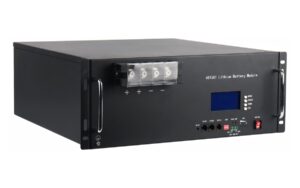
A LiFePO4 pack that is designed for industrial use, or weighs more than 5kg and is not an EV, LMT or SLI battery, falls into the EU industrial battery category. A 48V 100Ah telecom pack weighs 43kg, so it qualifies. The importer that first places the pack on the EU market is the producer, even when the factory is in China. That label brings registration, take-back and recycling duties.
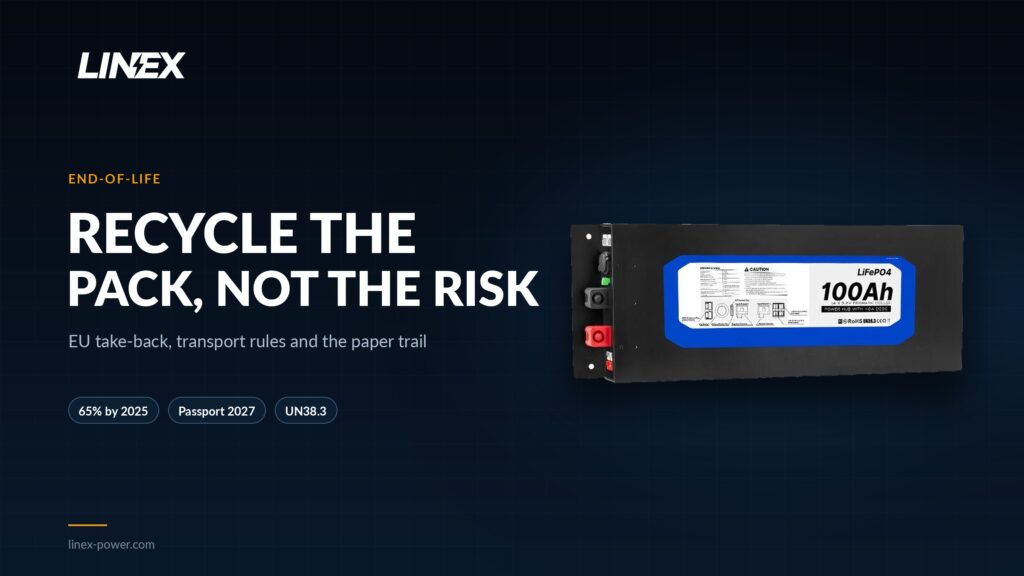
The producer can join a producer responsibility organisation or run an individual compliance scheme. The take-back must be free of charge, and the end user does not have to buy a new battery. The 48V 100Ah telecom battery is a useful example because its 43kg case puts it clearly above the 5kg threshold and its 4.8kWh pack is large enough to need a planned reverse logistics route.
The take-back duty covers industrial packs, not just portable cells
EU collection targets for portable batteries get most of the attention: 45% by 2023, 63% by 2027 and 73% by 2030. Industrial batteries work differently. Extended producer responsibility rules require producers to take back all waste industrial batteries free of charge, regardless of brand or condition, and to finance collection, treatment and recycling; Article 61 sets out the collection duty. There is no percentage collection target for industrial packs; the obligation is to accept every pack they placed on the market.
That difference changes the planning. A portable battery program can chase a collection rate. An industrial program has to answer a simpler question: where does each returned pack go, and who pays for the move? The answer belongs in the distributor agreement, not in a sustainability report.
Recycling efficiency is 65% now and 70% by 2030
Annex XII sets the recycling efficiency targets that permitted facilities must meet. For lithium-based batteries, the minimum is 65% by average weight by 31 December 2025, rising to 70% by 31 December 2030. The target is measured on the mass of output fractions against the mass of waste batteries that enter the process, not on the battery’s original energy rating.
Material recovery targets sit alongside the efficiency target. They apply to specific metals, so an LFP pack is judged on the copper and lithium that come out of the process, plus the overall recycling efficiency, not on the cobalt or nickel it never contained.
| Target | Material | Rate | Deadline |
|---|---|---|---|
| Recycling efficiency | Lithium-based batteries | 65% by average weight | 31 December 2025 |
| Recycling efficiency | Lithium-based batteries | 70% by average weight | 31 December 2030 |
| Material recovery | Cobalt, copper, lead, nickel | 90% each | 31 December 2027 |
| Material recovery | Lithium | 50% | 31 December 2027 |
| Material recovery | Cobalt, copper, lead, nickel | 95% each | 31 December 2031 |
| Material recovery | Lithium | 80% | 31 December 2031 |
The 2025 date has already passed, so an importer placing industrial packs on the EU market now should ask for the recycler’s current efficiency figure, not a target from a brochure. The 2030 and 2031 dates are the ones that affect a multi-year supply contract.
LFP recovery depends on copper, aluminum, steel and lithium
LFP cathodes use lithium iron phosphate, with no cobalt or nickel in the cathode. NMC packs carry nickel and cobalt, which recyclers can recover and sell. LFP packs have no cobalt or nickel to recover, so the output fractions that carry value are copper, aluminum, steel and a lithium-bearing stream. That mix makes the material value lower, so collection and gate fees carry more of the cost.
A 2026 Mitsui report puts it directly: “the low value of the materials in LFP batteries makes it difficult to ensure the profitability of recycling operations.” The EU targets still apply, so the recycler’s business model depends on volume, gate fees and lithium recovery efficiency. An importer who treats recycling as a scrap sale will misjudge the contract. An importer who treats it as a service with a per-kg fee will get a clearer quote.
The battery passport starts on 18 February 2027
From 18 February 2027, each industrial battery above 2kWh placed on the EU market must have an electronic battery passport. The passport is accessed through a QR code and carries model data, composition and dismantling information. The economic operator that places the battery on the market must keep the data accurate.
For an importer, the passport is an end-of-life document as much as a sales document. Recyclers use it to plan dismantling, identify the chemistry and find the safety information they need before a pack is opened. A passport that lists the wrong cell chemistry or the wrong weight creates a transport and treatment problem years after the sale.
Damaged packs cannot fly
A waste LiFePO4 pack is still a lithium battery shipment. 49 CFR 173.185 requires a UN38.3 test summary and a Watt-hour marking on the case. A damaged or defective pack is treated more strictly: it may travel by highway, rail or vessel only, in the packaging and with the mark specified in paragraph (f). Air transport is not allowed for a pack that has been “damaged or identified by the manufacturer as being defective for safety reasons.”
| Pack status | Air | Road, rail or vessel | Documents |
|---|---|---|---|
| Intact, UN38.3-tested | Allowed within the applicable packing instruction | Allowed | Test summary, lithium battery mark, shipping paper |
| Damaged or defective | Not allowed | Allowed with paragraph (f) packaging and mark | Test summary, damaged/defective mark, shipping paper |
The transport rule is one reason to inspect returns before they are consolidated. A swollen pack mixed into a pallet of intact packs can force the whole pallet onto the damaged/defective route, because the carrier cannot treat it as a normal lithium battery load. The UN38.3, MSDS and CE guide explains which document covers which claim; a UN38.3 summary is a transport test summary, not a product safety certificate.
The US framework is disposal rules, not a take-back mandate
US federal law sets disposal rules for batteries but does not create a producer take-back mandate for industrial LiFePO4. The federal universal waste rule streamlines disposal for batteries that would otherwise be hazardous waste, and states can add categories or run their own programs. The Mercury-Containing and Rechargeable Battery Management Act covers nickel cadmium, small sealed lead-acid and certain other rechargeable batteries, not large LiFePO4 packs. EPA’s guidance for medium and large Li-ion batteries is to contact the manufacturer or installer for management options and keep the pack out of trash and municipal recycling.
| US option | What it covers | Limitation for LiFePO4 importers |
|---|---|---|
| Federal universal waste (40 CFR 273) | Batteries that would otherwise be hazardous waste, with streamlined storage, labeling and transport | State adoption varies; it is not a producer take-back mandate |
| State battery stewardship laws | Collection and recycling programs, often for portable batteries | Coverage of industrial packs varies by state |
| Household hazardous waste sites | Small consumer packs | May not accept a 43kg industrial module |
| Manufacturer take-back | Pack-specific reverse logistics | Must be contracted before the first sale |
In practice, a US importer needs a voluntary take-back contract even where no statute requires one. The contract should name the recycler, the accepted condition, the packaging and the party that pays for a rejected load.
A take-back program needs four documents
A take-back promise is not a program. The file should contain the producer registration or producer responsibility organisation membership, the take-back contract, the transport documents for each shipment and the recycling certificate from the downstream facility. Missing any one of these turns a compliant return into an orphaned shipment.
| Document | Issued by | What it proves |
|---|---|---|
| Producer registration or PRO membership | National register or producer responsibility organisation | The importer has a legal route for the waste it placed on the market |
| Take-back contract | Importer and recycler or PRO | Who collects, who pays and what condition is accepted |
| Transport documents | Shipper and carrier | UN38.3 summary, hazard class, packaging and damaged/defective status |
| Recycling certificate | Downstream facility | The pack was treated and the output fractions were recorded |
Keep the documents for the same period as the sales records. An auditor who checks a 2027 shipment may ask for the registration that was valid on the shipment date, not the current one.
Questions to ask a recycler before you sign
A recycler’s permit is the first check, not the last. Ask which process the facility uses, what recovery rate it reports for lithium and copper, where the output fractions go, and whether the downstream facility is permitted. Ask for a mass balance for a recent shipment and a certificate that names the receiving site. A broker that cannot name the final facility is a transport arrangement, not a recycling contract.
| Question | Why it matters |
|---|---|
| Which permits cover the site and the process? | A transport broker may not hold a recycling permit |
| Mechanical pretreatment, pyrometallurgical or hydrometallurgical process? | The route decides which materials are recovered and at what rate |
| What lithium and copper recovery rates are reported? | The EU targets are set on the process, not on the sales pitch |
| Where do black mass and other fractions go? | The final facility decides whether the claim is real |
| Can you provide a mass balance and a certificate? | These are the documents an auditor will ask for |
| Who carries insurance for fire or leakage in transit? | Damaged packs are a transport risk before they are a recycling risk |
Cost drivers and contract terms
The gate fee is only one line. Reverse freight, packaging, testing, discharging and storage add cost before the pack reaches the recycler. A damaged pack may need a dedicated vehicle and a fire-resistant container. Volume matters because a full truckload costs less per kg than a single pallet. Ask for a quote per kg with the packaging and freight separated, and state who bears the cost of a rejected load.
The container loading guide shows how much a full load changes the freight math on export shipments. The same principle applies in reverse: a consolidated return load is cheaper per pack than a series of single-pallet pickups. The manufacturer vetting guide covers the factory audit side, and the cell verification guide covers the incoming inspection that reduces the number of warranty returns later.
A workable end-of-life plan needs a legal route for each market, a transport route that matches the pack condition, and a downstream facility that can document what it recovered. The Battery Regulation adds a passport requirement for EU sales from 2027, so the recycler can see what is inside the pack before it is opened.
Frequently asked questions
Not if they are damaged or defective. 49 CFR 173.185(f) allows damaged or defective lithium batteries by highway, rail or vessel only, with the specified packaging and mark. Intact packs can fly within the applicable packing instruction, with a UN38.3 test summary and the required state-of-charge limit.
The producer that first places the battery on the EU market. That can be the importer, not the Chinese factory. The producer must take back waste industrial batteries free of charge and finance collection, treatment and recycling.
It can be. The federal universal waste rule applies to batteries that would otherwise be hazardous waste, and state rules vary. EPA says Li-ion batteries should not go in trash or municipal recycling, and large packs should go through the manufacturer or installer.
65% by average weight by 31 December 2025, rising to 70% by 31 December 2030. Material recovery targets are separate: 90% for cobalt, copper, lead and nickel and 50% for lithium by 2027, rising to 95% and 80% by 2031.
From 18 February 2027 for industrial batteries above 2kWh, LMT batteries and EV batteries. The passport is accessed by QR code and must be accurate when the battery is placed on the market.
Yes, under the waste shipment rules, but the export must comply with Regulation (EC) No 1013/2006 and the treatment must be equivalent to EU standards for the waste to count toward recycling targets. Keep the documentary evidence from the destination authority.
Sources: Regulation (EU) 2023/1542 (industrial battery definition, producer definition, Article 61 free take-back, Article 71 and Annex XII Part B recycling efficiency targets of 65% by 31 December 2025 and 70% by 31 December 2030, Annex XII Part C material recovery targets of 90% cobalt, copper, lead and nickel and 50% lithium by 31 December 2027, 95% and 80% by 31 December 2031, Article 72 waste shipment, Article 77 battery passport from 18 February 2027 for industrial batteries above 2kWh); European Commission batteries page (Regulation in force since 17 August 2023, applies from 18 February 2024); US EPA universal waste page (40 CFR part 273, state adoption varies); US EPA used lithium-ion batteries page (no trash or municipal recycling, contact manufacturer for large packs); US EPA used household batteries page (Public Law 104-142 covers nickel cadmium and small sealed lead-acid batteries); 49 CFR 173.185 (UN38.3 test summary, Watt-hour marking, paragraph (f) damaged or defective transport by highway, rail or vessel only); Mitsui Global Strategic Studies Institute, LFP battery recycling report, August 2026 (low material value makes LFP recycling profitability difficult); Battery University BU-205 (LiFePO4 cathode and graphite anode, 3.2V per cell); LINEX 48V 100Ah product page (43kg, 4.8kWh, 6,000 cycles at 25°C and 80% DoD). Last updated 2026-11-11.