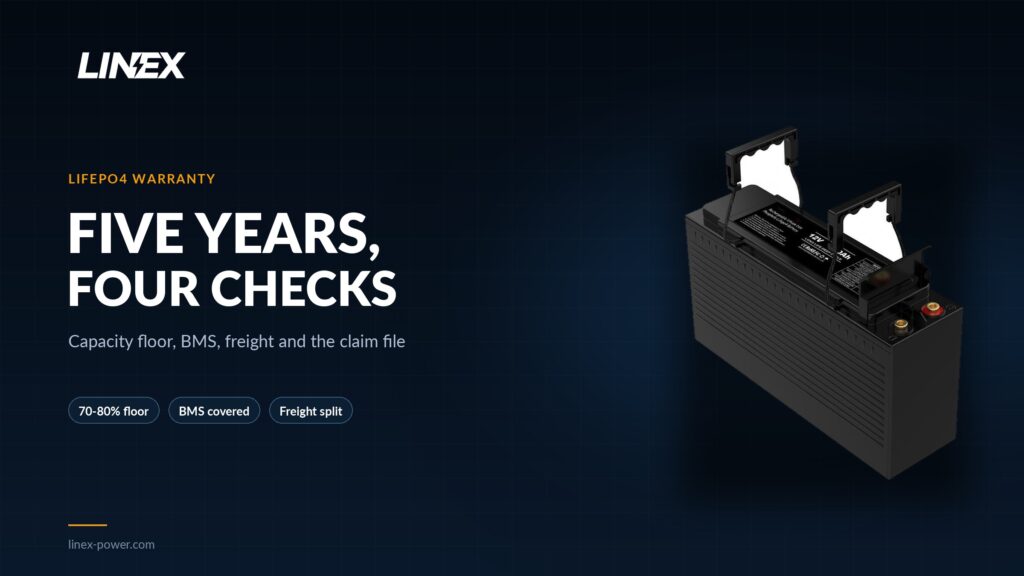
Five years is a term, not a coverage level
A five-year warranty on a LiFePO4 battery covers 60 months from a stated start date. At one full cycle per day, that is about 1,825 cycles. A 6,000-cycle pack is rated for roughly 16 years at the same rate, so the warranty ends long before the cycle-life rating. The gap matters because the warranty, not the cycle count, decides who pays for an early failure.
The start date is the first thing to check. A policy that starts on the shipment date can lose weeks before the battery reaches a project site, and longer if the pack sits in storage. A policy that starts on delivery or commissioning gives the buyer the full term. The difference is small on a 12V pack and large on a rack bank with a multi-month build schedule.
A usable policy names a capacity floor and a test method
Capacity fade is normal. The question is where the policy sets the floor. A 100Ah battery at 70% still delivers 70Ah; at 80% it delivers 80Ah. On a 12V 100Ah pack rated at 1,280Wh, those floors equal 896Wh and 1,024Wh at nominal voltage. Without a stated C-rate, temperature and cutoff, the number cannot be tested the same way twice.
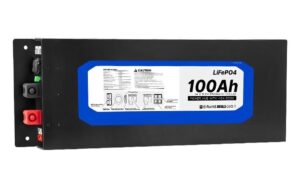
LINEX publishes a 5-year limited warranty that covers “capacity dropping below 70% of the rated value” under normal use. The floor is explicit. The policy does not publish a test procedure, so the method should be agreed in the purchase contract: a 0.2C discharge at 25°C, starting from a full charge, with the start and end voltages recorded. The 12V 100Ah model page lists 1,280Wh and 6,000 cycles at 80% depth of discharge, which gives the buyer a baseline for the test.
| Rated capacity | 70% floor | 80% floor | Energy at 70% (12.8V) | Energy at 80% (12.8V) |
|---|---|---|---|---|
| 100Ah | 70Ah | 80Ah | 896Wh | 1,024Wh |
| 200Ah | 140Ah | 160Ah | 1,792Wh | 2,048Wh |
| 300Ah | 210Ah | 240Ah | 2,688Wh | 3,072Wh |
The 70% floor is a minimum, not a target. A pack that reaches 72% at five years passes a 70% policy and fails an 80% policy. Buyers who need the pack to carry a critical load through year five should ask for the higher floor or plan a replacement before the term ends.
The BMS, cells and terminals should be named separately
A warranty that covers “the battery” but excludes the BMS leaves the most common failure point outside cover. The BMS contains the protection board, the balancing circuit and the current sensor. A cell imbalance or a failed protection board can strand a pack that still holds energy. Require each major assembly to be listed by name.
The LINEX warranty policy names BMS failure, protection board faults, cell imbalance and abnormal self-discharge as covered items. That level of detail matters. A policy that says only “manufacturing defects” leaves the buyer to argue about whether a failed BMS is a defect or normal wear.
| Component | Common failure | Should be covered | Why it matters |
|---|---|---|---|
| Cells | Capacity loss, imbalance, swelling | Yes, with a capacity floor | Cells are the largest cost in the pack |
| BMS and protection board | Overvoltage, overcurrent or temperature protection failure | Yes | A failed BMS can disable a healthy pack |
| Terminals and busbars | Corrosion, loose connection, heat damage | Yes, if not installer-caused | Small part, long downtime |
| Enclosure and seals | Water ingress within the IP rating | Yes | The IP rating is a product claim |
| Relay and precharge circuit | Welded contact or precharge failure | Yes, if fitted | Adds cost on rack models |
Freight and labor decide the real cost of a claim
A replacement cell or pack is only part of the cost. Return freight, inspection, labor and downtime can exceed the part value on a small 12V pack and can rival it on a rack module. A policy that pays for the part but leaves both freight legs with the buyer is weaker than a shorter policy that covers round-trip freight.
| Claim term | Buyer pays | Supplier pays | Practical effect |
|---|---|---|---|
| Round-trip freight | Nothing | Return and replacement freight | Best term for repeat importers |
| Return freight only | Outbound replacement freight | Return freight | Common middle ground |
| Both legs | Return and replacement freight | Nothing | Can exceed the part value on small packs |
| Both legs plus labor | Freight and installation labor | Nothing | Weakest term, treat it as no warranty |
Labor is the line most likely to be missing. A 12V 100Ah pack weighs about 10kg and swaps in minutes. A 48V rack module weighs 43kg, needs two people, and may need a technician to recommission the site. Put a labor allowance in writing, or accept that the warranty covers the part and not the downtime.
Proration should be a schedule, not a surprise
A prorated warranty reduces the supplier’s share over time. The schedule should be in the policy, not in a side letter. Epoch’s 11-year policy gives three years of free replacement, then 40% off MSRP on a replacement through Year 11. That is a clear structure: the buyer pays 60% of the list price in the prorated years. A five-year policy can use a simpler split, such as full replacement in Years 1 to 3 and a 50% credit in Years 4 and 5.
| Policy structure | Years 1 to 3 | Years 4 to 5 | Buyer share in the final year |
|---|---|---|---|
| Full replacement | Part and freight covered | Part and freight covered | 0% |
| Part only | Part covered | Part covered | Freight only |
| 50% credit after Year 3 | Full replacement | 50% credit | 50% of the part |
| 40% off MSRP after Year 3 | Full replacement | 40% discount | 60% of MSRP |
A proration schedule should state the basis: current list price, original invoice price or a fixed credit. It should also state whether freight is included in the credit. A 50% credit on a part that costs less than the freight is not a useful remedy.
Normal exclusions and red flags look different
Every warranty excludes misuse. The problem is wording that turns normal use into misuse. Physical damage, reverse polarity, water ingress beyond the IP rating, incompatible chargers and unauthorized repair are normal exclusions. A clause that voids the warranty for cycling below 50% depth of discharge is not normal on a LiFePO4 pack rated for 80% depth of discharge.
| Normal exclusion | Red flag |
|---|---|
| Physical damage, drops, punctures | Warranty void if the battery is cycled below 50% depth of discharge |
| Reverse polarity or short circuit from incorrect wiring | BMS not covered |
| Water ingress beyond the stated IP rating | No capacity coverage; cycle life is not a warranty |
| Charging with an incompatible or damaged charger | Buyer pays freight both ways on every claim |
| Unauthorized modification or repair | Warranty valid only for the original purchaser and non-transferable |
| Fire, flood or other external events | Installation must be by a certified installer, with no certification program |
The last red flag can appear in export contracts. A certified-installer clause sounds reasonable until the buyer cannot find a certified installer in the destination country. If the clause is in the warranty, the supplier should publish the certification path and the list of approved installers.
A claim file should start on installation day
Most rejected claims fail on documentation, not on the battery. Keep the serial number, invoice, shipment date, charger settings and installation photos in one folder. When a fault appears, add the BMS log and a capacity test. A complete file shortens the response and gives the supplier less room to dispute the cause.
| Record | Why it matters | When to capture |
|---|---|---|
| Serial number and model code | Ties the claim to the shipped unit | On receipt |
| Invoice and shipment date | Sets the warranty start | On order |
| Charger and inverter settings | Shows the pack ran inside its voltage and current limits | On commissioning |
| Installation photos | Documents torque, cable size and enclosure | On installation |
| BMS event log | Shows overvoltage, overcurrent or temperature events | At fault |
| Capacity test result | Measures remaining Ah against the floor | At fault |
A capacity test should use the same method the policy names. If the policy is silent, use a 0.2C discharge at 25°C and record the start voltage, end voltage and elapsed time. A test run at a different temperature or a higher C-rate will produce a different result, and the supplier can reject the claim on method alone.
How five years compares with published terms
Term length is the easiest number to compare and the least informative. The table below uses the published documents for three LiFePO4 products. It shows the term, the capacity floor where one is stated, and the replacement structure.
| Product | Term | Capacity floor stated | Replacement structure |
|---|---|---|---|
| LINEX LiFePO4 | 5 years | Below 70% of rated value | Repair or replace at company option; replacement unit or credit note |
| EG4 LL-S | 10 years | Not stated on the spec sheet | Not stated on the spec sheet |
| Epoch SR48100H | 11 years | 60% end-of-life for the cycle-life test, not a warranty floor | 3 years free replacement, then 40% off MSRP through Year 11 |
The EG4 sheet prints a 10-year warranty and 7,000 deep cycles but does not state a capacity floor. The Epoch page prints an 11-year warranty with a clear proration schedule, while its 60% figure belongs to the cycle-life test at 0.2C and 90% depth of discharge. The LINEX policy prints a 70% floor and a 5-year term. Read the warranty page, not the badge on the spec sheet.
What to put in the purchase contract
Write six terms into the purchase contract: the warranty start date, the capacity floor and test method, the freight and labor split, the replacement or credit remedy, the response and resolution times, and whether the warranty transfers to a reseller or second owner. If the supplier’s standard policy is silent on any of these, the contract term fills the gap.
The LiFePO4 order terms guide covers the commercial side of the same contract. The manufacturer vetting guide covers the factory audit that should come before either document is signed. For the technical baseline, the datasheet guide explains which capacity, current and cycle-life fields to compare, and the 6,000-cycle explainer turns the cycle rating into a service life.
A five-year warranty is a reasonable term for a LiFePO4 pack expected to run 6,000 cycles. It is only useful if the capacity floor, the BMS cover and the freight split are written down. Ask for the warranty document before the proforma invoice, not after the first failure.
Frequently asked questions
Only if the remaining capacity falls below the stated floor. Normal fade to 80% or 85% of rated capacity does not trigger a 70% policy. A pack that reaches 69% at year four does.
On a 100Ah pack, 70% of rated capacity is 70Ah. On a 200Ah pack, it is 140Ah. The test should be run at the C-rate and temperature named in the policy, because a fast discharge or a cold test room will lower the measured result.
No. A 10-year term with no capacity floor, no BMS cover and buyer-paid freight can cost more than a 5-year term with clear coverage. Compare the floor, the exclusions and the freight split before the term.
It depends on the policy. Some suppliers cover round-trip freight for a validated claim, some cover the return leg only, and some leave both legs with the buyer. Get the split in writing before the order.
Most limited warranties do not transfer. If you resell packs or change installers mid-project, ask for a transfer clause or a warranty that follows the serial number rather than the original purchaser.
Most suppliers ask for test data or a BMS log. A claim that says only “the battery does not last” is easy to reject. A 0.2C discharge record with start and end voltages gives the supplier a number to check.
Sources: LINEX warranty policy (5-year limited warranty, capacity below 70% of rated value, BMS and protection board faults, cell imbalance, swelling or leakage, exclusions, 2-business-day response, replacement or credit note, warranty from shipment date, checked 2026-11-11); LINEX 12V 100Ah product page (12.8V, 100Ah, 1,280Wh, 100A continuous, 6,000 cycles at 25°C and 80% DoD, about 10kg, checked 2026-11-11); EG4 LL-S 48V 100Ah spec sheet version 1.2.5 (51.2V, 100Ah, 100A continuous, 7,000 deep cycles, more than 15 years at 80% DoD daily, 10-year warranty, checked 2026-11-11); Epoch SR48100H product page (51.2V, 100Ah, 5.12kWh, 6,000+ cycles at 0.2C and 90% DoD to 60% of initial capacity, 11-year limited warranty with 3 years free replacement then 40% off MSRP through Year 11, checked 2026-11-11); Battery University BU-808 on lithium-ion capacity fade. Last updated 2026-11-11.