12V packs charge at 14.2V to 14.6V
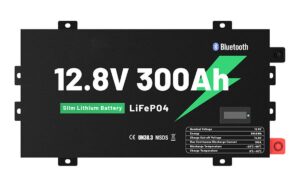
The 12V 100Ah datasheet lists a 14.6V fast charging voltage and a 13.5V to 13.8V standby and float range. The voltage chart gives a 14.2V to 14.6V absorption window because charger tolerance and cable drop move the terminal voltage. At 14.6V, the 4S pack sees 3.65V per cell; at 14.2V it sees 3.55V. The low-voltage protection opens at 8.8V to 10V.
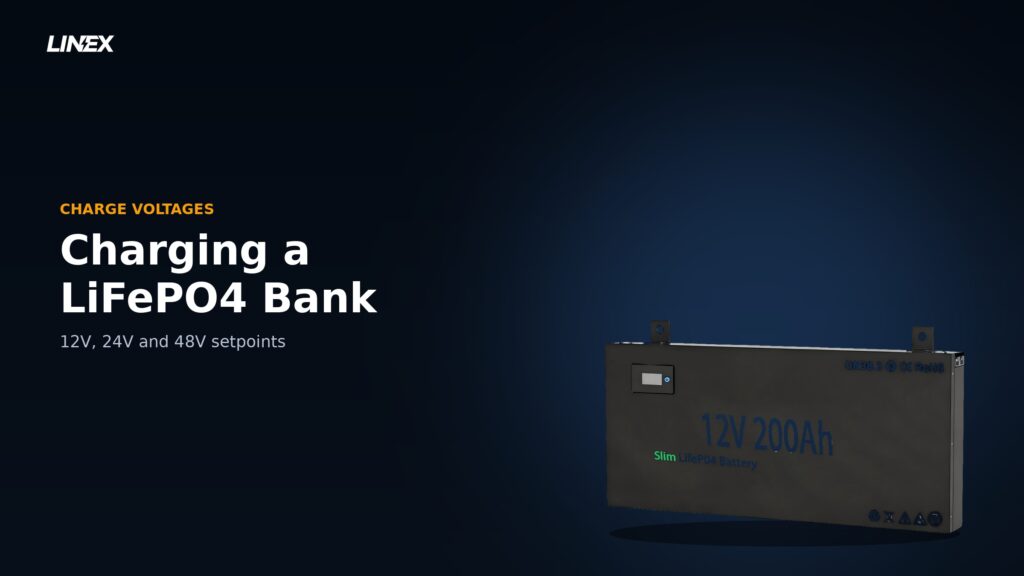
The 12V 200Ah model uses the same 14.6V charge voltage and 13.5V to 13.8V float range. Capacity changes the current, not the voltage.
24V packs double the 12V setpoints
The 24V 100Ah datasheet lists 29.2V fast charging and 27.0V to 27.6V float, which is twice the 12V values for an 8S pack. The low-voltage protection opens at 17.6V to 20V. A 24V 200Ah pack uses the same voltage setpoints and a higher charge current.
A 24V lead-acid profile is not a LiFePO4 profile, even though both are 24V nominal. Check the charger menu for a lithium iron phosphate setting before connecting a 24V pack.
48V charging depends on the pack configuration
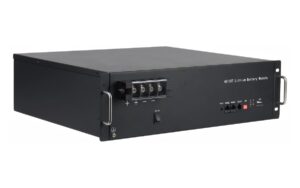
A generic 16S 48V pack takes 56.8V to 58.4V absorption and 54.0V to 54.4V float on the voltage chart. The 48V 100Ah telecom pack is different: its datasheet lists 53.3V equalization, 51.0V float and 40.5V cutoff. The LINEX voltage chart page states: “These are common ranges, not universal settings.” A charger set for a 16S pack can push 58.4V into a telecom pack whose equalization setting is 53.3V.
| Pack | Absorption / boost | Float | Low-voltage cutoff | Source |
|---|---|---|---|---|
| 12V (4S) | 14.2V to 14.6V | 13.5V to 13.8V | 8.8V to 10V | 12V datasheet, voltage chart |
| 24V (8S) | 28.4V to 29.2V | 27.0V to 27.6V | 17.6V to 20V | 24V datasheet, voltage chart |
| 48V (16S) | 56.8V to 58.4V | 54.0V to 54.4V | not listed | voltage chart |
| 48V telecom | 53.3V equalization | 51.0V | 40.5V | 48V telecom datasheet |
The telecom row uses the datasheet label “equalization” instead of “absorption” because the pack is built for rectifier-based site power. The 16S row is a generic chart value, not a manufacturer setting.
Charge current scales with capacity, not voltage
A 12V 100Ah pack lists 20A standard, 50A recommended and 100A maximum charge current. A 12V 200Ah pack doubles the standard and recommended values to 40A and 100A but keeps the same 100A maximum. The BMS, not the charger label, sets the ceiling.
| Model | Standard charge | Recommended charge | Max continuous charge | Max rate |
|---|---|---|---|---|
| 12V 100Ah | 20A | 50A | 100A | 1.0C |
| 12V 200Ah | 40A | 100A | 100A | 0.5C |
| 24V 100Ah | 20A | 50A | 100A | 1.0C |
| 24V 200Ah | 40A | 100A | 100A | 0.5C |
| 48V 100Ah | not listed | not listed | 100A | 1.0C |
| 48V 200Ah | not listed | not listed | 100A | 0.5C |
The C-rate column divides the maximum charge current by the capacity. A 100Ah pack at 100A is 1.0C; a 200Ah pack at 100A is 0.5C. The 48V 100Ah datasheet also lists a 10A charging current limit, so a site rectifier may charge well below the 100A maximum.
A charger needs bulk, absorption and float stages
A LiFePO4 charger runs three stages: bulk at constant current, absorption at 14.6V on a 12V pack, and float at 13.5V to 13.8V. In bulk the charger pushes its rated current. In absorption it holds the voltage and lets the current taper. In float it drops to a lower voltage that covers self-discharge without holding the cells at full charge.
A single-voltage charger either stops before the pack is full or holds it at absorption voltage. The 12V datasheet lists the 14.6V fast charge separately from the 13.5V to 13.8V float. Use a charger with a LiFePO4 profile, not a lead-acid profile with the same nominal voltage.
Temperature limits stop the charge before the voltage does
The 12V and 24V datasheets rate charging from 0°C to 50°C; the 48V telecom datasheet rates charging from 0°C to 65°C. Below 0°C the BMS blocks charge current, so a charger set to 14.6V will sit at the absorption voltage with no current flowing. Discharge is rated from -20°C to 60°C on the 12V and 24V packs and to 65°C on the 48V pack.
A pack that has been in a cold truck needs to warm above 0°C before charging. The BMS temperature sensor, not the charger’s ambient reading, decides whether current is allowed.
Rest voltage after 30 minutes shows the result
After a full charge, let the pack rest for 30 minutes with no load. A 12V pack reads about 13.6V at 100% and 13.0V at 50%; a 24V pack reads 27.2V and 26.0V; a 48V pack reads 54.4V and 52.0V on the 16S chart. A pack that reads 13.0V after a full charge did not complete absorption.
The rest check only works with no charger and no load. A charger that is still connected holds the terminal voltage above the rest value.
The LiFePO4 voltage charts give the full state-of-charge and charging tables for 12V, 24V and 48V packs. The 12V 100Ah LiFePO4 battery lists the 14.6V charge voltage and 100A maximum charge current. The 24V lithium battery line covers the 8S models, and the 48V 100Ah telecom battery lists the 53.3V equalization setting. The charging below 0°C guide explains the temperature cutoff in more detail.
Frequently asked questions
Charge a 12V LiFePO4 battery at 14.2V to 14.6V absorption, then float at 13.5V to 13.8V. The 12V 100Ah datasheet lists 14.6V as the fast charging voltage.
No. A 24V pack needs 28.4V to 29.2V absorption, and a 12V charger cannot reach that voltage. Use a charger with a 24V LiFePO4 profile.
The 12V datasheet lists 14.6V as the fast charging voltage. On a 4S pack that is 3.65V per cell. Do not exceed the datasheet value, and check the charger with a multimeter before the first full charge.
A generic 16S 48V pack floats at 54.0V to 54.4V. The 48V 100Ah telecom pack floats at 51.0V and equalizes at 53.3V. Use the model datasheet, not the nominal voltage.
The datasheet lists a float range, and a charger with a LiFePO4 profile can hold it there. For months of storage, 50% state of charge is better than a full float. The voltage chart gives 13.0V for a 12V pack at 50%.
The charger may have switched to float, or the BMS may be limiting current because the pack is cold or nearly full. Check the charge stage, the temperature and the current reading before assuming a fault.
Sources: LINEX LiFePO4 voltage charts, charging and state-of-charge tables (checked 2026-11-14); 12V 100Ah datasheet (12.8V, 100Ah, 1,280Wh, 14.6V fast charge, 13.5V to 13.8V float, 20A standard, 50A recommended, 100A maximum charge, 8.8V to 10V cutoff, 0°C to 50°C charge, -20°C to 60°C discharge, 4S, 6,000 cycles at 25°C and 80% DoD, checked 2026-11-14); 12V 200Ah datasheet (12.8V, 200Ah, 2,560Wh, 14.6V fast charge, 13.5V to 13.8V float, 40A standard, 100A recommended, 100A maximum charge, checked 2026-11-14); 24V 100Ah datasheet (25.6V, 100Ah, 2,560Wh, 29.2V fast charge, 27.0V to 27.6V float, 20A standard, 50A recommended, 100A maximum charge, 17.6V to 20V cutoff, 0°C to 50°C charge, 8S, checked 2026-11-14); 24V 200Ah datasheet (25.6V, 200Ah, 5,120Wh, 29.2V fast charge, 27.0V to 27.6V float, 40A standard, 100A recommended, 100A maximum charge, checked 2026-11-14); 48V 100Ah telecom datasheet (48V, 100Ah, 4.8kWh, 53.3V equalization, 51.0V float, 40.5V cutoff, 100A charge and discharge, 10A charging current limit, 0°C to 65°C charge, -20°C to 65°C discharge, IP20, 43kg, 3U, checked 2026-11-14); 48V 200Ah telecom datasheet (48V, 200Ah, 9.6kWh, 100A charge and discharge, checked 2026-11-14). Last updated 2026-11-14.
Related: the gel versus LiFePO4 charging profile comparison covers absorption, float, temperature compensation and low-temperature cutoff for 12V systems.