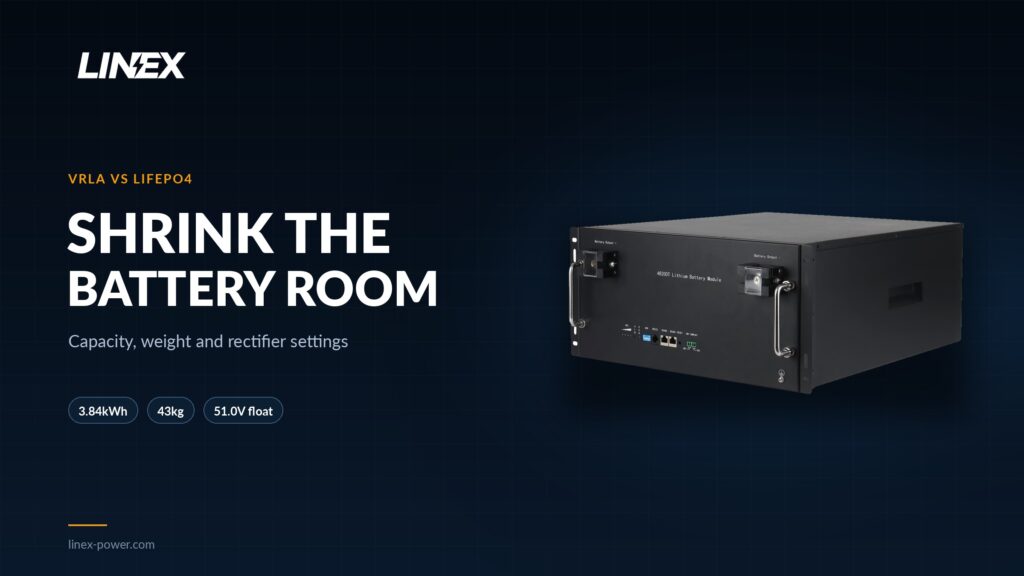
Usable capacity: 3.84kWh against 3.6kWh
A 48V 150Ah VRLA string stores 7.2kWh nominal and delivers about 3.6kWh at 50% depth of discharge. A 48V 100Ah LiFePO4 module stores 4.8kWh nominal and delivers about 3.84kWh at 80% depth of discharge, so the smaller lithium module matches the usable capacity of the larger lead-acid string. The swap also changes the rack layout and the rectifier settings.
| Parameter | 48V 150Ah VRLA string | 48V 100Ah LiFePO4 |
|---|---|---|
| Cells in series | 24 x 2V | 15 x 3.2V |
| Nominal energy | 7.2kWh | 4.8kWh |
| Usable energy | 3.6kWh at 50% DoD | 3.84kWh at 80% DoD |
| Weight | about 180kg | 43kg |
| Rack format | four blocks on one shelf | 3U, 19-inch rack |
| Float / equalize | 54.0V / 56.4V | 51.0V / 53.3V |
| Cycle rating | 300 to 500 at 50% DoD | 6,000 at 80% DoD |
| Monitoring | voltage and current only | RS485 and RS232 |
| Design life | 3 to 5 years | 10 years |
Usable energy, not the Ah label, sets the replacement size
The lead-acid string is larger in amp-hours because it can only use half of its capacity on a regular cycle. The lithium module uses 80% without shortening its rated cycle life. A 100Ah lithium module therefore does the work of a 150Ah VRLA string in this comparison. The lead-acid string also loses capacity as it ages and as discharge current rises, so a string at end of life may deliver half its rated Ah. Operators replace on measured capacity, not on the nameplate.
Weight falls from 180kg to 43kg and the footprint from four blocks to 3U
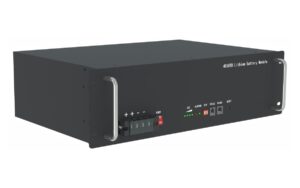
Four 12V 150Ah VRLA blocks need a shelf and clearance for terminal access. The 48V 100Ah LiFePO4 module is 442mm wide, 420mm deep and 133mm high, or 482mm deep with handles and terminals, and fits a 19-inch rack at 3U. Weight falls from about 180kg to 43kg, which changes the lifting plan and the floor loading. Two people can move the module; the old string usually needs a pallet truck. The case is IP20, so the retrofit suits an indoor power room or a cabinet, not a pole.
The rectifier moves from 54.0V float to 51.0V
The cell count explains the change. A 48V lead-acid plant uses 24 cells at 2V each, and a 15S LiFePO4 pack uses 15 cells at 3.2V each. Twenty-four lead-acid cells float at 2.25V each, or 54.0V. Fifteen LiFePO4 cells float at 3.4V each, or 51.0V. The datasheet labels are “Floating Charge Voltage: 51.0Vdc” and “Equalization Charge Voltage: 53.3Vdc”. A rectifier left at 54.0V float holds the lithium pack 3V above its specification.
| Parameter | Lead-acid setting | LiFePO4 setting | Action |
|---|---|---|---|
| Float voltage | 54.0V | 51.0V | Lower the setpoint |
| Equalize voltage | 56.4V | 53.3V | Disable automatic equalize |
| Low-voltage disconnect | 43.2V typical | Above 40.5V cutoff | Confirm with a discharge test |
| Temperature compensation | About -3mV/°C/cell | Off | Disable |
| Charge current limit | 0.1C to 0.2C | 100A per 100Ah module | Set the rectifier limit |
An equalize timer left active sends 56.4V into a pack whose datasheet equalize figure is 53.3V. Temperature compensation must also be disabled because the BMS manages cell voltage on its own. Check the low-voltage alarm and disconnect settings at the same time: a lead-acid site often treats 43.2V as empty, while the LiFePO4 pack can run to 40.5V.
Cycle life: 300 to 500 cycles against 6,000
A VRLA string in a telecom cabinet is typically replaced at three to five years. The 48V 100Ah module is rated for 6,000 cycles at 80% depth of discharge and a 10-year design life. A typical telecom site cycles the battery only during grid failures, so calendar life and cabinet temperature set the replacement date before the cycle count does. Maintenance visits drop from capacity tests and equalize checks to terminal torque and BMS log review.
Sizing the lithium bank starts with the site load and backup hours
Use the site’s DC load, not the old battery’s Ah rating. A 400W load for 8 hours needs one 100Ah module; 800W for 4 hours also fits one 100Ah module; 1,200W for 8 hours needs a 200Ah module or two 100Ah modules in parallel. Add 20% capacity margin for aging and high-temperature sites.
| Site DC load | 4 hours | 8 hours | 12 hours |
|---|---|---|---|
| 400W | 50Ah | 100Ah | 150Ah |
| 800W | 100Ah | 150Ah to 200Ah | 200Ah + parallel |
| 1,200W | 150Ah | 200Ah + parallel | 2 x 200Ah |
A 100Ah module at a 1kW load runs about 3.6 hours at 80% depth of discharge and 95% DC efficiency. A short runtime usually points to an unlisted load, such as a cabinet heater or an air conditioner, before it points to the battery.
VRLA still fits low-cycle and legacy sites
VRLA remains a reasonable choice when the site cycles rarely or the existing rectifier cannot be set to 51.0V float. A light backup duty and a fixed budget can also keep VRLA in place. It gives up usable capacity per kilogram and cycle life, and it reports less data to the site controller. The decision should follow the site load and outage pattern, not the purchase price alone.
Where the 100Ah and 200Ah modules fit
The 48V 100Ah module is 4.8kWh, 100A continuous, 43kg and 3U. It replaces a 150Ah VRLA string in the comparison above. The 48V 200Ah module is 9.6kWh, 100A continuous and 78kg in a 482 x 610 x 178mm case. Both use 53.3V equalize, 51.0V float and 40.5V cutoff. The 200Ah module doubles energy without doubling current, so a 10kW load needs two modules in parallel. For the full range, see the 48V lithium battery line and the telecom remote sites guide. The 48V 100Ah telecom battery and 48V 200Ah telecom battery pages list the full specifications. The 48V telecom site retrofit guide covers the changeover, and the 48V 100Ah vs 200Ah comparison covers capacity choice.
Frequently asked questions
About 8 hours at 80% depth of discharge and 95% DC efficiency. At 800W the same module runs about 4 hours, so size the bank on the site load and the required backup window.
Yes, in this comparison. The lithium module gives 3.84kWh usable at 80% depth of discharge against 3.6kWh at 50% for the VRLA string. Check the rack, rectifier settings and DC breaker before the swap.
Not always. The existing rectifier can work if it can be set to 51.0V float and 53.3V equalize and its current limit follows the module count. Check the low-voltage disconnect and temperature compensation too.
The BMS blocks charging below 0°C. Discharge continues to -20°C. An unheated cabinet needs a heating option or a temperature-controlled room.
Not on the same bus without an engineering review. The charge profiles and internal resistance differ. Run separate rectifiers and transfer the load, or take the site off battery during the swap.
Sources: LINEX 48V 100Ah telecom battery page (4.8kWh, 100A, 43kg, 442 x 420 x 133mm, 3U, 53.3V equalize, 51.0V float, 40.5V cutoff, 6,000 cycles, 10-year design life, checked 2026-11-20); LINEX 48V 200Ah telecom battery page (9.6kWh, 100A, 78kg, 482 x 610 x 178mm, checked 2026-11-20); LINEX 48V lithium battery range (50Ah to 200Ah, charge settings, checked 2026-11-20); LINEX 48V telecom site retrofit guide (150Ah VRLA string, 3.6kWh usable, 180kg, 54.0V/56.4V, 300 to 500 cycles, 3 to 5 years, checked 2026-11-20); LINEX telecom remote sites page (site load table, VRLA vs LiFePO4, checked 2026-11-20); LINEX 48V 100Ah vs 200Ah telecom battery page (capacity choice, checked 2026-11-20); LINEX 48V telecom battery selection guide (site load and backup hours, checked 2026-11-20); LINEX Ah to kWh calculator (48V conversions, checked 2026-11-20). Last updated 2026-11-20.
Related: the telecom rectifier settings guide gives the 51.0V float, 53.3V boost and current limits to set before a 48V LiFePO4 module is connected.