Start with battery current, not inverter wattage
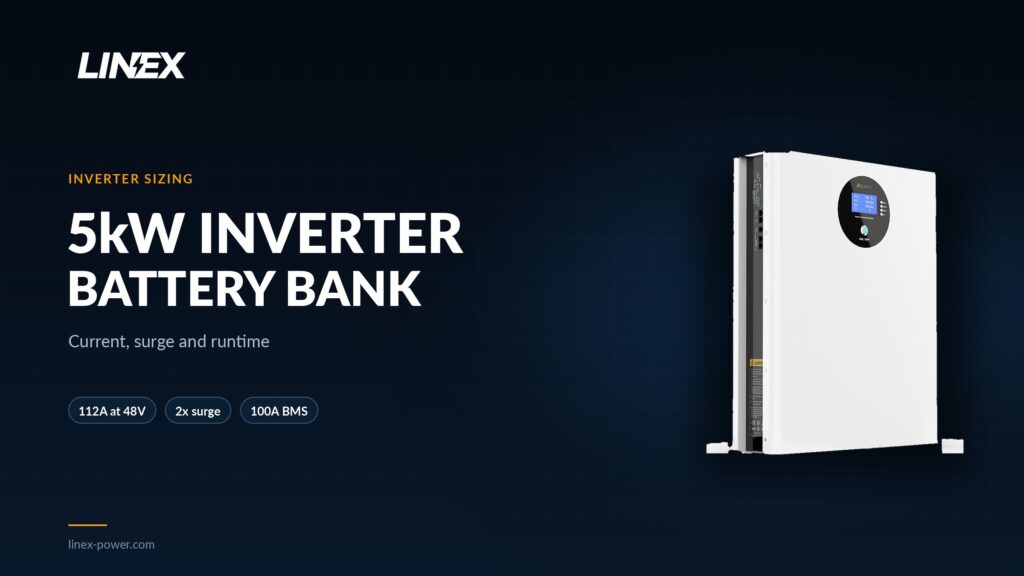
A hybrid inverter’s wattage rating does not say how much current the battery must supply. The battery voltage and inverter efficiency set that number. At 48V nominal and 93% efficiency, a 5,000W load draws about 112A. A single 48V 100Ah pack with a 100A BMS cannot carry that load at full output, even though the inverter is rated for it. The mismatch is common because the inverter datasheet and the battery datasheet use different units.
Continuous current: 5kW needs about 112A at 48V
DC current equals AC power divided by inverter efficiency and battery voltage: I = P / (η x V). The table uses 93% for the SC-MAX peak efficiency and 90% for the lower end of the MKSII range, then shows the pack count at the published continuous limits.
| Inverter | Rated output | DC current at 48V, 93% | DC current at 48V, 90% | 100Ah packs | 150Ah packs |
|---|---|---|---|---|---|
| MKSII 5kW | 5,000W | 112A | 116A | 2 | 1 |
| SC-MAX 8kW | 8,000W | 179A | 185A | 2 | 2 |
| SC-MAX 11kW | 11,000W | 246A | 255A | 3 | 2 |
| 3kW example | 3,000W | 67A | 69A | 1 | 1 |
The 100Ah column assumes a 100A continuous BMS, the rating on the 48V 100Ah rack module. The 150Ah column assumes the LINEX standard 48V 150Ah model with a 150A BMS. The 3kW example is included because many small hybrid systems start there and grow. The 48V column uses the datasheet’s nominal label and is the conservative case; a 16S pack at 51.2V draws about 105A at 5kW, still above a 100A limit.
Surge current decides how many packs run in parallel
The MKSII 5kW and SC-MAX 8kW/11kW inverters publish the same surge rule: “surge power at twice rated power for 5 seconds.” The battery bank must supply that surge current as well as the continuous load. A motor start that lasts two seconds can still exceed a BMS limit that is set for continuous current.
| Inverter | Rated output | Surge for 5s | Surge current at 48V, 93% | 100Ah packs | 150Ah packs |
|---|---|---|---|---|---|
| MKSII 5kW | 5,000W | 10,000W | 224A | 3 | 2 |
| SC-MAX 8kW | 8,000W | 16,000W | 358A | 4 | 3 |
| SC-MAX 11kW | 11,000W | 22,000W | 493A | 5 | 4 |
| 3kW example | 3,000W | 6,000W | 134A | 2 | 1 |
The surge lasts 5 seconds, but the BMS current limit is a hard stop. If the bank cannot supply the surge, the inverter trips even though its own surge rating is adequate. A soft starter reduces the surge but does not remove it.
Adding Ah adds runtime, not current
A 48V 200Ah pack stores twice the energy of a 48V 100Ah pack, but its published continuous limit is still 100A. The extra Ah does not double the current. The 48V 150Ah standard model is the exception in the LINEX range: it lists 150A charge and discharge, so it carries more current than the 200Ah model.
| Model | Nominal energy | Continuous charge and discharge | Weight | Form |
|---|---|---|---|---|
| Wall-mounted 5kWh ESS | 5,324Wh | 100A / 100A | 46kg | Wall mount |
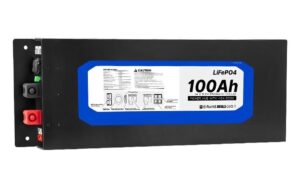
| 48V 100Ah rack | 4,800Wh | 100A / 100A | 43kg | 3U rack |
| 48V 150Ah rack | 7,200Wh | 150A / 150A | 60kg | Rack |
| 48V 200Ah rack | 9,600Wh | 100A / 100A | 78kg | Rack |
Two 100Ah packs can outperform one 200Ah pack on a high-current load: 200A combined versus 100A, with 9.6kWh of energy in both cases. The tradeoff is two cases, two sets of cables and two BMS units to monitor.
Runtime follows usable energy, not the Ah label
A bank’s runtime at a given AC load is its nominal energy multiplied by depth of discharge and inverter efficiency, divided by the load. The table uses 80% depth of discharge, 93% efficiency and two load points.
| Bank | Usable at 80% DoD | 2.5kW runtime | 5kW runtime |
|---|---|---|---|
| Wall-mounted 5kWh ESS | 4,259Wh | 1.6h | BMS limit (105A) |
| 48V 100Ah rack | 3,840Wh | 1.4h | BMS limit (112A) |
| 48V 150Ah rack | 5,760Wh | 2.1h | 1.1h |
| 48V 200Ah rack | 7,680Wh | 2.9h | BMS limit (112A) |
The 5kW column is not a pure energy calculation. The wall unit and the 100Ah and 200Ah racks hit their 100A limit before they reach 5kW, so the BMS stops the load before the energy is used. The 150Ah rack carries 112A at 5kW and finishes the hour with the energy shown.
The wall-mounted 5kWh unit sits at the 5kW limit
The wall-mounted 5kWh ESS stores 5,324Wh at 51.2V and lists a 100A maximum charge and discharge current. At 5kW output and 93% efficiency, the DC current is about 105A, just above the published limit. At 4.5kW, the current falls to about 94A and the unit sits inside the limit. For continuous 5kW output, use a 48V 150Ah pack with a 150A BMS, or two 100Ah packs in parallel.
PV and charge current must fit the same bank
The MKSII 5kW has an 80A solar charger and an 80A AC charger. The SC-MAX 8kW and 11kW models list 120A and 150A. A charger that can deliver 150A will not push 150A into a 100Ah pack unless the BMS allows it, so the battery’s published charge limit is the ceiling. The MKSII PV array tops out at 4,500W; the SC-MAX accepts 8,000W or 11,000W. Check the array against the bank’s charge acceptance and the site’s daytime load, not only against the inverter’s MPPT rating.
A sizing sequence that avoids the mismatch
Size a hybrid inverter and battery bank in five steps: continuous load, surge load, battery current, battery energy and charge current. Sum the continuous AC watts first. Add the largest motor start. Divide by efficiency and battery voltage to get current. Pick a bank that meets the current with at least 20% headroom. Check the charger current and the PV array against the bank.
A 5kW load with a 10kW surge needs 112A continuous and 224A surge. Three 100Ah packs or two 150Ah packs cover the surge, and the runtime comes from the energy in those packs. The same sequence works for an 8kW or 11kW inverter; only the current and pack count change.
Where the LINEX inverter and 48V bank fit
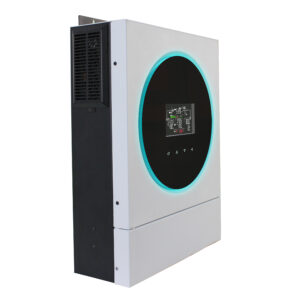
The MKSII 5kW off-grid inverter provides 5,000W rated output, 2x surge for 5 seconds, a 48V battery system, 80A MPPT and 80A AC charging. The SC-MAX 8kW/11kW inverter adds 8,000W or 11,000W output and 120A or 150A charging. The wall-mounted 5kWh ESS, 48V 100Ah rack module and 48V 150Ah rack module cover the bank side. The 48V lithium battery range lists the full set, and the series vs parallel guide covers fusing and current sharing for a parallel bank. For the load side, the home energy storage page covers sizing a bank around household loads.
Frequently asked questions
Not at full output. A 5kW load at 48V and 93% efficiency draws about 112A, above the 100A limit. Use a 150Ah pack with a 150A BMS or two 100Ah packs in parallel. At a 4.5kW load, the current is about 101A, still at the limit.
Not always. The LINEX 48V 200Ah lists 100A continuous, the same as the 100Ah model. The 48V 150Ah lists 150A. Check the BMS current rating, not only the Ah.
About 0.8 hours at 80% depth of discharge and 93% efficiency, but the 100A BMS limit stops a single 100Ah or 5kWh wall unit before full load. A 150Ah pack runs about 1.1 hours at 5kW.
A pump that draws 1.5kW running may pull 4.5kW to 9kW for a second or two. The inverter’s 2x surge for 5 seconds covers many starts, but the battery bank must supply the surge current: 9kW at 48V and 93% is about 202A, so two 100Ah packs or two 150Ah packs are needed.
Yes, if the added packs match the model, voltage, firmware and age, and the parallel wiring and protection are reviewed. Adding a pack raises energy and current capacity, but the inverter’s charge current and the existing packs’ share of the load must be checked. Do not mix a new 100Ah pack with an old 100Ah pack without a state-of-charge check.
Sources: LINEX product pages and guides: MKSII 5kW off-grid inverter (5,000W rated, 2x surge for 5 seconds, 48V battery, 54V float, 66V overcharge, 90% to 93% peak efficiency, 80A solar and AC charge, 4,500W PV, checked 2026-11-25); SC-MAX 8kW/11kW inverter (8,000W and 11,000W rated, 2x surge for 5 seconds, 48V battery, 93% peak efficiency, 120A and 150A charge, 8,000W and 11,000W PV, checked 2026-11-25); wall-mounted 5kWh ESS (5,324Wh, 51.2V, 104Ah, 100A maximum charge and discharge, 46kg, 410 x 185 x 610mm, checked 2026-11-25); 48V 100Ah rack (4,800Wh, 100A charge and discharge, 43kg, 442 x 420 x 133mm, checked 2026-11-25); 48V 150Ah rack (7,200Wh, 150A charge and discharge, 60kg, 482 x 440 x 178mm, checked 2026-11-25); 48V 200Ah rack (9,600Wh, 100A charge and discharge, 78kg, 482 x 610 x 178mm, checked 2026-11-25); 48V lithium battery range (rack and wall formats, checked 2026-11-25); series vs parallel battery bank guide (fusing and current sharing, checked 2026-11-25); home energy storage page (bank sizing, checked 2026-11-25). Other reference: Wikipedia Lithium iron phosphate battery (3.2V nominal and 3.60V to 3.65V maximum charge voltage, checked 2026-11-25). Last updated 2026-11-25.